LLMbda calculus gives agents safety rules
A formal calculus for AI agents models conversations and enforces information-flow rules for safer LLM-based programming.

A formal calculus models AI-agent conversations and enforces information-flow safety rules.
The LLMbda Calculus: AI Agents, Conversations, and Information Flow is about giving agentic LLM systems a precise semantic foundation. Instead of treating prompts, tool calls, and multi-turn chats as ad hoc application logic, the paper models conversations directly and uses that model to reason about what information is allowed to affect an LLM call.
That matters because once an LLM agent can call code, hold state, or participate in a multi-step conversation, you need more than “best effort” prompt hygiene. You need a way to talk about isolation, confidentiality, and integrity in a way that is rigorous enough to prove something about. This paper is aimed at that problem.
What problem this paper is trying to fix
Get the latest AI news in your inbox
Weekly picks of model releases, tools, and deep dives — no spam, unsubscribe anytime.
No spam. Unsubscribe at any time.
Agentic systems are messy. A single LLM call may depend on prior messages, generated code, tool output, and other sub-conversations. If any of those inputs are untrusted, it becomes hard to say whether a sensitive piece of data influenced the model in a way that should have been blocked.
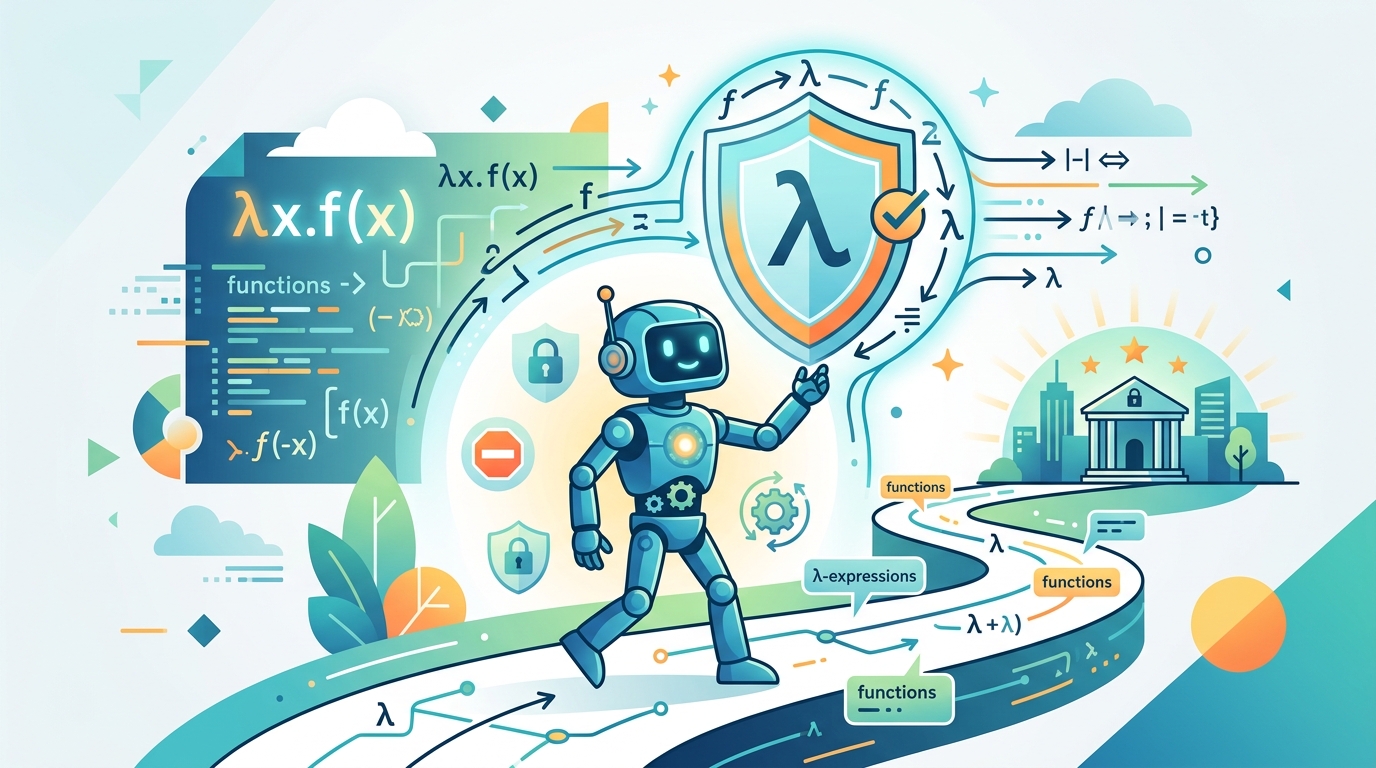
The abstract points to three concrete concerns: quarantined sub-conversations, isolation of generated code, and information-flow restrictions on what may influence an LLM call. In plain English, the paper is trying to make it possible to separate trusted and untrusted parts of an agent workflow and then prove that the separation actually holds.
This is not about improving model accuracy or reducing latency. It is about safety properties for programs built around LLMs, especially programs where one bad message can leak into a broader chain of reasoning or execution.
How the method works in plain English
The core move is to define a calculus whose semantics explicitly captures conversations. That means the formal system does not treat a chat as a vague sequence of strings; it treats conversation structure itself as part of the program model.
Once conversations are part of the semantics, the calculus can express which sub-conversations are quarantined, which generated code should be isolated, and which inputs are permitted to influence a given LLM call. In other words, the safety rules are not bolted on after the fact. They are part of the language-level model.
The paper also states that the calculus supports reasoning about information flow restrictions. That is the key ingredient for proving that sensitive data does not cross a boundary it should not cross, or that untrusted data cannot affect a protected computation in the wrong way.
For developers, the practical idea is familiar even if the formalism is not: think of it as a typed or policy-aware execution model for agent workflows, where conversation segments can be isolated and influence can be controlled by design rather than by convention.
What the paper actually shows
The abstract highlights one formal result: a termination-insensitive noninterference theorem. That theorem establishes integrity and confidentiality guarantees. In practical terms, noninterference is the kind of property you want if you care that secret or untrusted inputs do not change protected outputs in ways that violate policy.
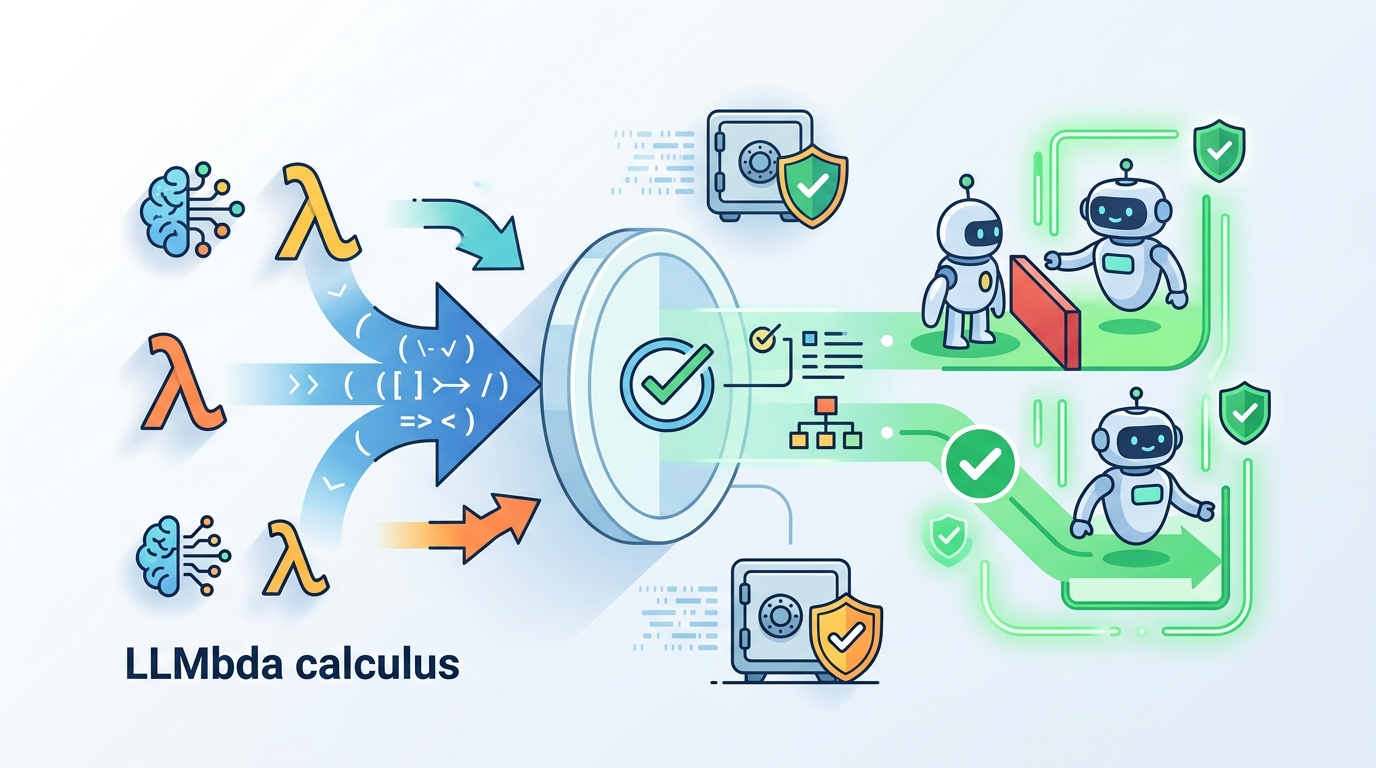
“Termination-insensitive” is an important qualifier. It means the theorem does not rule out leaks through whether a computation terminates or diverges. So the guarantee is strong, but not absolute; it covers certain classes of information flow while leaving termination-channel issues outside the stated result.
The abstract does not include benchmark numbers, empirical evaluations, or performance measurements. So there is no claim here about throughput, token overhead, runtime cost, or adoption in a real agent framework. The contribution described in the source is formal, not experimental.
That makes the paper more of a foundations piece than a systems paper. Its value is in defining a model and proving a property, not in showing that a production stack got faster or safer overnight.
Why engineers should care
If you are building AI agents, the biggest challenge is often not getting the model to answer; it is making sure the surrounding system behaves predictably when the model is embedded in a larger workflow. This paper argues that conversation structure itself should be treated as a first-class part of that workflow.
That has a few concrete implications:
- You can reason about agent subflows instead of treating every message as globally visible.
- Generated code can be modeled as isolated rather than implicitly trusted.
- Policies about what may influence an LLM call can be stated formally, not just documented informally.
- Security reviews for agent systems can move from “this seems safe” to “this property is provable in the model.”
For teams working on copilots, autonomous agents, or tool-using assistants, that kind of formalism could become useful when you need to justify boundaries between sensitive data, user input, and model behavior.
Limitations and open questions
The source material is thin on implementation details, so several practical questions remain unanswered. The abstract does not say how the calculus maps to an actual programming language, runtime, or agent framework. It also does not explain how easy it would be to enforce these rules in real systems with many tools and services.
There is also a gap between a theorem and a deployed product. A termination-insensitive noninterference result is a meaningful safety guarantee, but it does not by itself solve prompt injection, tool misuse, sandbox escapes, or all side-channel issues. The abstract only claims integrity and confidentiality guarantees within the formal system it defines.
Still, the direction is clear: if LLM agents are going to be treated as serious software components, they need better semantics than “a chat with some tools attached.” This paper’s contribution is to sketch one such semantic foundation and prove that it can support strong information-flow reasoning.
For now, the main takeaway is simple: the paper is less about making LLMs smarter and more about making agentic systems safer to build and reason about.
// Related Articles
- [RSCH]
How VLMs Learned Complex Scene Descriptions
- [RSCH]
Visual Pretraining Beats Text-Only in Language Models
- [RSCH]
PHINN-EEG brings topology to dream-state EEG
- [RSCH]
Google’s Android Bench update exposes Gemini’s gap
- [RSCH]
Benchmarks should not pick your LLM in 2026
- [RSCH]
Rust Breaks Into TIOBE’s Top 10