PHINN-EEG brings topology to dream-state EEG
PHINN-EEG replaces EEG dream detection’s spectral features with topological dynamics and a topology-conditioned synthesis model.
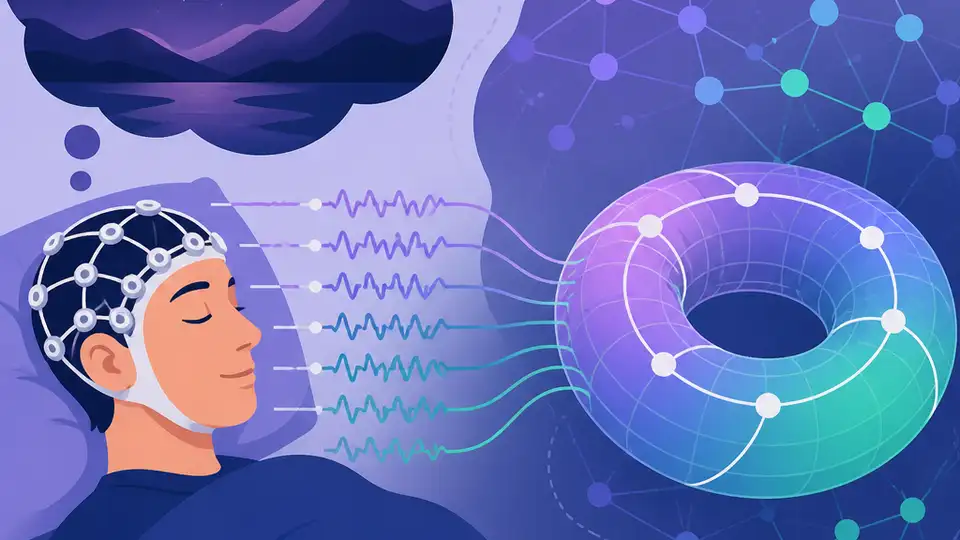
PHINN-EEG replaces EEG dream detection’s spectral features with topological dynamics and a topology-conditioned synthesis model.
- Research org: Unspecified in arXiv abstract
- Core data: Targeting AUC = 0.82-0.90 on 1,462 awakenings
- Breakthrough: Sliding-window Takens embeddings plus Vietoris-Rips Betti curves
Until now, dream-state EEG work has leaned on power spectral density and statistical moments. This paper argues that those features miss something important: the geometry of the signal as it evolves over time. The payoff, if the method holds up, is a different way to detect dream mentation and a way to synthesize EEG conditioned on topology instead of just spectrum.
PHINN-EEG: Topological Time-Series Analysis of Dream-State EEG -- Dynamic Betti Curves for Dream Content Classification and Topology-Conditioned Neural Signal Synthesis is presented as a topological time-series framework for dream analysis. The authors frame it as the first approach of its kind for this problem, and they position it against existing PSD- and catch22-based baselines rather than against a full new benchmark suite.
What problem this paper is trying to fix
Get the latest AI news in your inbox
Weekly picks of model releases, tools, and deep dives — no spam, unsubscribe anytime.
No spam. Unsubscribe at any time.
Dream detection from EEG is a rare-event problem. The abstract says current systems rely on PSD and statistical moment features and have reached a state-of-the-art AUC of about 0.70 on the DREAM database. That is useful, but it also suggests the signal representation may still be too shallow for what the model is trying to infer.
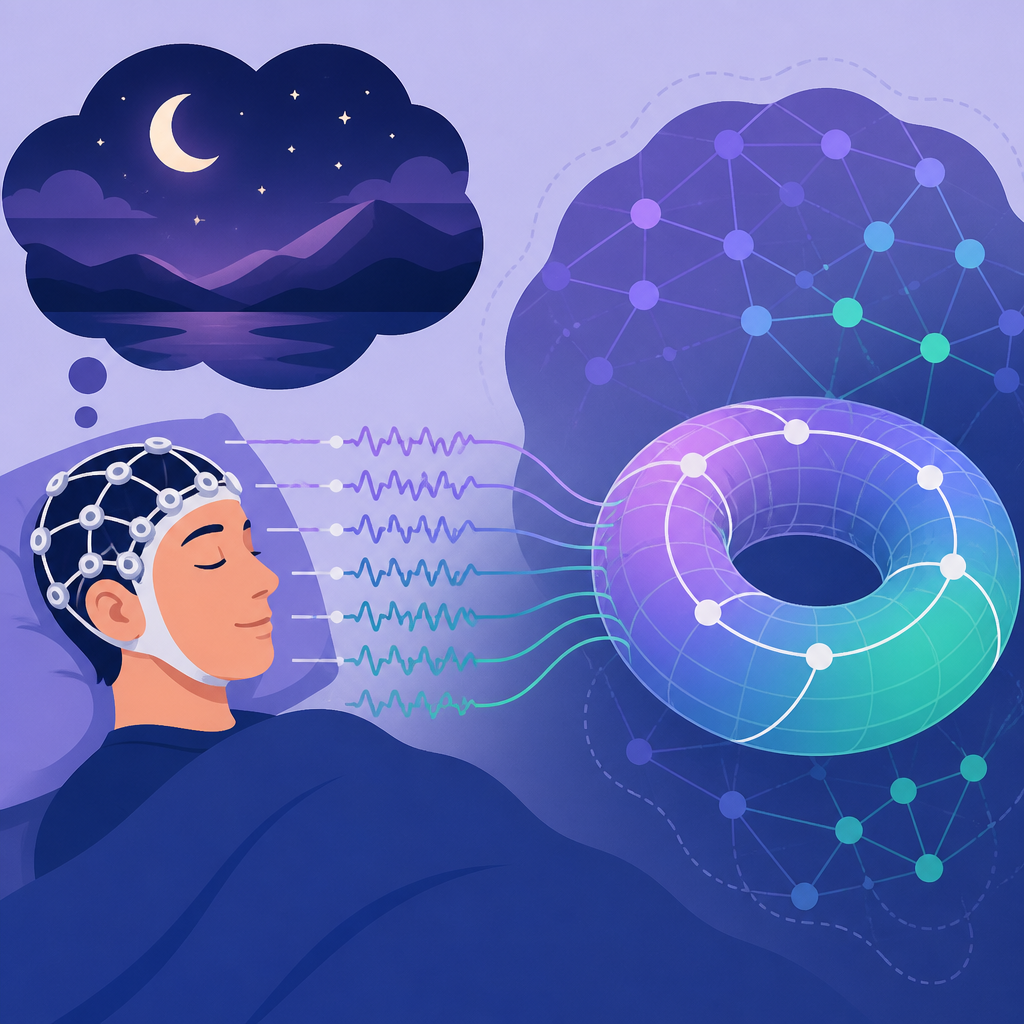
The core complaint here is simple: energy-based features describe how strong the signal is, but not how its structure changes in phase space. For an engineer, that matters because feature choice often sets the ceiling on downstream performance. If the representation cannot capture the relevant state changes, bigger models may not help much.
The paper is trying to move the feature layer from “what is the spectrum doing?” to “what is the geometry of the signal trajectory doing?” That shift is what motivates the topological machinery.
How the method works in plain English
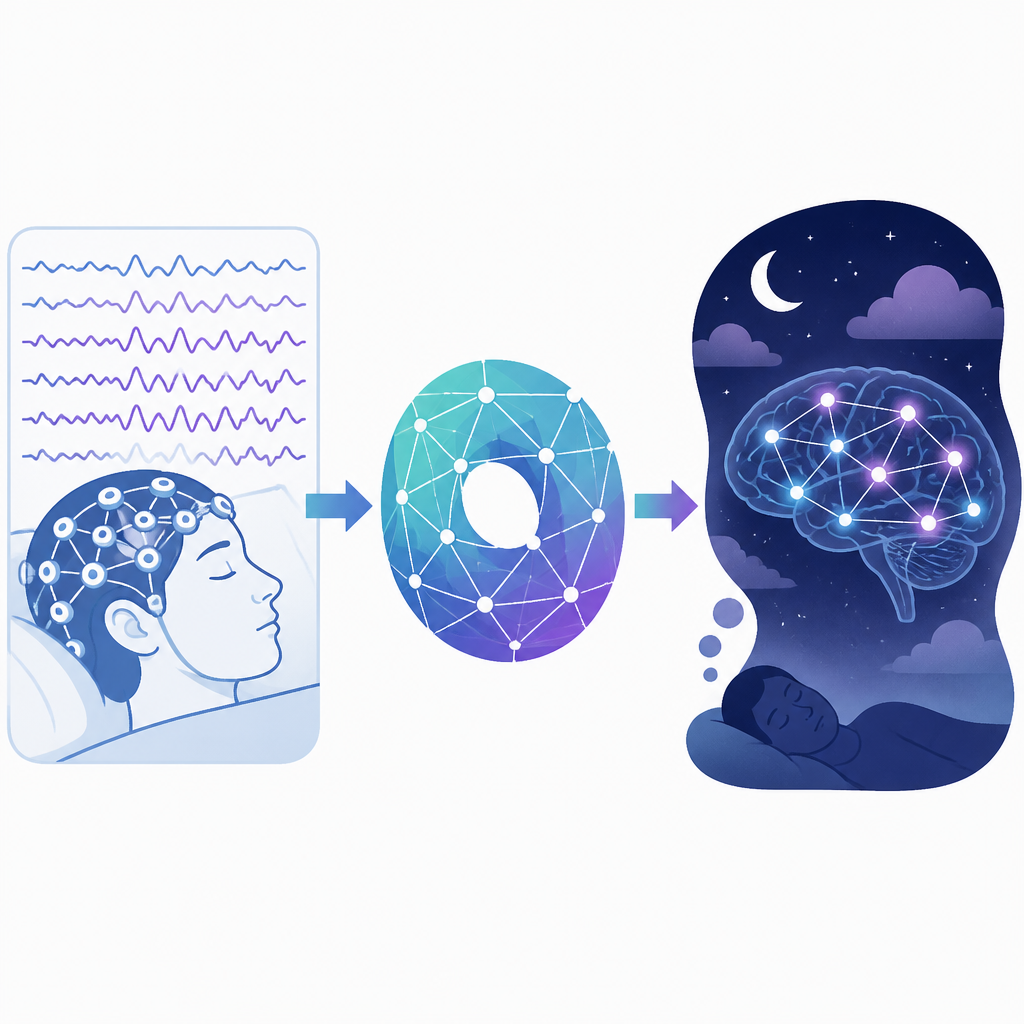
The pipeline starts with multichannel pre-awakening EEG epochs. Instead of extracting only conventional time-series features, the authors use sliding-window Takens delay embeddings to reconstruct the signal in a higher-dimensional phase space.
From those embedded windows, they build Vietoris-Rips filtrations and compute Dynamic Betti Curves. In practical terms, that means they track how topological structures appear and disappear over time. Betti numbers are a compact way to count features such as connected components and holes, so the resulting curves summarize the evolving shape of the neural activity.
The important distinction is that these features are described as characterizing the geometric architecture of the signal, not just its energy. That is the paper’s central technical bet: dream content may be easier to separate when you model the trajectory geometry of EEG rather than only its frequency content.
The second part of the system is a topology-conditioned flow model. The abstract describes a topology-conditioned rectified flow model for EEG synthesis, and it also mentions a spectral-conditioned flow model with comparable feature dimensionality as an ablation baseline. That baseline is there to isolate the value of topological conditioning specifically, which is the right kind of control if the goal is to test whether topology adds something beyond “just another conditioning signal.”
What the paper actually shows
Here the abstract is careful about language, and that matters. It does not report final benchmark results in the text provided. Instead, it says the method is analytically projected to outperform existing PSD and catch22 benchmarks, with a target AUC of 0.82-0.90 on the 1,462-awakening open-access subset of the DREAM database.
That target set is part of a larger registry: 3,191 total awakenings from 263 participants across 20 independent laboratories. Those numbers matter because they show the scale and heterogeneity of the underlying dataset, even if the abstract stops short of reporting measured gains from the new method.
So the honest read is: the paper proposes a concrete topological pipeline and a synthesis model, and it claims the approach should beat existing feature sets, but the abstract does not provide the final empirical confirmation in the form of achieved scores. If you are evaluating this as an engineer, treat the AUC range as a target, not a demonstrated result.
The paper also introduces candidate Betti transition archetypes linked to phenomenological dream report categories. But the authors explicitly label this as an exploratory hypothesis space pending empirical validation. In other words, it is an idea for future analysis, not a settled mapping from topology to dream content.
Why developers should care
For people building EEG pipelines, the main takeaway is not “use topology everywhere.” It is that representation choice can be the difference between a signal classifier that plateaus early and one that captures more of the underlying dynamics. If the topological features really do separate dream-state EEG better than PSD and catch22, that could influence how future biosignal models are designed.
The synthesis angle is also interesting. A topology-conditioned flow model suggests a way to generate or transform neural signals using structural constraints rather than only spectral ones. That could be useful in simulation, augmentation, or interpretability workflows, but the abstract does not show deployment details, latency, or robustness under noisy wearable conditions.
There is a broader engineering lesson here too: if a task depends on temporal structure that is not well summarized by moments or Fourier-style features, topological time-series methods may be worth testing. This paper is essentially a case study in that idea, applied to dream-state EEG.
Limitations and open questions
The biggest limitation is straightforward: the abstract promises performance, but it does not show the final numbers. It also does not include implementation details that would let a reader reproduce the full pipeline from the abstract alone, such as window sizes, embedding parameters, model architecture, or training setup.
Another limitation is that the dream-content archetypes are explicitly presented as exploratory. That means the paper is not yet proving a stable semantic link between Betti transitions and report categories. It is proposing a hypothesis space, which is useful, but not the same as validation.
Finally, the practical wearable-BCI angle is framed as a potential future implication, not a demonstrated application. So the paper points toward a new direction for neural rare-event detection, but it does not yet establish that the method is ready for real-world dream monitoring products.
Still, the direction is clear: if topology can capture discriminative structure in pre-awakening EEG, then future biosignal models may need to look beyond spectrum-first features. For developers working on neural time-series, that is a reminder that the signal representation layer is still an open design space, not a solved problem.
Bottom line
PHINN-EEG proposes a topological alternative to standard EEG feature engineering for dream detection and adds a topology-conditioned synthesis model on top. The abstract does not give final benchmark results, but it does lay out a concrete method that could matter if the reported targets hold up in full evaluation.
- The paper shifts dream EEG analysis from spectral features to dynamic topology.
- It uses Takens embeddings, Vietoris-Rips filtrations, and Betti curves on pre-awakening EEG.
- It proposes topology-conditioned flow matching, but the abstract stops short of final measured results.
// Related Articles
- [RSCH]
How VLMs Learned Complex Scene Descriptions
- [RSCH]
Visual Pretraining Beats Text-Only in Language Models
- [RSCH]
Google’s Android Bench update exposes Gemini’s gap
- [RSCH]
Benchmarks should not pick your LLM in 2026
- [RSCH]
Rust Breaks Into TIOBE’s Top 10
- [RSCH]
AI ransomware still needs a human bottleneck