Visual Pretraining Beats Text-Only in Language Models
Visual pretraining on the same corpora consistently outperforms text-only pretraining across backbones and benchmarks.

Visual pretraining on the same corpora consistently outperforms text-only pretraining across backbones and benchmarks.
- Research org: Unspecified in arXiv abstract
- Core data: No benchmark numbers in abstract
- Breakthrough: Directly pretrains on visual documents without text extraction
Most foundation-model training pipelines still flatten visually rich material into plain text before learning from it. That is convenient, but it also throws away structure that matters: figures, equations, page layout, and other visual cues that can carry information text alone does not preserve.
This paper argues that those discarded signals are not just nice to have. The authors study unsupervised visual pretraining as a scalable way to learn language intelligence from the same underlying corpora that text-only systems use, but without converting documents and web pages into plain text first.
What problem this paper is trying to fix
Get the latest AI news in your inbox
Weekly picks of model releases, tools, and deep dives — no spam, unsubscribe anytime.
No spam. Unsubscribe at any time.
The core issue is a mismatch between how information appears in the real world and how many language models are trained. A lot of useful knowledge lives in documents, PDFs, web pages, and other formatted sources where the meaning depends on visual structure. If you extract only text, you may lose the relationship between a formula and its surrounding explanation, or between a table and the layout that makes it readable.

The abstract frames this as a default assumption in current pretraining: language models are trained on text-only representations, even when the source material was visually rich. The paper challenges that assumption directly.
For engineers, the practical question is simple: if you already have large corpora of documents, should you spend effort extracting text first, or can a model learn better from the raw visual form? This paper is about that tradeoff.
How the method works in plain English
The method is called visual pretraining, and the key idea is straightforward: feed the model the visual documents themselves instead of stripping them down to extracted text. In the abstract, the authors describe this as unsupervised visual pretraining paradigms that directly leverage visual documents without text extraction.
That matters because it changes what the model can potentially learn. A page is not just a sequence of words. It is also spacing, alignment, structure, and visual organization. By keeping the source in visual form, the training process can preserve those signals rather than collapsing them into plain text.
The paper does not describe a single narrow architecture in the abstract. Instead, it says the authors run a systematic study across multiple backbones and benchmarks. So the contribution is less “here is one new model” and more “here is evidence that this training strategy works broadly.”
That broader framing is useful for practitioners. It suggests the idea is not tied to one special setup, which makes it more relevant as a training recipe or research direction than as a one-off demo.
What the paper actually shows
The strongest claim in the abstract is comparative: across multiple backbones and benchmarks, visual pretraining on the same underlying corpora consistently outperforms text-only pretraining. In other words, the gain is not from using more data. It is from using the same data in a way that preserves visual information.
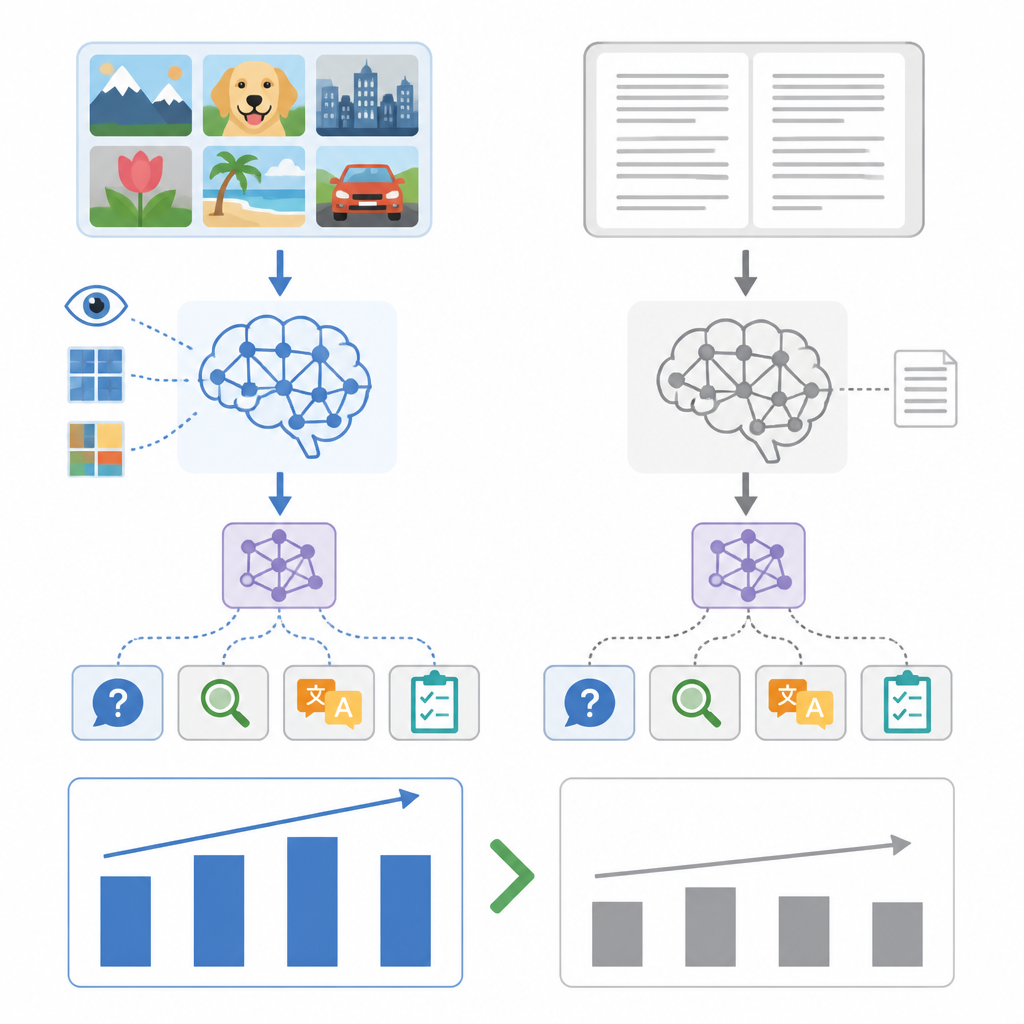
The abstract does not give benchmark names or numerical scores, so there are no exact percentages or leaderboard results to report here. That is an important limitation of the source material: the paper claims consistent improvement, but the abstract alone does not quantify how large those gains are.
Even without numbers, the practical implication is clear. If the result holds up in the full paper, then text extraction may be leaving performance on the table for pretraining pipelines that rely on documents or web pages. That is a meaningful shift for teams building foundation models from mixed-format corpora.
The paper also positions visual pretraining as an efficient pathway to scalable language intelligence. That phrase matters, but it should be read carefully: the abstract supports the efficiency claim only at the level of training paradigm, not with published throughput, cost, or compute numbers in the notes provided.
Why developers should care
If you work on training data pipelines, this paper is a reminder that preprocessing is not neutral. Converting everything to text can simplify ingestion, but it may also destroy information that helps a model learn. For document-heavy domains, that could affect retrieval, representation learning, and downstream reasoning.
It also hints at a broader design choice: instead of treating visual structure as an obstacle to be removed, you can treat it as part of the signal. That idea could matter for models trained on scientific papers, manuals, forms, slide decks, or any corpus where layout and notation are important.
At the same time, the abstract leaves open several engineering questions. It does not say what visual encoder setup was used, how expensive visual pretraining is relative to text-only training, or how robust the gains are across different data mixtures. Those details will matter if someone wants to turn the idea into a production training stack.
What is still unclear
Because this is only the abstract and notes, the evidence is intentionally high level. We know the authors conducted a systematic study, but we do not know the full experimental matrix from the source provided. We know visual pretraining outperformed text-only pretraining across multiple backbones and benchmarks, but we do not have the exact tasks, scores, or compute budget.
That means the right way to read this paper is as a strong direction, not a finished recipe. It suggests that preserving visual form during pretraining can improve language intelligence, but it does not yet tell us the full cost-benefit curve.
For now, the takeaway is practical: if your data source is visually rich, flattening it into text may be an unnecessary loss. This paper argues that the visual layer itself can be part of the learning signal, and that models trained this way can do better than text-only baselines on the same corpora.
- Visual structure in documents may carry useful signal that text extraction removes.
- The paper claims consistent gains across multiple backbones and benchmarks, but gives no numbers in the abstract.
- For document-heavy training pipelines, preserving visual form may be worth evaluating before defaulting to text-only preprocessing.
// Related Articles
- [RSCH]
How VLMs Learned Complex Scene Descriptions
- [RSCH]
PHINN-EEG brings topology to dream-state EEG
- [RSCH]
Google’s Android Bench update exposes Gemini’s gap
- [RSCH]
Benchmarks should not pick your LLM in 2026
- [RSCH]
Rust Breaks Into TIOBE’s Top 10
- [RSCH]
AI ransomware still needs a human bottleneck