A tighter sample-complexity bound for multiclass learning
This paper closes a long-standing gap in multiclass sample complexity by tying it tightly to DS dimension, with implications for list learning too.

Most machine learning engineers know the binary case: if you understand VC dimension, you have a clean handle on sample complexity. Multiclass learning has been messier. This paper, The Optimal Sample Complexity of Multiclass and List Learning, tackles that gap by showing that a key conjectured upper bound is actually true, which pins down the optimal dependence on DS dimension for multiclass classification and list learning.
Why should you care? Because sample complexity is not just theory trivia. It tells you how much data a learner needs before generalization becomes plausible. If you work on classification systems with many labels, or on learning setups that resemble list prediction, knowing the right complexity measure helps you reason about when a model class is learnable and how hard it is to estimate from finite data.
What problem this paper is trying to fix
Get the latest AI news in your inbox
Weekly picks of model releases, tools, and deep dives — no spam, unsubscribe anytime.
No spam. Unsubscribe at any time.
In binary classification, the story is settled: VC dimension captures the right notion of complexity, and sample complexity bounds are well understood. For multiclass classification, the right parameter is the DS dimension. But even with that parameter in hand, there was still a stubborn gap of a square root factor between known upper and lower bounds on sample complexity.

That gap matters because it means the theory was incomplete. Researchers knew DS dimension was the right direction, but not whether the existing bounds were tight. In practical terms, that leaves an engineer without the cleanest possible answer to a basic question: how much data is enough for a given multiclass hypothesis class?
The paper is aimed at closing that gap. It builds on recent work by Hanneke et al. (2026), which gave a novel algebraic characterization of multiclass hypothesis classes in terms of DS dimension. Using that foundation, the paper proves a bound that had been conjectured for years.
How the method works in plain English
The core move is to connect multiclass hypothesis classes to hypergraph structure. The paper shows that the maximum hypergraph density of any multiclass hypothesis class is upper-bounded by its DS dimension. That statement is the engine behind the improved sample-complexity result.
In less formal terms, the author is using a structural property of the hypothesis class to control how complicated it can be. If the class cannot form overly dense hypergraph patterns beyond what its DS dimension allows, then its learning behavior is more tightly constrained than previously known.
This is not a new learning algorithm. It is a theory result about the geometry and combinatorics of hypothesis classes. The value is that it converts an abstract complexity measure into a stronger handle on sample complexity bounds.
The paper also extends the conclusion to list learning. That matters because list learning is another setting where you do not necessarily predict a single label in the same way as standard classification, and the same complexity questions still apply.
What the paper actually shows
The headline result is that the longstanding conjecture of Daniely and Shalev-Shwartz (2014) is proved: the maximum hypergraph density of any multiclass hypothesis class is upper-bounded by its DS dimension.
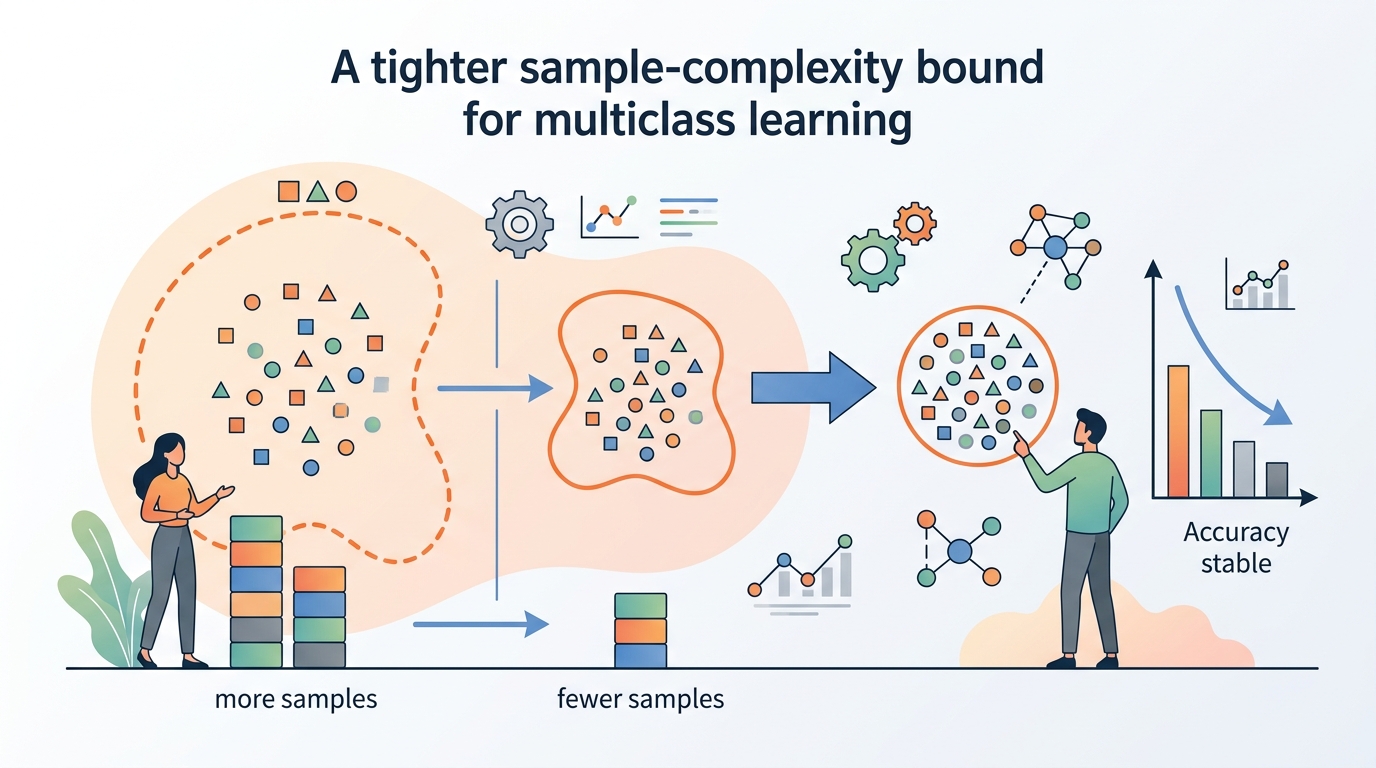
From that, the paper derives the optimal dependence of sample complexity on DS dimension for multiclass learning as well as list learning. In other words, the earlier square-root gap between upper and lower bounds is resolved.
The abstract does not provide benchmark numbers, experimental results, or empirical comparisons. This is a purely theoretical paper, so there are no accuracy charts, training curves, or dataset results to report. The concrete outcome is a mathematical characterization and the sample-complexity consequence that follows from it.
That matters because theory papers like this often become the reference point for later algorithmic work. Once the tight bound is known, future papers can build on a sharper foundation instead of carrying around a known looseness in the analysis.
Why developers should care
If you build classification systems with many possible labels, you are already living in multiclass territory. Even if you never compute DS dimension directly, the result tells you that the theoretical limits of learnability are cleaner than previously established. That can influence how you think about model class design, data requirements, and whether a learning problem is fundamentally feasible with limited samples.
For practitioners, the main takeaway is not that you should implement DS dimension tomorrow. It is that the sample-complexity story for multiclass and list learning is now sharper. When theory tightens, it often changes how people compare hypothesis classes, reason about generalization, and define the boundary between “needs more data” and “is structurally too complex.”
There is also a broader engineering lesson here: seemingly small gaps in learning theory can persist for years, and closing them can require importing tools from other parts of mathematics. In this case, the bridge runs through algebraic characterization and hypergraph density, not through a new optimizer or architecture trick.
Limitations and open questions
Because this is a theory result, it does not tell you how to train a better model on a real dataset. It does not introduce a new algorithm, and it does not include empirical validation in the abstract. The paper also does not give practical procedures for estimating DS dimension from data.
Another important limitation is that the abstract only states the main theorem at a high level. It does not spell out the exact constants, the full proof strategy, or the precise form of the optimal sample-complexity bound. Those details live in the paper itself.
Still, the contribution is substantial: it resolves a long-open conjecture and removes a known gap in the theory of multiclass learning. For developers and researchers working near the boundary of learnability, that is the kind of result that quietly changes the map.
If you care about how much data a learning problem fundamentally needs, this paper is worth reading. It does not promise a new model or a faster training loop. It gives something more foundational: a tighter answer to what makes multiclass and list learning hard in the first place.
- Binary classification has VC dimension; multiclass uses DS dimension.
- The old multiclass bounds had a square-root gap.
- This paper proves a conjectured hypergraph-density bound.
- The result yields optimal sample-complexity dependence for multiclass and list learning.
// Related Articles
- [RSCH]
Why AI safety teams are wrong to blame only alignment
- [RSCH]
Why fine-tuning LLMs for domain tasks is the right default
- [RSCH]
RefDecoder adds reference conditioning to video decoders
- [RSCH]
ATLAS Makes Visual Reasoning Use One Token
- [RSCH]
EntityBench Tackles Long-Range Video Consistency
- [RSCH]
TurboQuant and the SEO Shift for Small Sites