Triple-band FSS MIMO antenna targets sub-6 GHz
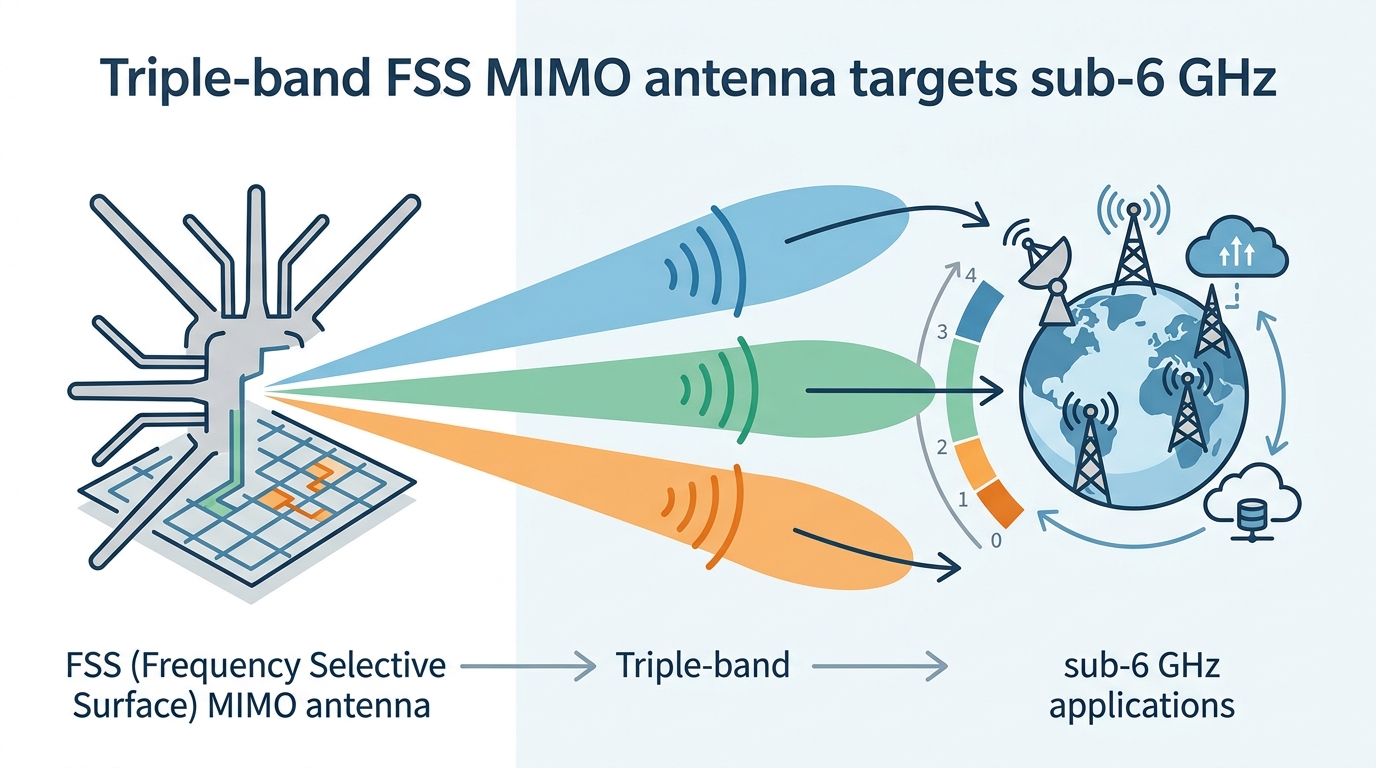
Researchers built a compact FSS-backed MIMO antenna that hits 3.4, 6.68, and 8.4 GHz while pushing gain to 12–14 dBi.

Wireless hardware keeps getting smaller, but the frequency targets keep multiplying. In a new preprint on Research Square, Ashish Kumar, Kinny Garg, Preeti Sharma, and Ramesh Kumar describe a triple-band MIMO antenna that operates at 3.4 GHz, 6.68 GHz, and 8.4 GHz, with reported gain in the 12–14 dBi range.
That matters because those three bands map to very different jobs: sub-6 GHz 5G, C-band wireless systems, and X-band communication. The paper’s pitch is simple enough to appreciate even if you do not live inside antenna theory every day: keep the hardware compact, improve isolation between antenna elements, and use a frequency selective surface, or FSS, to push performance higher without making the design bulky.
This is still a preprint, so the numbers should be treated as provisional until peer review finishes. Even so, the design is interesting because it combines three ideas that usually fight each other: multiband operation, MIMO diversity, and higher gain from an added radiating structure.
What the antenna is trying to solve
Get the latest AI news in your inbox
Weekly picks of model releases, tools, and deep dives — no spam, unsubscribe anytime.
No spam. Unsubscribe at any time.
Modern wireless gear often needs to cover more than one band while staying small enough for practical devices. A single-band antenna can be tuned for one job, but once you start asking for 5G access, wider-area wireless links, and higher-frequency channels, the design gets harder fast. The authors use a slotted patch structure to create multiple resonant paths, which is a familiar trick in antenna design, but the FSS layer changes the story by shaping how energy radiates and how surface waves behave.

In plain terms, the slots help the antenna “speak” on several frequencies, while the FSS helps it speak more efficiently. The paper says the added periodic FSS layer boosts gain, improves radiation efficiency, and suppresses unwanted surface waves. That combination is especially attractive for compact MIMO systems, where element-to-element coupling can ruin performance if the geometry is not handled carefully.
The reported operating bands are also well chosen. 3.4 GHz sits in the sub-6 GHz 5G zone used by many carriers. 6.68 GHz reaches into C-band territory, and 8.4 GHz is squarely in X-band territory, which is useful for a range of wireless and radar-adjacent applications. If the measurements hold up, this kind of tri-band coverage could reduce the need for multiple separate antennas in one device.
- Operating bands reported: 3.4 GHz, 6.68 GHz, 8.4 GHz
- Target use cases: sub-6 GHz 5G, C-band wireless, X-band communication
- Reported gain with FSS: 12–14 dBi
- Key MIMO metrics analyzed: reflection coefficient, ECC, diversity gain
- Design goal: compact multiband operation with improved isolation
Why the FSS layer changes the equation
An FSS is basically a periodic structure that filters electromagnetic waves in a frequency-dependent way. In antenna work, that means it can be used to reflect, pass, or shape energy at selected bands. The authors place a periodic FSS layer in the antenna structure to improve gain and reduce unwanted surface-wave effects, which is a smart move if the goal is to squeeze more performance from a compact footprint.
There is a practical reason antenna engineers keep returning to FSS designs: they let you tune the radiation environment without redesigning the whole antenna from scratch. That can be especially useful for MIMO systems, where isolation and radiation efficiency often matter as much as raw bandwidth. The paper reports better impedance matching and stronger element isolation at the target frequencies, which is exactly what you want to see if the antenna is meant for real wireless deployments.
For readers who want a broader technical context, the antenna world has been steadily moving toward more integrated, multi-band structures as device makers cram more radios into less space. Standards bodies like 3GPP have pushed sub-6 GHz 5G into mainstream products, while the IEEE ecosystem continues to define the wireless and antenna research vocabulary that these designs build on. This preprint sits right in that overlap.
“The future of wireless is going to be about connecting everything to everything else.” — Qualcomm chief executive Cristiano Amon, speaking at the company’s 2023 Investor Day
That quote is about the market, not this paper specifically, but it captures why designs like this matter. If devices need to support more bands, more links, and more simultaneous connections, antenna complexity becomes a product problem, not just a lab problem.
How it compares with common antenna tradeoffs
The most interesting thing about this preprint is the way it tries to balance the usual antenna tradeoffs instead of pretending they do not exist. Multiband antennas often give up some gain to gain flexibility. MIMO arrays often need more spacing than a compact device can spare. FSS structures can improve radiation behavior, but they also add design complexity. The point here is that the authors are trying to manage all of those constraints at once.
Here is the practical comparison that matters for engineers and product teams:
- Simple single-band antennas are easier to tune, but they cannot cover 3.4 GHz, 6.68 GHz, and 8.4 GHz in one design.
- Plain compact MIMO arrays can improve diversity, but they may suffer from lower gain and stronger coupling without extra structure.
- Adding an FSS layer can lift gain into the 12–14 dBi range, but it increases the number of parameters that need simulation and validation.
- Slot-based multiband patches are common, yet the reported combination here aims for better isolation and efficiency than a slot-only design.
The paper also mentions parametric analysis and simulation work around reflection coefficient, radiation patterns, gain, ECC, and diversity gain. That matters because antenna claims can look great on paper until the coupling, matching, or pattern stability gets tested across the full operating range. The more metrics a design survives, the more likely it is to survive contact with actual hardware integration.
If you want a useful external reference point, the 3GPP 5G specifications show why sub-6 GHz support remains so important for commercial wireless gear. Most phones, routers, and embedded radios still depend on these lower bands for coverage and reliability, even when higher frequencies get the marketing attention.
What to watch before anyone calls it product-ready
Because this is a preprint on Research Square, the next question is not whether the idea is interesting. It is whether the measured results survive peer review, fabrication tolerances, and the messiness of real deployment. Antenna papers often look strongest in simulation, then get narrower margins once the design is built and measured.
The strongest signal in this paper is the combination of tri-band operation, MIMO isolation, and higher gain from the FSS layer. If the reported performance holds, the design could fit compact wireless systems that need multiple bands without a larger antenna farm. If the final review process exposes weak spots, the paper will still be useful because it shows a design path that other researchers can test, modify, or simplify.
For now, the most sensible takeaway is also the most practical one: the antenna industry keeps moving toward designs that do more with less physical space, and this preprint is another example of that pressure in action. The next version worth watching is the one that pairs these simulation results with a clean fabrication report and measured performance across real devices, not just test fixtures.
If that happens, the question changes from “can this antenna work?” to “which product class can fit it first?” That is the kind of detail that decides whether a paper stays academic or ends up in shipping hardware.
// Related Articles
- [RSCH]
How VLMs Learned Complex Scene Descriptions
- [RSCH]
Visual Pretraining Beats Text-Only in Language Models
- [RSCH]
PHINN-EEG brings topology to dream-state EEG
- [RSCH]
Google’s Android Bench update exposes Gemini’s gap
- [RSCH]
Benchmarks should not pick your LLM in 2026
- [RSCH]
Rust Breaks Into TIOBE’s Top 10