Why coding benchmarks are finally telling the truth
BenchLM’s coding leaderboard says LiveCodeBench and SWE-bench Pro are the only signals that still matter.

LiveCodeBench and SWE-bench Pro now separate real coding models from benchmark chasers.
BenchLM’s March 2026 coding leaderboard makes one thing clear: the era of treating HumanEval as a serious selector for coding models is over, and teams that still do are making bad product decisions. Claude Mythos Preview sits at the top with a 100.0 weighted score, Gemini 3.1 Pro follows at 93.9, and GPT-5.3 Codex has surged to a 77.3 on SWE-bench Pro, the highest open-weight coding result shown on the page. That spread is not trivia. It is the difference between a model that can survive real repository work and one that only looks good in a demo.
First argument: real coding work is not a toy benchmark
Get the latest AI news in your inbox
Weekly picks of model releases, tools, and deep dives — no spam, unsubscribe anytime.
No spam. Unsubscribe at any time.
The strongest reason to trust this leaderboard is that BenchLM weights SWE-bench Pro and LiveCodeBench equally, and that is the right call. SWE-bench Pro reflects real GitHub issues from software repositories, while LiveCodeBench keeps sourcing fresh problems to resist contamination. Together they measure the two things teams actually need: can the model fix code in a messy repo, and can it still reason on unseen programming tasks when the prompt stops looking familiar.

HumanEval, by contrast, is basically spent. BenchLM says frontier models all score 95% or higher there, which means the benchmark no longer separates useful systems from merely competent ones. That matters because a benchmark that everyone clears does not help you choose an agent, a copilot, or a self-hosted code model. It just rewards familiarity with old test sets. If your evaluation stack still leans on HumanEval, you are optimizing for the past.
Second argument: the leaderboard exposes the real tradeoff between quality, cost, and deployment
The ranking is useful because it does not pretend accuracy is the only constraint. BenchLM shows Claude Mythos Preview at the top, but it also surfaces the practical alternatives: GPT-5.3 Codex for self-hosting-minded teams, GPT-5.4 for balanced cost and quality, and cheaper open models like Qwen3.6-27B for teams that care about price first. That is exactly how model selection should work. You do not buy the highest score in a vacuum. You buy the model that can clear your reliability bar without blowing up latency or spend.
The table makes that tradeoff concrete. Gemini 3.1 Pro is listed at $2.00 per million input tokens and $12.00 per million output tokens, with 109 tokens per second and a 29.71-second TTFT. GPT-5.3 Codex is pricier on output than some open options, but its 88.7 weighted score and 85 on SWE-bench Verified put it in a different class from budget models. That gap matters because BenchLM says a 5-point difference is meaningful, often separating a model that can solve a complex multi-file bug from one that gets stuck. In coding, the wrong five points is not rounding error. It is a failed patch.
The counter-argument
There is a serious case for ignoring leaderboards altogether. Benchmarks are always incomplete, and coding is especially slippery. A model can ace a public suite, then fail on your private monorepo because your stack uses weird build tooling, fragile tests, or domain-specific conventions. The strongest critics are right to say that a leaderboard can become a proxy war for benchmark tuning instead of a measure of production value.
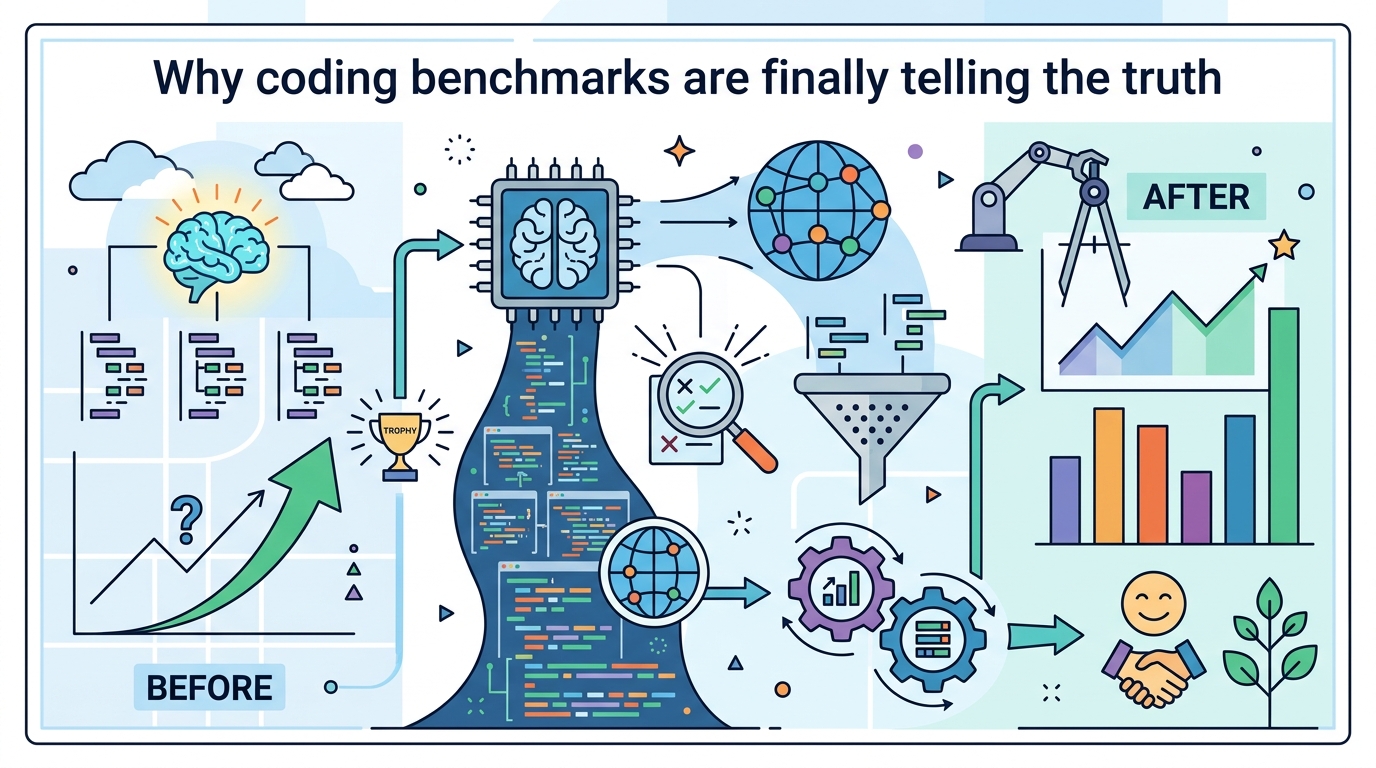
That critique is valid, but it does not defeat BenchLM’s approach. It tells you not to worship a single score. BenchLM already acknowledges the limits: HumanEval is saturated, SWE-bench Verified is only a reference point, and LiveCodeBench is the more contamination-resistant signal. That is the correct answer to benchmark skepticism. Use the leaderboard as a filter, then validate on your own repos. What you should reject is the idea that all coding benchmarks are equally useless. They are not. Some are broken, and some still tell you a lot.
What to do with this
If you are an engineer, use this leaderboard to narrow the field fast: start with models that score well on SWE-bench Pro and LiveCodeBench, then run them on your own bug-fix and code-review tasks. If you are a PM, stop asking for “the best coding model” and start asking which model clears your latency, cost, and deployment constraints while staying above the reliability threshold. If you are a founder, build your product around the benchmark that tracks real repo work, not the one that flatters your slide deck. The winner here is not the model with the prettiest number. It is the model that survives contact with code.
// Related Articles
- [RSCH]
How VLMs Learned Complex Scene Descriptions
- [RSCH]
Visual Pretraining Beats Text-Only in Language Models
- [RSCH]
PHINN-EEG brings topology to dream-state EEG
- [RSCH]
Google’s Android Bench update exposes Gemini’s gap
- [RSCH]
Benchmarks should not pick your LLM in 2026
- [RSCH]
Rust Breaks Into TIOBE’s Top 10