Why Distributed Systems Talks Beat Blog Posts for Real Learning
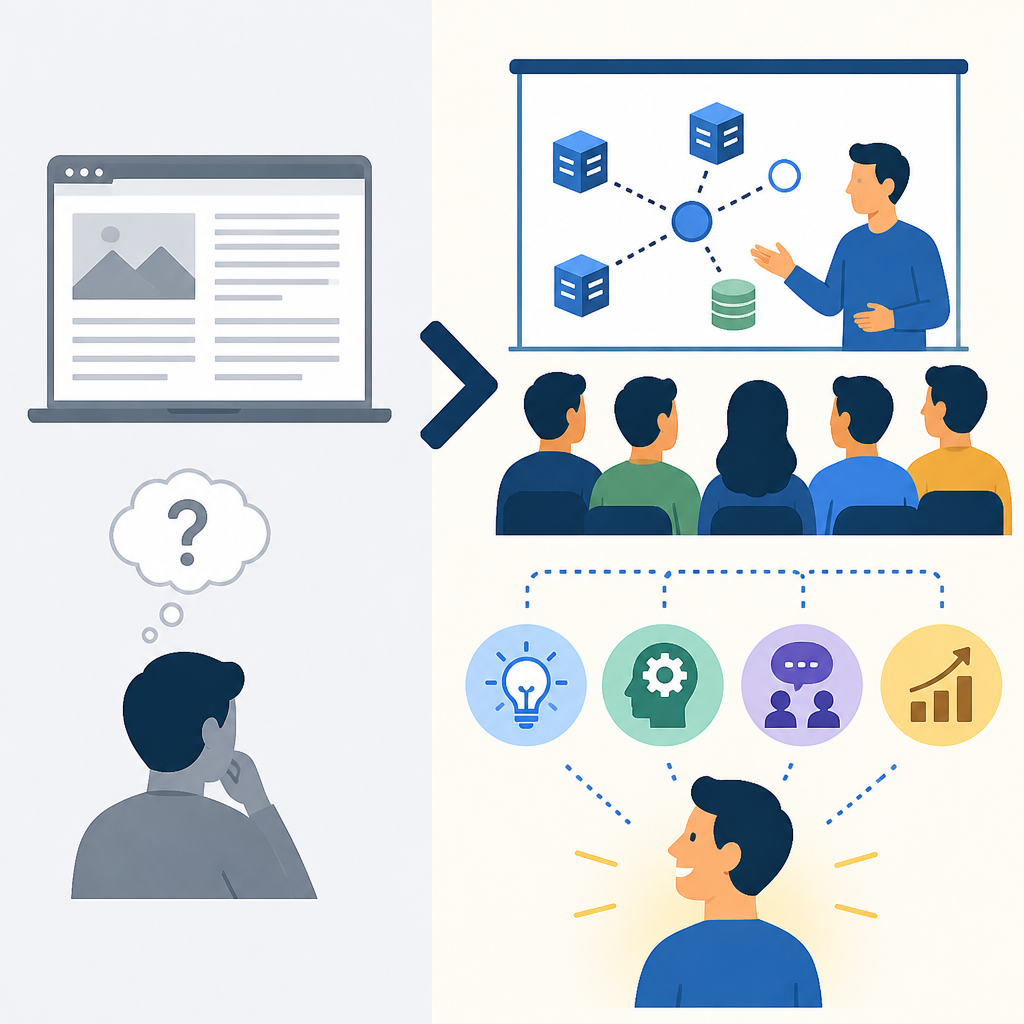
Distributed systems talks are the fastest way to learn the field’s real tradeoffs, not blog posts.

Distributed systems talks are the fastest way to learn the field’s real tradeoffs, not blog posts.
If you want to understand distributed systems, watch the talks and skip the polished blog-post summaries.
The best evidence is in the list itself: it mixes Martin Kleppmann’s Cambridge lectures, Netflix’s load-spike and stateful-systems case studies, Cloudflare’s Kafka lessons, Duolingo’s Super Bowl notification story, and classics from Lamport, Armstrong, Fowler, and Aphyr. That is not random content curation. It is a map of the field’s actual learning path, from theory to failure modes to production scars.
First, talks compress hard-won operational knowledge better than text
Get the latest AI news in your inbox
Weekly picks of model releases, tools, and deep dives — no spam, unsubscribe anytime.
No spam. Unsubscribe at any time.
A good distributed-systems talk does what a blog post rarely does: it shows the architecture, the failure, the metric, and the fix in one sitting. Martin Kleppmann’s Cambridge lectures are the clearest example in the list. Eight lectures can teach the vocabulary of replication, consistency, and consensus faster than weeks of piecing together scattered articles, because the material is sequenced by design instead of discovered by search.

The company case studies make the same point with sharper edges. Netflix’s “How Netflix Handles Sudden Load Spikes in the Cloud” and “How Netflix Ensures Highly-Reliable Online Stateful Systems” are not generic “best practices” pieces. They are concrete accounts of what breaks when traffic surges and state becomes the bottleneck. That specificity matters. A talk can show the tradeoff between latency, resilience, and cost in a way that a written summary usually smooths over.
Second, the best talks are production postmortems disguised as education
Distributed systems is not a field you learn by memorizing abstractions. You learn it by seeing where the abstractions fail. That is why talks like Cloudflare’s “Lessons Learnt on the Way to 1 Trillion Messages” and Duolingo’s “Delivering Millions of Notifications within Seconds During the Super Bowl” matter so much. They reveal the scale where ordinary patterns stop working and the team has to redesign around throughput, backpressure, and reliability.
The same goes for the architecture talks in the list. “Complexity is the Gotcha of Event-driven Architecture” and “How Event Driven Architectures Go Wrong & How to Fix Them” are valuable because they treat event-driven systems as a source of failure, not a marketing slogan. In a field where teams often adopt Kafka, microservices, or sagas before they understand the operational burden, that kind of honesty is worth more than a thousand glossy diagrams.
Third, a curated talk list is a better signal than endless feeds
The strongest argument for this compilation is not the talks themselves. It is the curation. The author pulled together foundational lectures, company case studies, architecture lessons, and classics into one ordered list. That structure solves a real problem: engineers waste time bouncing between YouTube, conference archives, and RSS feeds without a clear path from beginner concepts to advanced practice.
That is why the inclusion of older talks still matters. Leslie Lamport, Joe Armstrong, Greg Young, Martin Fowler, and Kyle Kingsbury are not there for nostalgia. They anchor the modern material to the ideas that still define the field: partitions, agreement, self-healing, event sourcing, and the limits of microservices. A good learning path needs historical depth, because distributed systems keeps repeating the same mistakes under new branding.
The counter-argument
The best objection is simple: talks are passive, time-consuming, and easy to overvalue. A 50-minute video can feel profound without forcing the viewer to implement anything. Blog posts, docs, and code samples are often better for direct application, especially when an engineer needs an answer now rather than a survey of the field.
That criticism is fair, and it exposes a real limit. Talks do not replace hands-on work, and a curated list can still hide the gap between understanding a concept and operating it under production pressure. But that is not a reason to dismiss talks. It is a reason to use them for what they are best at: building a mental model of failure, tradeoff, and scale before you touch the system. In distributed systems, that sequence is not optional. Learning by incident is too expensive.
What to do with this
If you are an engineer, use a list like this as a syllabus, not entertainment. Start with the foundational lectures, then watch one company case study in the same domain you work in, then one architecture talk on the failure mode you fear most. Take notes on the exact tradeoffs, the metrics mentioned, and the failure patterns. If you are a PM or founder, use these talks to calibrate your roadmap: every “simple” distributed feature has hidden cost in latency, observability, retries, state, and support. The point is not to collect videos. The point is to build better instincts before production teaches you the hard way.
// Related Articles
- [RSCH]
How VLMs Learned Complex Scene Descriptions
- [RSCH]
Visual Pretraining Beats Text-Only in Language Models
- [RSCH]
PHINN-EEG brings topology to dream-state EEG
- [RSCH]
Google’s Android Bench update exposes Gemini’s gap
- [RSCH]
Benchmarks should not pick your LLM in 2026
- [RSCH]
Rust Breaks Into TIOBE’s Top 10