How 1970s Boston built the term paper mill
Boston’s 1970s term paper mills turned student cheating into a high-margin business before the internet existed.

Boston’s 1970s term paper mills turned student cheating into a high-margin business before the internet existed.
In 1971, one custom paper sold for about $35, roughly $270 today, and the market spread fast across campus newspapers, alt-weeklies, and student gossip. The Boston Globe’s new retrospective shows how a shady side hustle grew into a national business with thousands of buyers, dozens of writers, and a few very loud founders.
| Metric | 1970s figure | Today’s equivalent |
|---|---|---|
| Custom 10-page paper | $35 | About $270 |
| Top weekly pay for David Kamen | $675 | Over $5,300 |
| Publicly claimed annual gross revenue | $2 million | Roughly $15 million+ |
| Stockpile at International Term Papers | 80,000 papers | N/A |
Boston was the perfect market
Get the latest AI news in your inbox
Weekly picks of model releases, tools, and deep dives — no spam, unsubscribe anytime.
No spam. Unsubscribe at any time.
The term paper trade did not appear in a vacuum. Greater Boston had about 150,000 college students, a steady supply of smart but broke writers, and a media ecosystem where a startup could advertise in student papers and weeklies without much friction. That mix made the city an unusually good place for a business built on academic shortcuts.
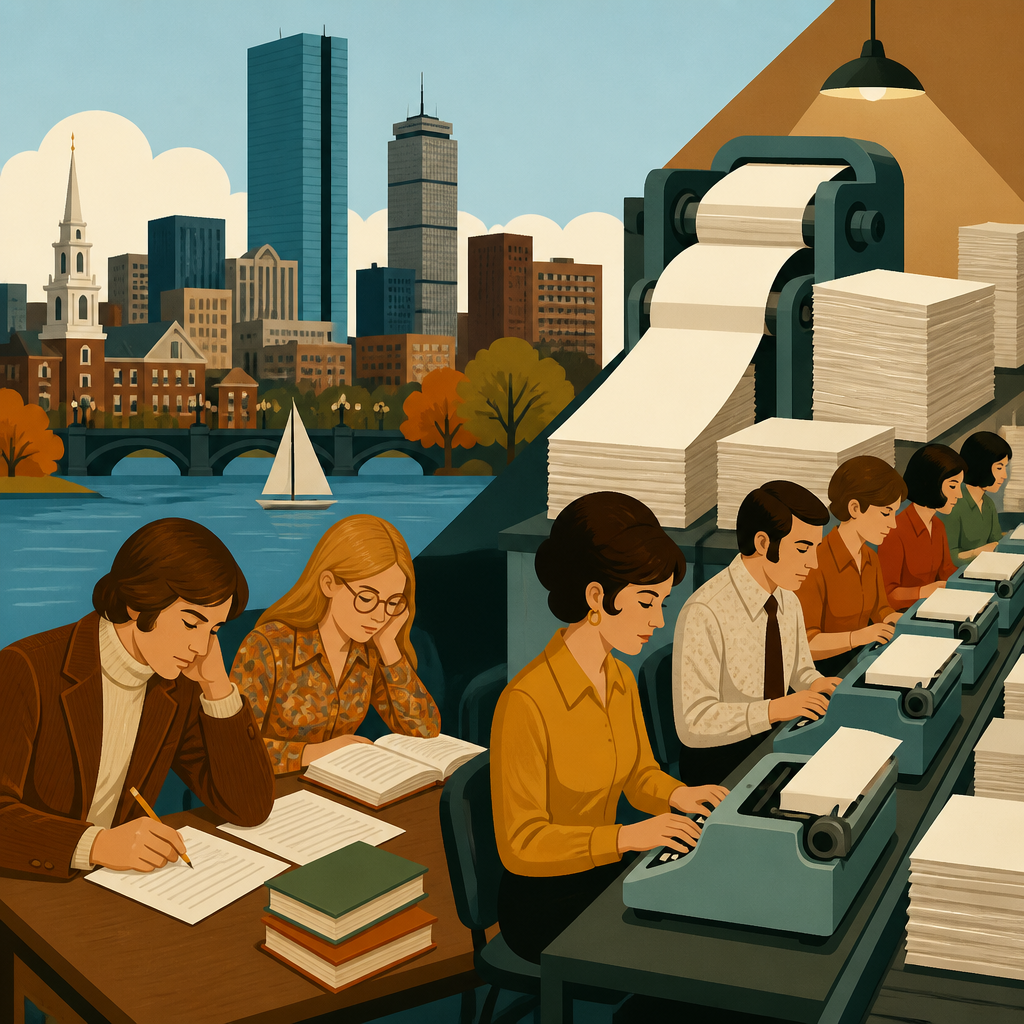
The Globe’s story makes clear that the founders were not hidden operators working in the shadows. They were loud, self-promoting, and happy to explain the economics. That mattered because the business was simple: keep a library of prewritten papers, sell them cheaply by the page, and charge more for custom work.
- Prewritten papers sold for $1.50 to $3 per page.
- Custom papers cost $2.25 to $6 per page, plus a $2 to $5 application fee.
- A 10-page custom paper usually ran about $35.
- Some firms claimed inventories of thousands of papers.
That pricing model looks familiar in 2026 because it is basically a content marketplace with a darker purpose. The product was speed, not quality. The customer wanted something that looked original enough to pass, and the seller wanted volume.
The men behind the mills were hustlers, not academics
The most colorful name in the piece is David Kamen, better known as Mr. Papers, who told the Harvard Crimson he had graduated with honors from one of the country’s top colleges and could turn out as many as 35 papers a week. He later claimed he typed 100 words a minute and barely needed to write English papers at all.
Then there was Ward Warren, who opened Termpapers Unlimited at 21 while still studying finance at Babson College. He had a gift for publicity and self-mythology. He called himself a “small-scale J. Paul Getty,” claimed the company had 50 branches across the United States and Canada, and said annual gross revenue topped $2 million.
“I’m in it for the ideas, and the causes.” — Ward Warren, in an interview cited by the Boston Globe
That quote is doing a lot of work, because it shows how these operators framed the business. They knew the service looked dubious, so they wrapped it in a defense about access, efficiency, and educational reform. It is the same rhetorical move that appears every time a new cheating tool gets normalized.
The money was real, and so was the moral fog
The Globe’s reporting shows a business that was half hustle, half rationalization. Warren posted signs that said “We Do Not Condone Plagiarism” while also insisting most students did not submit the papers unchanged. That distinction mattered to him because it gave the company legal cover and a moral escape hatch.
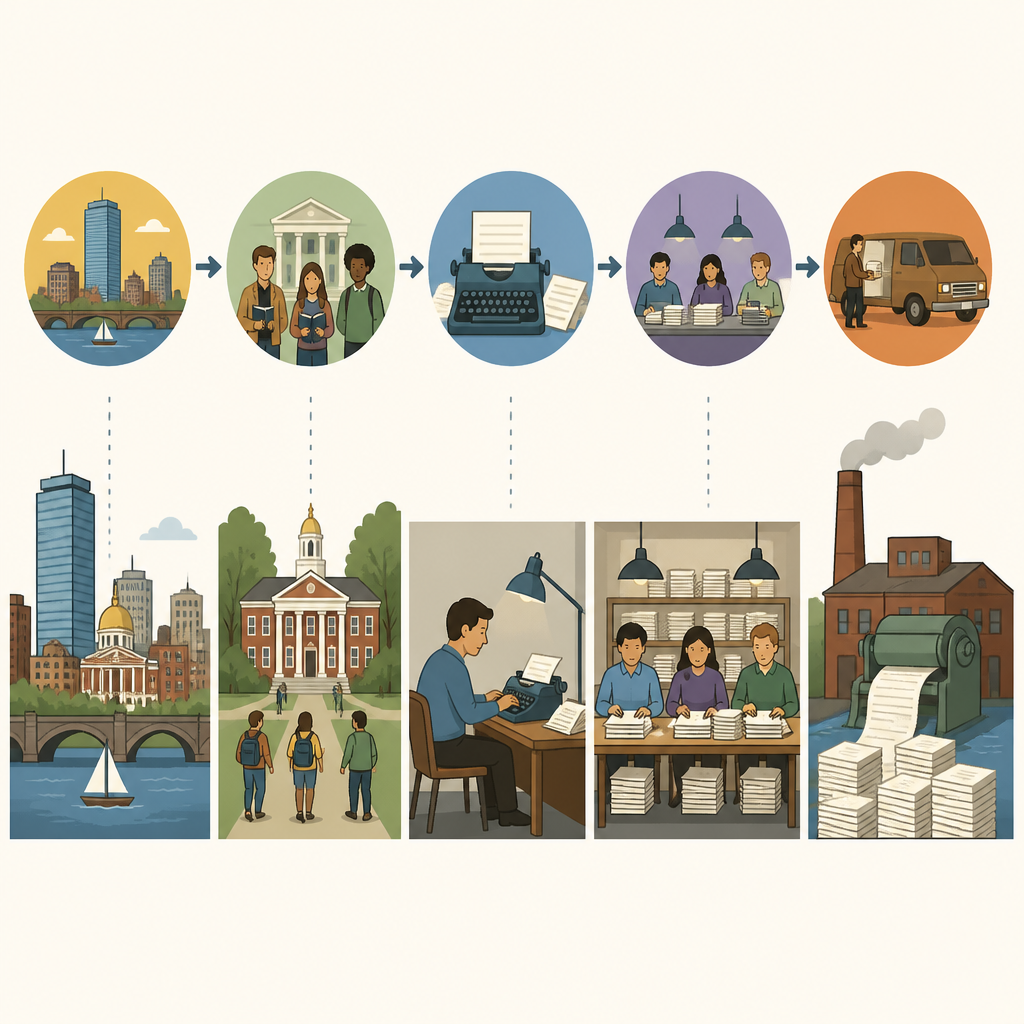
Other operators leaned on the same logic. If students were too busy, too underprepared, or too skeptical of stale assignments, then outsourcing the essay was just a market response. That argument sounds very modern, especially now that students can use AI tools to draft, rewrite, and summarize work in seconds.
- One company said it had 80,000 papers in stock.
- Another claimed 2,000 employees who could write “anything on any level in any language.”
- Franchises reportedly sold for $10,000 each.
- Some firms expanded into Connecticut, Rhode Island, Ohio, California, and Canada.
There was also a real labor market underneath the hype. Writers were recruited from unemployment lines, from campuses, and from the same post-Woodstock crowd that filled Boston with underemployed graduates and restless strivers. In that sense, the term paper mills were an early version of the gig economy: uneven, opportunistic, and built on people willing to trade speed for cash.
The comparison to AI cheating is hard to miss
The Globe’s own framing pushes the analogy pretty far, and it is a fair one. The term paper mills sold a shortcut for students who wanted a finished product without doing the work. AI tools do the same thing now, except they are faster, cheaper, and far easier to access.
That does not mean the two eras are identical. The 1970s version depended on physical offices, ads, writers, and paper inventories. Today’s version depends on model access, prompt skill, and a student’s willingness to gamble on detection. But the incentives are close enough that the old arguments keep coming back.
- Then: a 10-page paper cost about $35.
- Now: AI tools can draft similar material for a monthly subscription or a free tier.
- Then: companies stamped papers “For Research Purposes Only.”
- Now: users can ask a model to rewrite, paraphrase, or summarize in seconds.
That comparison matters because it shows cheating is not a new tech problem. It is a design and policy problem. Schools that rely on generic essays create a market for shortcuts, and entrepreneurs always find a way to sell them.
Boston’s old paper mills still matter
The story is funny on the surface, with its mustaches, Jaguars, and absurd company names like Easy Writer and Quality Bullshit. But the deeper lesson is less nostalgic. Whenever institutions use the same assignments, the same grading habits, and the same weak enforcement, someone will build a business around the gap.
That is why this Boston story still feels current. The tools have changed, but the incentives have not. If colleges want fewer term paper mills in the AI era, they need to ask a simple question: which assignments actually force students to think, and which ones are just waiting to be outsourced?
The next wave of academic cheating will probably look less like a storefront in Cambridge and more like a chat window on a laptop. The real test is whether universities update their teaching before students decide the shortcut is easier than the class.
// Related Articles
- [IND]
Gemini lands inside Apple’s developer stack
- [IND]
Five AI coding IDEs that fit real workflows
- [IND]
Devin Desktop turns Windsurf into an agent hub
- [IND]
Korea’s Nvidia talks point to an AI factory push
- [IND]
OpenAI should not rush its IPO just to win the AI race
- [IND]
OpenAI updates its Europe privacy policy