5 antenna gains from a Hilbert fractal MIMO design
5 antenna gains from a compact four-element Hilbert fractal MIMO design, including 56.6% bandwidth and isolation above 20 dB.
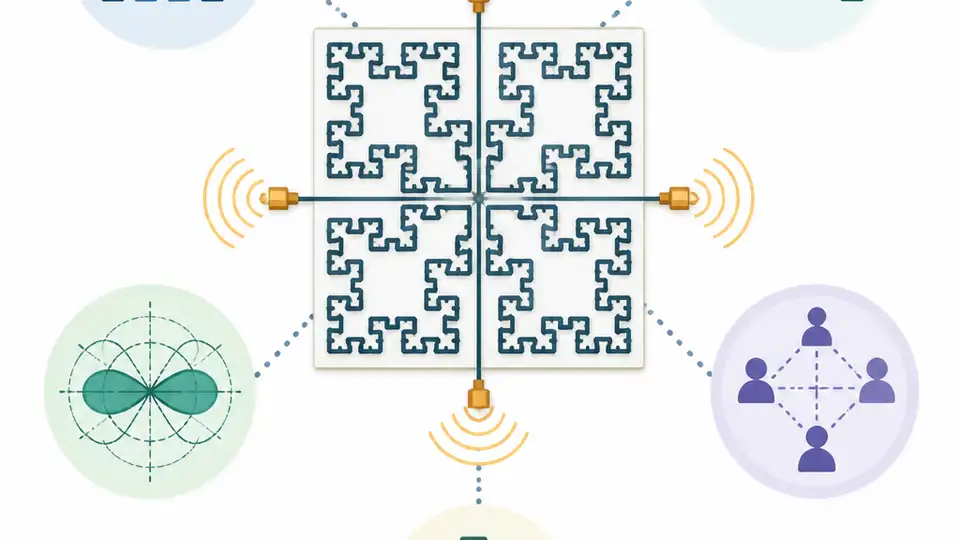
This preprint describes a compact four-element Hilbert fractal MIMO antenna with wider bandwidth and high isolation.
This preprint shows how a four-element Hilbert fractal MIMO antenna uses stub loading and tight element spacing to improve 5G NR performance, with fractional bandwidth rising to 56.6% and isolation staying above 20 dB in key bands.
1. Compact four-element layout
Get the latest AI news in your inbox
Weekly picks of model releases, tools, and deep dives — no spam, unsubscribe anytime.
No spam. Unsubscribe at any time.
The main draw is the small footprint. The full array measures 33 × 33 mm², which the authors describe as 0.23λ0 × 0.23λ0 at the lower cutoff frequency. That makes the design a fit for compact 5G devices where board space is tight.

The antenna uses four radiating elements in an axially symmetric arrangement, which helps keep the form factor simple while still supporting MIMO operation.
- Array size: 33 × 33 mm²
- Element count: 4
- Substrate: CER10 0470
2. Third-order Hilbert fractal radiator
The radiator uses a third-order Hilbert fractal structure. Fractal geometry is a common antenna trick for fitting more electrical length into less physical area, and here it helps shrink each radiator to 22 × 10.3 mm².
That miniaturization is important because it allows the antenna to cover multiple 5G NR bands without growing the board. The paper points to support for n40/n41 and the wider n77/n78 range.
Individual radiator dimensions: 22 × 10.3 mm²
Supported bands: n40/n41, n77/n78
3. Open-circuit stub loading
The biggest performance change comes from the open-circuit stub. The stub adds a reactive load that shifts the lower cutoff frequency downward and widens the operating band. In the paper, fractional bandwidth improves from 11.18% in the stub-less version to 56.6% in the final radiator.
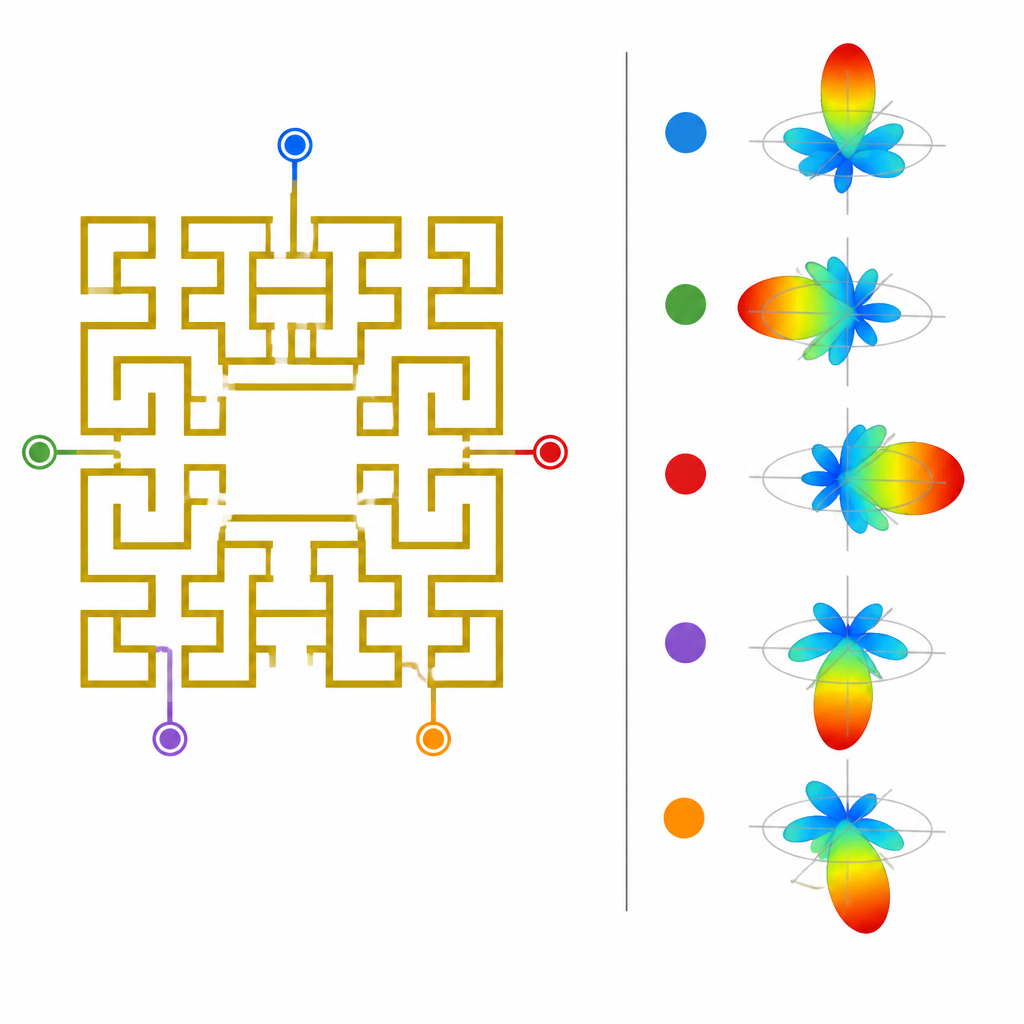
That is the kind of change designers care about when a small antenna needs to cover more spectrum without adding extra elements or larger matching networks.
- Stub-less fractional bandwidth: 11.18%
- Final fractional bandwidth: 56.6%
- Effect: lower cutoff moves down
4. High inter-element isolation
Dense MIMO arrays often suffer from coupling between elements, but this design keeps isolation above 20 dB in the lower and mid-bands and above 30 dB in the upper bands. The authors attribute that to physical isolation barriers between radiators.
For a compact four-element array, that matters because better isolation can improve channel behavior without forcing wider spacing. It also helps the antenna stay practical for small terminals and embedded wireless hardware.
- Lower and mid-bands: > 20 dB isolation
- Upper bands: > 30 dB isolation
- Method: physical isolation barriers
5. Strong MIMO metrics
The paper reports MIMO figures that point to efficient diversity performance. The Envelope Correlation Coefficient is below 0.002, Diversity Gain is at least 9.9, Total Active Reflection Coefficient stays below −10 dB in random-phase analysis, and Channel Capacity Loss remains under 0.4 bits/s/Hz.
Those numbers suggest a design that does more than just fit on a small board. It also behaves well as a multi-antenna system, which is the real test for 5G NR use.
- ECC: < 0.002
- DG: ≥ 9.9
- TARC: below −10 dB
- CCL: < 0.4 bits/s/Hz
How to decide
If you need the smallest possible footprint, the compact four-element layout is the main selling point. If your priority is broader band coverage, the stub-loaded radiator is the key feature. If you care most about MIMO behavior, the isolation and ECC results are the strongest reasons to pay attention.
For 5G NR device designers, the best takeaway is that this preprint combines miniaturization, bandwidth expansion, and low coupling in one array rather than trading one for another.
// Related Articles
- [IND]
OpenAI should not rush its IPO just to win the AI race
- [IND]
OpenAI updates its Europe privacy policy
- [IND]
OpenAI is right to keep ads out of sensitive chats
- [IND]
AI bootlegs are already draining streaming royalties
- [IND]
AMD and Microsoft push Windows ML on GPU and NPU
- [IND]
OpenAI’s IPO filing turns hype into scrutiny