How a benefit show turns one night into funding
A copyable template for framing a benefit show as a clean, donation-driven event story.

A copyable template for framing a benefit show as a clean, donation-driven event story.
I’ve been using local event blurbs for a while now, and they keep feeling weirdly flat. Same ingredients every time: a venue, a date, a name people know, and a charity tie-in. But the writing just sits there like a bulletin board post. No angle. No tension. No reason to care beyond “okay, noted.”
That’s what jumped out at me in the Nashua Ink Link item about Seth Meyers returning to SNHU Arena on Aug. 7 to benefit CASA of New Hampshire and the Granite State Children’s Alliance. The facts are fine. The problem is that this kind of announcement can either read like a throwaway calendar note or like a real community story. The difference is in how you break it down. I want the second version, because that’s the one people actually use.
The source that kicked this off is Nashua Ink Link’s short announcement, published at nashua.inklink.news. It doesn’t give us a pile of stats or a dramatic backstory, just the core event: Seth Meyers, one night, SNHU Arena, two child-focused nonprofits. That’s enough for a useful breakdown if you’re trying to write, edit, or repurpose this kind of local announcement without making it feel like filler.
Stop writing this like a calendar entry
Get the latest AI news in your inbox
Weekly picks of model releases, tools, and deep dives — no spam, unsubscribe anytime.
No spam. Unsubscribe at any time.
Court Appointed Special Advocates (CASA) of New Hampshire and the Granite State Children’s Alliance are thrilled to announce that Seth Meyers is performing a special live show on August 7 at the SNHU Arena to benefit both organizations.
What this actually means is: the whole story is already inside one sentence, but it’s buried under event-poster language. I see this all the time with fundraisers, charity performances, and civic events. The writer dumps the announcement up front and assumes the reader will do the work of figuring out why it matters.

I don’t love that approach because it makes the piece sound interchangeable. If I swapped Seth Meyers for another recognizable name, the sentence would still work. That’s the problem. Good event writing should tell me what kind of night this is, who benefits, and why the setup matters to the audience in that city.
How to apply it: when you get a one-paragraph announcement, extract three things before you write anything else. First, the person or act. Second, the beneficiary. Third, the local anchor, which here is SNHU Arena in Manchester. Then decide which of those should lead. If the beneficiary is the real story, lead with the cause. If the draw is the name, lead with the performer. Don’t just repeat the press release in different words.
I ran into this exact problem when editing community event copy for a client site. The draft kept saying “excited to announce” and “special event” and “in support of.” None of that told the reader what they were supposed to do next. Once I forced the copy to answer “who’s this for?” and “why now?”, the whole piece got shorter and better.
The nonprofit angle is the actual engine
CASA of New Hampshire and the Granite State Children’s Alliance are not decorative names here. They are the reason the event exists. If I’m writing this for readers, I need to make the beneficiary the spine of the story, not a footnote at the end of the sentence.
CASA, or Court Appointed Special Advocates, is a model people may know by acronym, but not always by function. The organization supports children involved in the court system through trained advocates. The Granite State Children’s Alliance is also child-centered, and in this context the pairing tells me the event is built around support for kids, not just entertainment.
What this actually means is that the show has a built-in public-interest hook. The celebrity name gets attention, sure, but the charity connection gives the event legitimacy and purpose. Without that, it’s just another appearance. With it, the event becomes a fundraiser that local readers can justify attending, sharing, or covering.
How to apply it: if you’re writing a benefit announcement, spend more space on the mission than on the performer’s résumé. You do not need a biography of Seth Meyers. You need one clean paragraph that tells readers why these two organizations matter and what the event supports. If the source material doesn’t explain the mission, don’t invent it. Link to the organization’s official pages instead: CASA of New Hampshire and Granite State Children’s Alliance.
- Lead with the cause if the event is fundraising-first.
- Use the performer as the draw, not the whole story.
- Translate acronyms the first time you use them.
That little move matters more than people admit. Readers don’t want to decode your shorthand while deciding whether to buy a ticket.
Local venue context gives the story a place to land
SNHU Arena is the other piece that keeps this from floating away into generic celebrity-news mush. A benefit show is not just about who’s on stage. It’s also about where the audience is expected to show up. The venue is part of the pitch.
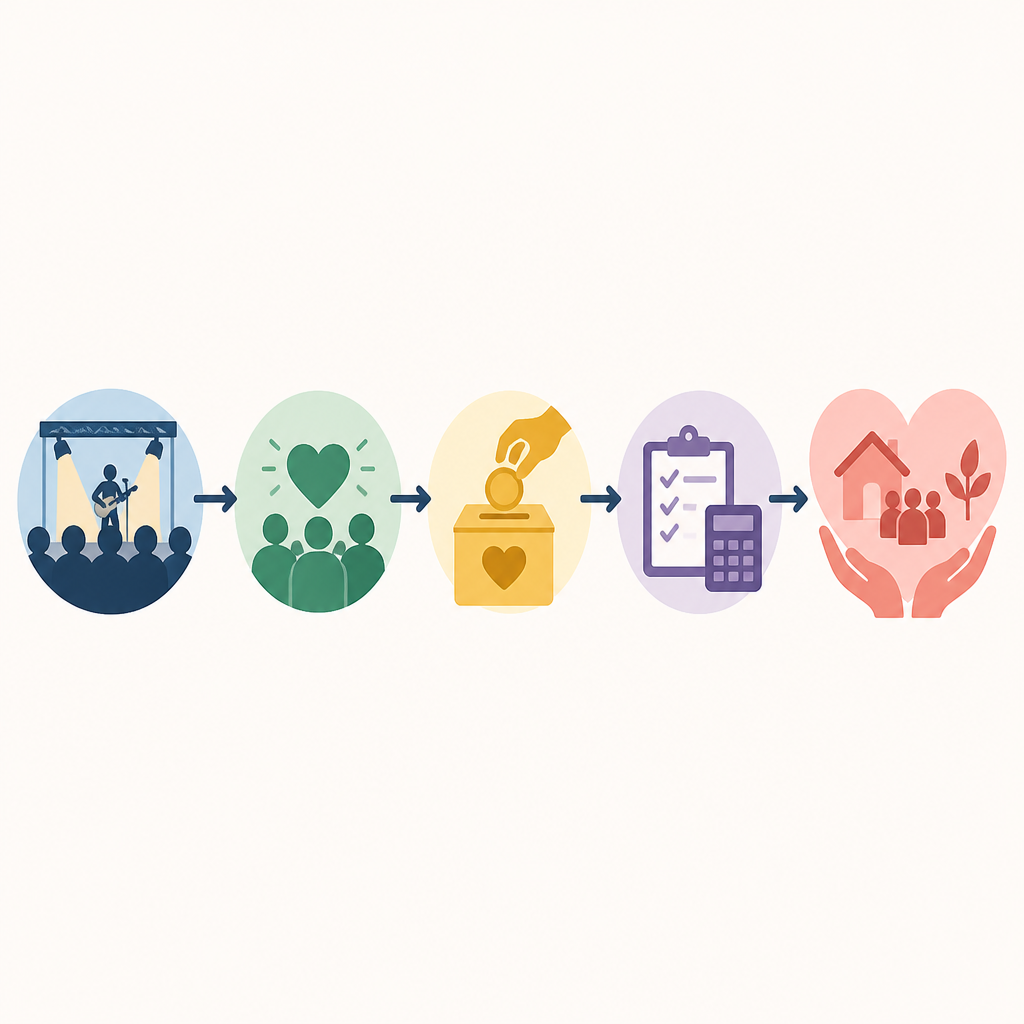
In plain language, this means the story should tell local readers why this belongs to them. A recognizable venue turns a national name into a local event. That matters because it changes the reader’s mental model from “something happening somewhere” to “something I could actually attend.”
I’ve seen a lot of community announcements fail right here. They mention the city, but not the venue. Or they mention the venue, but never explain whether the event is public, ticketed, or charity-driven. Then the reader has to go hunting. That’s sloppy.
How to apply it: whenever you have a benefit show, include one sentence that does the job of location and access. Say where it is, whether it’s a ticketed event, and who it’s for. If the original source doesn’t give ticket details, don’t fake them. Instead, point readers to the venue’s official site, like SNHU Arena, or to the organizer’s announcement page.
There’s also an editorial trick here: the venue can help you frame scale without making up numbers. “At SNHU Arena” tells me this isn’t a backyard fundraiser. It signals a larger public event, which is useful context even when the source is short.
- Use the venue to localize the story.
- Use the city to orient the audience.
- Use the ticketing language, if available, to tell readers what action to take.
Celebrity names work best when they are not the headline
Seth Meyers is the attention magnet in this story, obviously. He’s the name people recognize first. But I think a lot of editors overdo that part and end up writing celebrity-first copy that forgets the actual purpose of the event.
What this actually means is that the performer should be framed as the vehicle, not the destination. The audience is not just buying a comedy night. They’re buying a comedy night that helps fund child advocacy work. That distinction changes the tone from “look who’s coming” to “here’s why this appearance matters.”
I’m not saying ignore the name. I’m saying don’t let the name swallow the point. If you’re editing a local announcement, the performer gets one clean mention, maybe two if you need to explain the draw. After that, shift back to the mission and the venue.
How to apply it: write one sentence that answers “why this person?” and one sentence that answers “why this cause?” Then stop. If you keep adding celebrity trivia, the piece starts sounding like a fan page. If you keep it tight, it reads like a useful community notice.
For reference, Meyers’ own site is here: sethmeyers.com. If you’re linking out, that’s the right place to send readers who want the performer’s official schedule or background.
Short announcements need structure, not padding
The hard part with a source this short is that there’s not much raw material. That’s not a bug. It’s the test. If I can turn a one-sentence announcement into a useful editorial package, I’m actually doing the job.
What this actually means is I need to separate facts from framing. Facts: who, what, when, where, why. Framing: which fact leads, what context gets added, and what the reader should do with the information. Most weak event copy mixes those together and ends up sounding mushy.
I like to use a simple order when I’m rebuilding a short announcement:
- Start with the event and the reason it exists.
- Then name the performer or speaker.
- Then anchor it in the venue and date.
- Then explain the beneficiary.
- Then give a clean action path, like tickets or more info.
I ran into this when I was editing a nonprofit event calendar that had dozens of nearly identical listings. The ones that worked were the ones that answered the reader’s next question immediately. The bad ones buried the useful part under slogans and adjectives. Nobody needs “thrilled to announce” if they still don’t know why the event matters.
How to apply it: if your source is only one paragraph long, resist the urge to invent depth. Instead, make the structure do the work. A tight headline, one strong lede, one mission paragraph, one venue paragraph, and one action paragraph is usually enough.
Here’s the angle I’d actually publish
If I were turning this into a local feature or a polished event post, I would not pretend it’s bigger than it is. I’d make it clean, useful, and easy to scan. That’s the whole job.
What this actually means is the article should answer three questions fast: What is happening? Who benefits? Where does it happen? Once those are clear, everything else is supporting detail. And if you don’t have supporting detail, fine. Don’t pad. Just be precise.
My preferred structure for this kind of piece is:
- One sentence on the event and the cause.
- One paragraph on the nonprofit mission.
- One paragraph on the venue and date.
- One paragraph on why the performer is the draw.
- One closing line that points people to tickets or the organizer.
That’s it. No drama, no fake urgency, no filler. The clean version is usually the one people trust.
The template you can copy
# [Performer] to headline benefit show for [Nonprofit 1] and [Nonprofit 2] at [Venue]

[Performer] will perform a special live show on [date] at [venue] to benefit [Nonprofit 1] and [Nonprofit 2]. The event brings a recognizable name to a local stage while supporting organizations focused on [mission or cause].

[Nonprofit 1] is a [one-line plain-English description of what it does]. [Nonprofit 2] works on [one-line plain-English description of what it does]. Together, the two groups use the event to raise awareness and support for [shared cause].

The show will take place at [venue name] in [city], giving local attendees a chance to see [performer] while contributing to a community-focused fundraiser. If ticket details are available, add them here. If they are not, point readers to the venue or organizer’s official announcement.

Why this format works:
- It leads with the event, not the press-release fluff.
- It explains the beneficiary in plain language.
- It gives the reader a local anchor.
- It keeps the performer as the draw, not the whole story.

Copy block for editors:

[Performer] will perform a special live show on [date] at [venue] to benefit [Nonprofit 1] and [Nonprofit 2]. The event supports [plain-English mission], and tickets or event details are available through [official source].
That template is intentionally plain because plain is what works here. I’d rather have a clean, reusable structure than a paragraph full of adjectives that says almost nothing.
The original source for this breakdown is Nashua Ink Link’s article at this URL. The template and editorial framing above are mine, built from that short announcement rather than copied from it.
// Related Articles
- [IND]
Korea’s Nvidia talks point to an AI factory push
- [IND]
OpenAI should not rush its IPO just to win the AI race
- [IND]
OpenAI updates its Europe privacy policy
- [IND]
OpenAI is right to keep ads out of sensitive chats
- [IND]
AI bootlegs are already draining streaming royalties
- [IND]
AMD and Microsoft push Windows ML on GPU and NPU