Cowboys turned offseason moves into real depth
Dallas added proven veterans and rookies this spring, creating real roster competition and a tougher final cutdown.
Dallas added proven veterans and rookies this spring, creating real roster competition and a tougher final cutdown.
The Dallas Cowboys are heading into camp with a problem they have not had often enough: too many credible players for too few spots. After an offseason of heavier spending and more experienced additions, the fight for the final 53 looks far less theoretical than it did a year ago.
This matters because the NFL punishes thin rosters fast. Injuries do not wait for a team to “find out” what it has, and Dallas appears to have decided that the better answer is to stock the bench with players who can actually take snaps.
| Roster signal | Number | What it means |
|---|---|---|
| Drafted rookies retained over the last decade | 89% | Dallas usually keeps its draft picks |
| Rookies selected in the first four rounds this year | 6 of 7 | Most of the class is close to roster-safe |
| Likely wild card rookie | Anthony Smith | Seventh-round receiver enters camp without a clear path |
| Veteran additions with starting experience | Multiple | Raises the floor across the roster |
Dallas changed how it shops for depth
Get the latest AI news in your inbox
Weekly picks of model releases, tools, and deep dives — no spam, unsubscribe anytime.
No spam. Unsubscribe at any time.
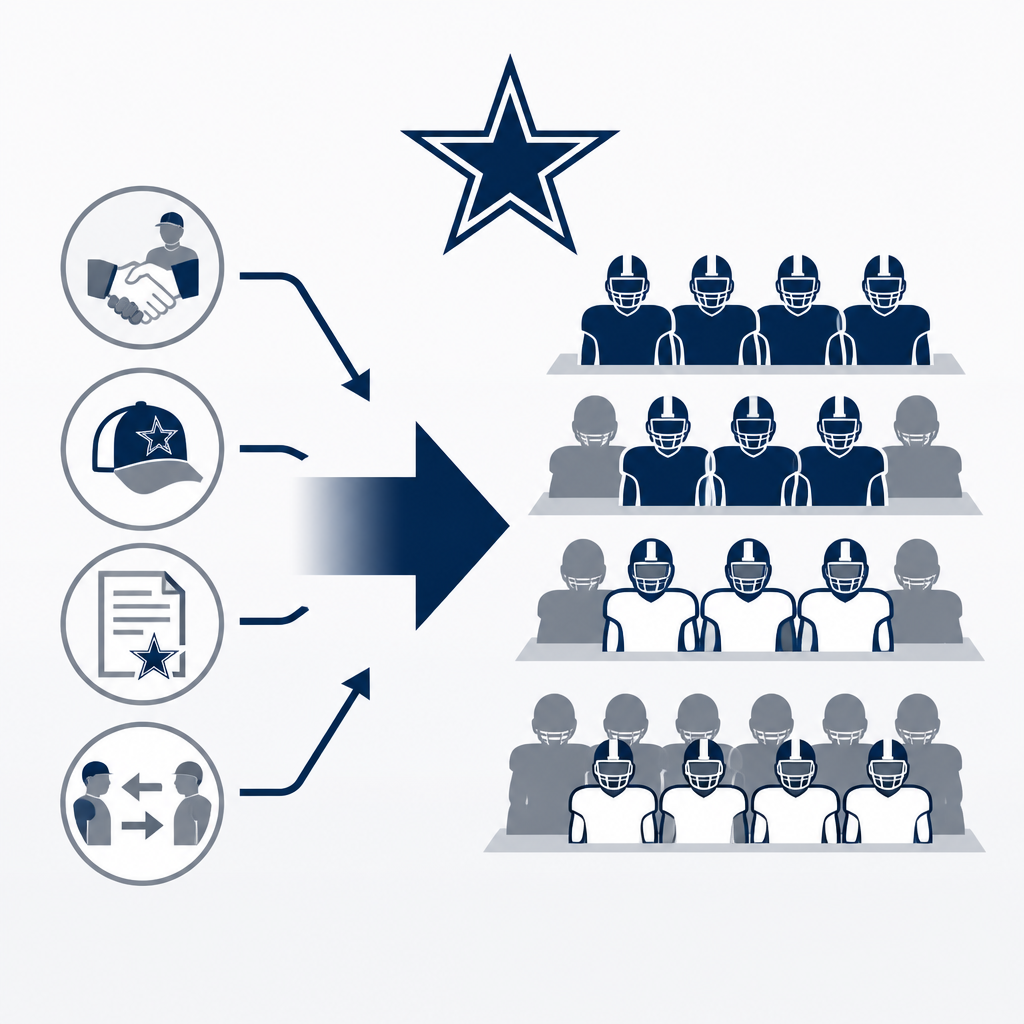
The biggest shift is philosophical. In past offseasons, Dallas often treated outside additions like low-cost bets. The article points to names such as Jack Sanborn and Kaiir Elam as examples of the kind of swing the team used to take: cheap, uncertain, and easy to cut if the fit never clicked.
This spring looked different. The Cowboys went after players with real NFL starting experience instead of hoping a reclamation story would solve a depth problem. That is a more expensive way to build a roster, but it also gives the coaching staff more usable answers when injuries hit in October or November.
- More veterans who can play meaningful snaps right away
- Less dependence on one-off success stories
- Better insurance when starters miss time
The draft class also blocks the path
Dallas did not stop at free agency and trades. The draft class itself makes the roster picture tighter. With six of seven rookies taken in the first four rounds, the Cowboys have already invested enough draft capital to make those players hard to cut. That is especially true in a team that has kept 89% of its drafted rookies over the last decade.
That retention habit matters because it creates a built-in bias toward keeping young players, even when a veteran might be more ready on day one. The result is a camp where good players can lose jobs simply because the roster math no longer works in their favor.
“It is a survival mechanism.” — Dan Rogers, Blogging The Boys
Rogers’ line gets to the heart of the article. Depth is not about making preseason feel more interesting. It is about surviving the season when the injuries start stacking up and the schedule gets ugly.
The names pushing for jobs are better than usual
The article highlights a deeper group than Dallas has typically carried into August. Players such as Rashan Gary, Jalen Thompson, and Dee Winters look like clear roster locks, while Cobie Durant and Otito Ogbannia could take on meaningful rotational work.
Even the lower end of the depth chart looks more functional than it has in recent years. That is where players like P.J. Locke, Jonathan Bullard, Matt Hennessy, and Sam Howell matter. A roster gets tested by the ninth and tenth names on the list, not by the stars.
- Some additions look like starters
- Others look like real rotational pieces
- Even fringe names project as competent backups
Why this matters when the schedule gets ugly
The article notes that Dallas has not just improved depth for its own sake. It has done it because the 2026 schedule includes difficult stretches that will force the team to use that depth early. That is where the difference between a cheap flyer and a proven veteran becomes obvious.
In recent seasons, the Cowboys leaned too hard on a top-heavy roster. When injuries hit, the drop-off underneath the stars was too steep. This year, the front office seems to have fixed that specific flaw, even if the team still has to prove it can turn better depth into wins.
That is the real question now: does this roster merely look better on paper, or does it hold together when the season starts taking hits? If Dallas keeps most of these additions through cutdown day, the answer will tell us a lot about how serious this front office is about building for November, not just September.
For readers following the roster battle, the next useful checkpoint is training camp. That is when the new depth stops being a theory and starts becoming a list of real decisions.
// Related Articles
- [IND]
Korea’s Nvidia talks point to an AI factory push
- [IND]
OpenAI should not rush its IPO just to win the AI race
- [IND]
OpenAI updates its Europe privacy policy
- [IND]
OpenAI is right to keep ads out of sensitive chats
- [IND]
AI bootlegs are already draining streaming royalties
- [IND]
AMD and Microsoft push Windows ML on GPU and NPU