ESPN’s playoff bracket turns NBA chaos into a tracker
I break down ESPN’s 2026 NBA playoffs page and turn it into a copyable bracket tracker template.
I break down ESPN’s 2026 NBA playoffs page into a copyable bracket tracker template.
I’ve been using ESPN’s playoff pages for years, and they always do the same thing: they cram a ton of signal into one giant wall of scores, dates, and links, then make me work way harder than I should to answer a simple question like, “who’s still alive?” or “when is Game 4?” This 2026 NBA playoffs page is better than most, but it still feels like a browser tab I keep open out of obligation, not because it’s pleasant. The bracket is there, the scores are there, the TV info is there, and somehow I still end up scanning the page three times because the important stuff is buried under the noise.
What finally clicked for me is that ESPN isn’t really trying to be elegant here. It’s trying to be the single source of truth for a live postseason. That means the page is basically a data container with a little editorial frosting on top. Once I stopped treating it like a story and started treating it like a workflow, the whole thing got easier to use. I can pull the bracket, track series state, and keep a clean view of what matters without babysitting the page like it’s a dashboard from 2014.
For the source anchor, I’m working from ESPN’s own playoff hub: 2026 NBA playoffs: Schedule, scores, news and highlights. ESPN staff published the page on May 21, 2026, and the piece is explicitly built as a live bracket-and-schedule reference, not a narrative recap.
ESPN’s real product here is not the article, it’s the bracket state
Get the latest AI news in your inbox
Weekly picks of model releases, tools, and deep dives — no spam, unsubscribe anytime.
No spam. Unsubscribe at any time.
“Here’s what we know about the Eastern and Western Conference playoff brackets.”
What this actually means is that the page is organized around current state, not around prose. ESPN gives you the bracket first, then the series results, then the upcoming games. That’s the order I want when I’m checking a playoff page in the middle of a workday. I don’t want a long intro before I get to the thing I’m looking for.
I ran into this same problem when I built internal sports dashboards for a client project. If the current state isn’t visible in the first screenful, people stop trusting the page and start asking Slack for updates. ESPN avoids that by putting the bracket front and center, even if the page is still busy as hell.
How to apply it: if you’re making any live status page, lead with the state object. Put the current bracket, current score, current deployment phase, current incident status, or current sprint milestone at the top. Everything else can come later.
- Show the current winners and losers first.
- Separate completed rounds from active rounds.
- Keep the “next game” or “next action” visible without scrolling.
Series records matter more than single scores
“All four rounds of the playoffs are best-of-seven, and teams are not reseeded after each round.”
What this actually means is that one score line is never the whole story. The series record tells me whether a team is in control, hanging on, or already cooked. ESPN knows this, so it pairs each matchup with the series result: 2-0, 1-1, 4-0, 4-3. That tiny bit of context does a lot of work.
I’ve made the mistake of tracking live events with only the latest update. It feels fine for about five minutes, then you realize you’ve got no memory of the path that got you there. In a playoff bracket, that’s useless. In engineering, it’s the same mistake as showing only the latest build result without the history of what passed, what regressed, and what got rolled back.
How to apply it: track a stateful summary alongside every event stream. If you’re building a bracket, show series count. If you’re building CI visibility, show branch health over time. If you’re tracking customer onboarding, show stage completion, not just the last action.
- One event is an update.
- A sequence of events is a narrative.
- A state summary is what people actually need to act.
Home-court formatting is just a data model in disguise
“The team with the better regular-season record in each series will have home-court advantage for that series.”
What this actually means is that the page is encoding priority and venue into the bracket itself. ESPN’s 2-2-1-1-1 format is not just trivia. It’s a scheduling rule that determines where the action happens and when the pressure shifts. You can read the bracket and know who gets the early edge, who gets the swing games, and who has to survive on the road.
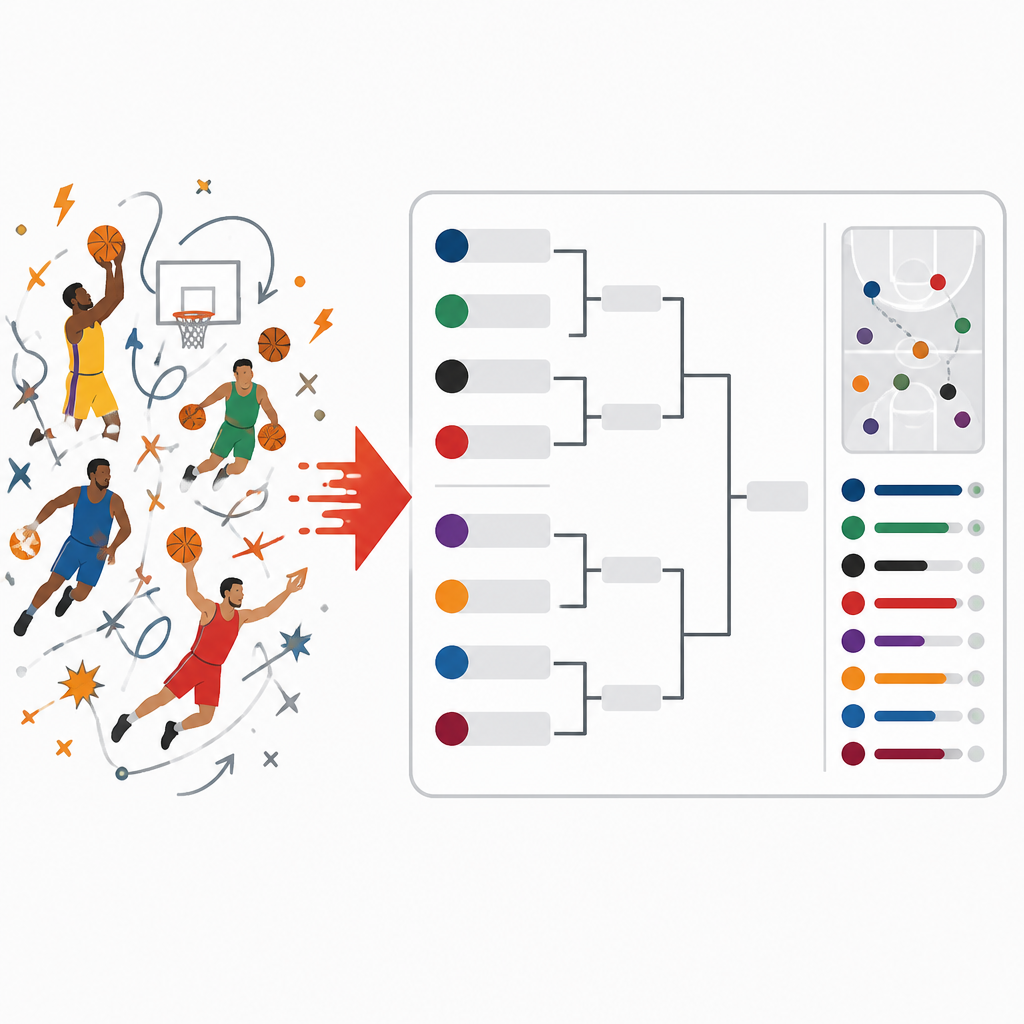
I like this because it’s a reminder that formatting can carry meaning. I’ve seen too many internal tools throw every field into a table and call it done. But if venue, priority, or ownership matters, it should be visible in the shape of the data, not buried in a tooltip.
How to apply it: when you design a tracker, bake the rules into the display. Use ordering, labels, and grouping to show advantage, ownership, or dependency. Don’t make users infer it from a footnote.
For example, in project management:
- Show the owner next to the task, not on a separate page.
- Show the deadline in the same row as status.
- Group blockers above non-blockers if urgency matters.
ESPN’s page works because it mixes live and archived states
“Conference semifinals,” “first round,” and “play-in tournament” all sit together on the same page.
What this actually means is that ESPN is not forcing me to jump between separate pages for current series, completed series, and qualifying rounds. That’s smart. A playoff run isn’t just the present tense. It’s a chain of results, and the page preserves that chain.
I’ve felt the pain of splitting live and historical views too aggressively. Users lose context. They can’t tell whether a team advanced through a sweep or a seven-game grind. They also can’t see the path from the play-in to the conference finals without clicking around like they’re hunting for receipts.
How to apply it: keep the current state visible, but don’t delete the path that led there. If you’re building a content system, store both the active record and the completed history. If you’re building a product dashboard, let people see the last few transitions without leaving the page.
This is especially useful when the audience has two jobs to do at once:
- Check what’s happening now.
- Understand how the current state came to be.
The news links are the editorial layer, not the main event
“Sam Presti bet on fit over flash to turn the Thunder into champions” and “Victor Wembanyama is shattering the NBA's age curve.”
What this actually means is that ESPN uses the bracket page as the anchor and the surrounding stories as context. The news items are not competing with the scoreboard. They’re there to explain why the scoreboard matters. That’s a much better pattern than dumping opinion and updates into the same visual bucket.
I like this separation because it respects intent. Sometimes I want the score. Sometimes I want the story behind the score. ESPN gives me both, but it doesn’t pretend they’re the same thing. That’s the part a lot of product teams miss when they try to blend analytics, alerts, and commentary into one messy feed.
How to apply it: split your content into layers. Put the canonical data at the top, then add analysis, then add related reading. Don’t let editorial content bury the operational truth.
If you’re building something similar, I’d keep the layers like this:
- Layer 1: current state and next action.
- Layer 2: recent results and completed history.
- Layer 3: commentary, notes, and related stories.
The schedule section is the part people actually bookmark
“Game 3: May 23 at Cleveland (8:00 p.m. ET, ABC)”
What this actually means is that the schedule is the most actionable part of the whole page. Brackets are nice, but the schedule tells me what to watch, when to check back, and which games matter next. ESPN knows this, so every active series gets a tight list of dates, times, and broadcast info.
I’ve always found that people say they want a summary, but what they really need is a calendar. Once the series is underway, the next game becomes the only thing anyone cares about. If your page doesn’t answer “when is the next thing?” quickly, it’s not doing its job.
How to apply it: make your tracker future-facing. Show the next deadline, next game, next deployment, next release, or next meeting in the clearest possible format. And if there’s a channel, time zone, or broadcast equivalent, put that right beside it.
My rule of thumb:
- Current state first.
- Next action second.
- Historical context third.
The template you can copy
## Live bracket tracker template

### Current state
- Round: [conference finals | semifinals | first round | play-in]
- Active series:
  - [Team A] vs. [Team B] — [A leads 2-1 | tied 1-1 | B wins 4-0]
  - [Team C] vs. [Team D] — [status]
- Next game: [Game number], [date], [time], [venue], [network]

### Bracket view
#### Eastern Conference
1. [Seed] [Team] vs. [Seed] [Team]
2. [Seed] [Team] vs. [Seed] [Team]
3. [Seed] [Team] vs. [Seed] [Team]
4. [Seed] [Team] vs. [Seed] [Team]

#### Western Conference
1. [Seed] [Team] vs. [Seed] [Team]
2. [Seed] [Team] vs. [Seed] [Team]
3. [Seed] [Team] vs. [Seed] [Team]
4. [Seed] [Team] vs. [Seed] [Team]

### Series detail format
- [Team A] vs. [Team B] — [series record]
  - Game 1: [result]
  - Game 2: [result]
  - Game 3: [date, location, network]
  - Game 4: [date, location, network]
  - Game 5 (if necessary): [date, location, network]
  - Game 6 (if necessary): [date, location, network]
  - Game 7 (if necessary): [date, location, network]

### Rules block
- Best-of-seven series
- No reseeding after each round
- Better regular-season record gets home-court advantage
- 2-2-1-1-1 format

### Context links
- Latest analysis: [link]
- Injury report: [link]
- Game recap: [link]
- Full bracket: [link]

### Copy-paste note
Use this structure for any live event page where people need:
1. The current state
2. The next action
3. The path that led here
4. A clean way to jump into deeper analysis
I built this template to match the part of ESPN’s page that actually works: state first, schedule second, context third. If you’re turning a live event into a page, dashboard, or internal doc, this layout keeps the important stuff from getting buried.
Original source: ESPN’s 2026 NBA playoffs hub. My breakdown and template are original, but they’re derived from the structure and information on that page, not from any separate ESPN API or unpublished data.
// Related Articles
- [IND]
Gemini lands inside Apple’s developer stack
- [IND]
Five AI coding IDEs that fit real workflows
- [IND]
Devin Desktop turns Windsurf into an agent hub
- [IND]
Korea’s Nvidia talks point to an AI factory push
- [IND]
OpenAI should not rush its IPO just to win the AI race
- [IND]
OpenAI updates its Europe privacy policy