MARLIN tackles greener LLM inference in datacenters
MARLIN uses multi-agent game-theoretic RL to make cloud LLM inference more sustainable.

MARLIN uses multi-agent game-theoretic RL to make cloud LLM inference more sustainable.
- Research org: Unspecified in arXiv abstract
- Core data: No benchmark numbers in abstract
- Breakthrough: Multi-agent game-theoretic reinforcement learning for LLM inference
Large language models are now a normal part of cloud services, and that creates a very practical systems problem: how do you keep inference running efficiently without wasting compute? This paper, MARLIN: Multi-Agent Game-Theoretic Reinforcement Learning for Sustainable LLM Inference in Cloud Datacenters, proposes a control approach aimed at making that infrastructure more sustainable.
The important angle for engineers is not just that the paper cares about sustainability. It is that the authors frame LLM serving as a coordination problem inside a datacenter, where different agents can use reinforcement learning while accounting for game-theoretic interactions. That suggests the paper is trying to move beyond static policies or isolated optimizers and toward a system that adapts to changing load and resource pressure.
What problem MARLIN is trying to fix
Get the latest AI news in your inbox
Weekly picks of model releases, tools, and deep dives — no spam, unsubscribe anytime.
No spam. Unsubscribe at any time.
The abstract says LLMs have become increasingly prevalent in cloud-based platforms, driven by AI consumer and enterprise services. That means inference is no longer a niche workload. It is part of the core cloud stack, and it competes with other services for GPU time, memory, power, and scheduling attention.
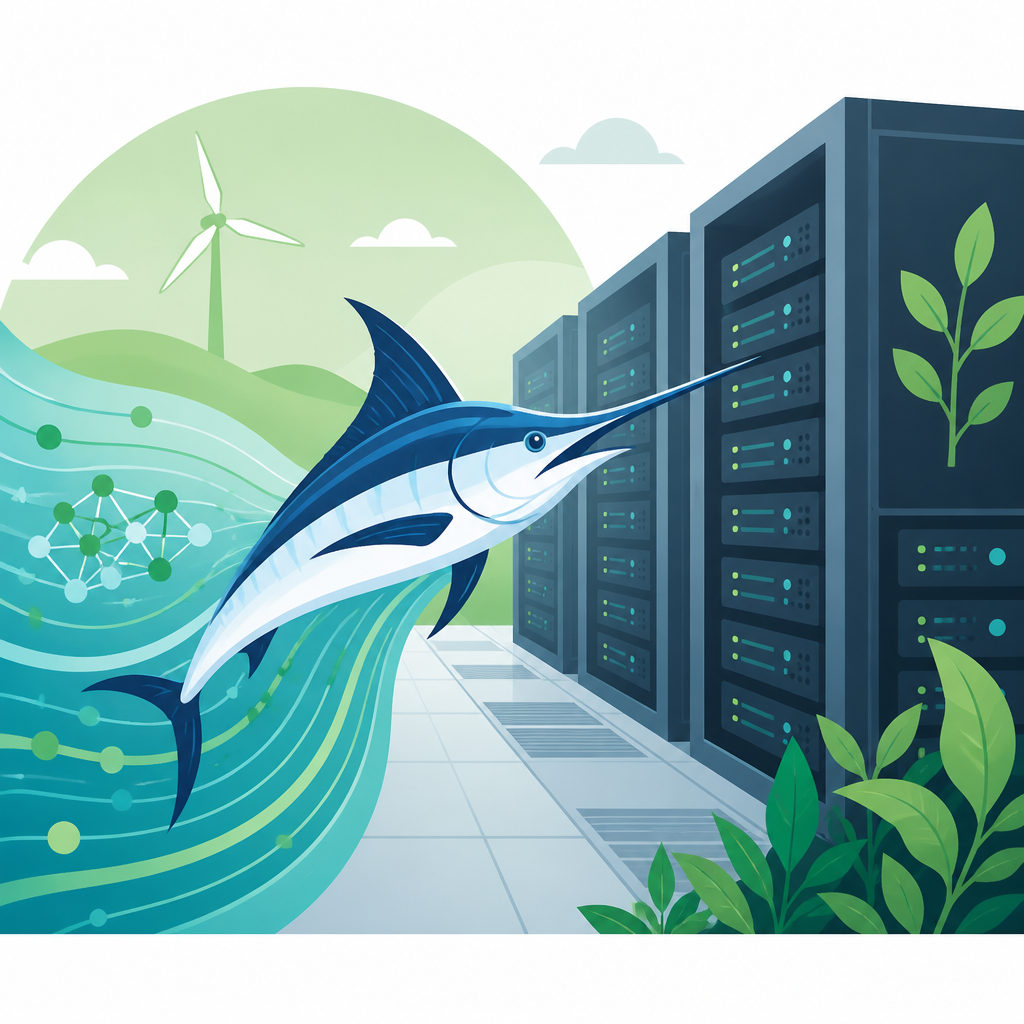
In practice, that creates a tension between serving quality and sustainability. If you overprovision, you waste energy and infrastructure capacity. If you underprovision, you risk latency spikes, unstable throughput, or poor user experience. The paper is positioned around that tradeoff, but the abstract does not spell out the exact system metrics it optimizes or the deployment setup it uses.
What is clear is that the authors see the datacenter as a multi-actor environment, not a single-controller optimization problem. That matters because cloud inference usually involves multiple components making decisions at once: request routing, resource allocation, scheduling, and possibly policy adjustments under changing demand.
How the method works in plain English
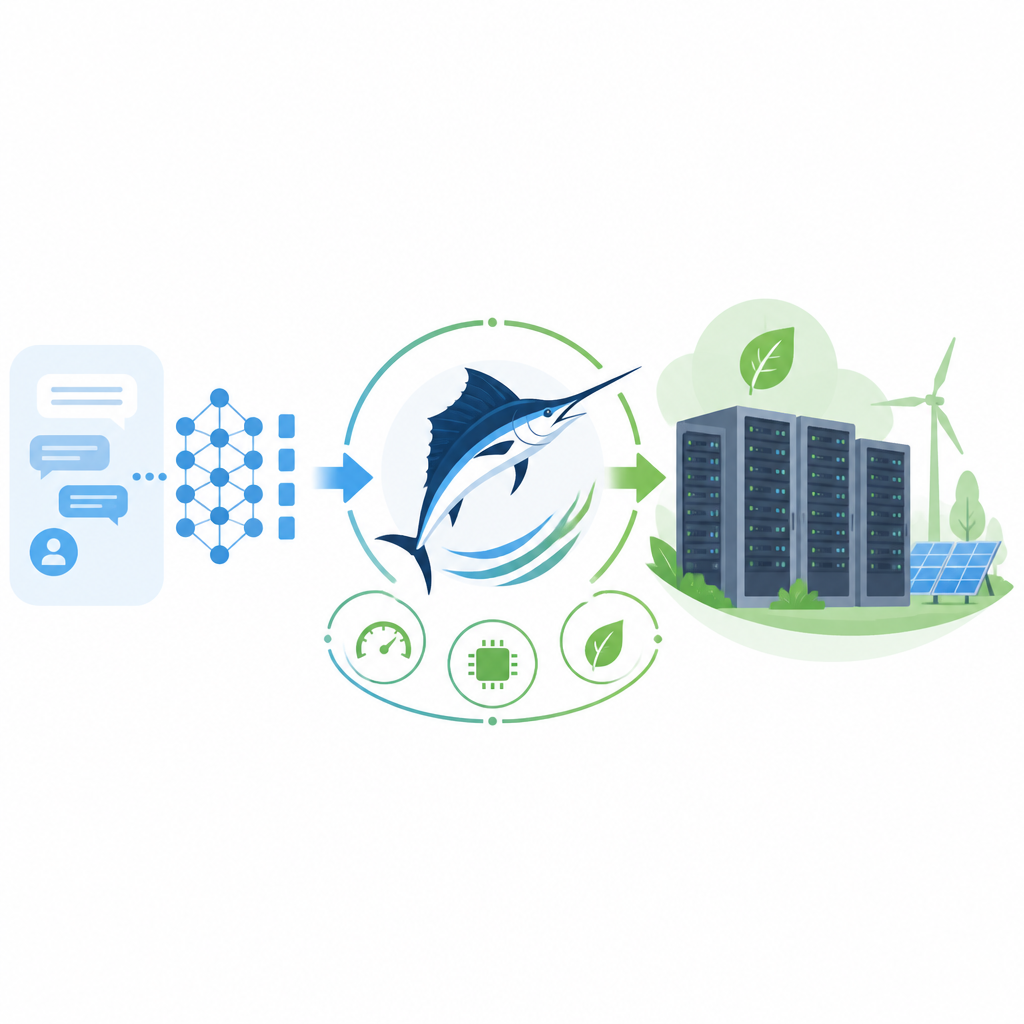
MARLIN stands for Multi-Agent Game-Theoretic Reinforcement Learning. That combination tells you a lot about the design, even from the abstract alone. Reinforcement learning means the system learns by interacting with an environment and improving decisions based on feedback. Multi-agent means more than one decision-maker is involved. Game-theoretic means those decision-makers are modeled as interacting strategically rather than independently.
In plain English, the paper is treating sustainable LLM inference like a coordination game inside the datacenter. Each agent likely represents some part of the system or some policy surface, and each agent learns actions that affect shared outcomes. The game-theoretic layer is there to handle the fact that one agent’s choice can change the rewards or constraints seen by another.
That is a useful framing for cloud systems because real datacenters are full of coupled decisions. A local optimization can look good in isolation and still hurt the global system. A multi-agent approach is meant to reduce that mismatch by making the learning process aware of interaction effects.
The abstract does not provide implementation specifics such as the state representation, reward function, number of agents, or whether the system is trained offline, online, or in simulation. So the safe reading is that MARLIN proposes a control framework, but the source text available here does not expose the full algorithmic detail.
What the paper actually shows
Here is the honest version: the abstract fragment provided does not include benchmark numbers, comparison tables, or explicit performance claims. There are no reported percentage gains, latency reductions, energy savings, or throughput figures in the source material we have.
That means we cannot say from the abstract alone whether MARLIN outperforms a baseline by a specific margin, or on what workloads it was evaluated. If the full paper contains experiments, those details are not present in the raw note supplied here.
Still, the paper’s contribution is easy to understand at a systems level. It reframes sustainable inference as a learning-and-coordination problem rather than a fixed policy problem. That is a meaningful move for anyone building LLM serving infrastructure, because cloud traffic and resource conditions are rarely static.
Why developers should care
If you work on inference platforms, the core lesson is that sustainability is becoming a first-class systems concern, not an afterthought. LLM serving can be expensive in both compute and energy, and those costs compound when demand is variable or when multiple services share the same datacenter resources.
A multi-agent RL approach could, in principle, help operators adapt policies dynamically instead of relying on hand-tuned thresholds. That is attractive in environments where load changes quickly and where local decisions interact in non-obvious ways. Even if MARLIN is still a research proposal, the framing is relevant to anyone designing schedulers, autoscalers, or resource managers for model serving.
The main limitation, based on the abstract alone, is that we do not know how practical the method is to deploy. Multi-agent RL can be powerful, but it can also be hard to stabilize, hard to debug, and sensitive to reward design. The abstract does not tell us how MARLIN avoids those common failure modes.
Open questions the abstract leaves unanswered
- What exactly are the agents controlling in the datacenter stack?
- What sustainability metric is being optimized: energy, carbon, utilization, or something else?
- How does MARLIN compare with simpler heuristics or non-RL baselines?
- Does the method require online training, or can it be deployed from a pre-trained policy?
Those are the questions practitioners should ask before treating the idea as production-ready. The paper’s title suggests a serious attempt to connect reinforcement learning, game theory, and cloud inference operations, but the abstract alone does not give enough evidence to judge maturity.
Even so, the direction is important. As LLMs keep moving deeper into cloud infrastructure, the challenge is no longer just serving tokens quickly. It is serving them in a way that fits power, capacity, and operational constraints. MARLIN is trying to make that problem learnable.
// Related Articles
- [RSCH]
How VLMs Learned Complex Scene Descriptions
- [RSCH]
Visual Pretraining Beats Text-Only in Language Models
- [RSCH]
PHINN-EEG brings topology to dream-state EEG
- [RSCH]
Google’s Android Bench update exposes Gemini’s gap
- [RSCH]
Benchmarks should not pick your LLM in 2026
- [RSCH]
Rust Breaks Into TIOBE’s Top 10