Weak Rewards for Persistent LLM User Models
This paper explores using weak rewards from retrieval-augmented interaction to model user preferences in chat agents.

This paper explores using weak rewards from retrieval-augmented interaction to model user preferences in chat agents.
- Research org: Unspecified in arXiv abstract
- Core data: No benchmark numbers in abstract
- Breakthrough: Weak rewards from retrieval-augmented interaction for preference modeling
Personal assistants built on large language models are useful, but they still have a basic memory problem: they often do not keep a persistent model of what a user likes. That means people end up repeating the same preferences across sessions, which is annoying for users and a real product gap for anyone building conversational systems.
This paper looks at a practical way to fix that gap without pretending the assistant has perfect supervision. Instead of requiring a clean, fully labeled preference dataset, it uses weak rewards extracted from retrieval-augmented interaction to help build a user preference model. For engineers, the interesting part is not just the idea of remembering preferences, but the training signal: if the signal can be collected from normal interaction patterns, it may be easier to scale than manual feedback pipelines.
What problem this paper is trying to fix
Get the latest AI news in your inbox
Weekly picks of model releases, tools, and deep dives — no spam, unsubscribe anytime.
No spam. Unsubscribe at any time.
The abstract frames the core issue clearly: LLMs are increasingly used as personal assistants, but most of them do not maintain a persistent user model. In practice, that means the system may answer a question well in the moment, but it does not reliably carry forward things like style preferences, recurring constraints, or user-specific habits into later conversations.

For developers, this is a product and infrastructure issue, not just a model-quality issue. A chat assistant that forgets preferences forces users to re-explain themselves, which breaks the illusion of continuity. It also creates extra friction for long-running workflows, where the value of the assistant comes from adapting over time rather than treating each prompt as isolated.
The paper’s framing suggests that the authors are targeting preference modeling as a way to make assistants more personal across sessions. That is a narrower and more actionable goal than “make the model smarter” in general. If you can represent user preferences explicitly, you can potentially use that state to shape retrieval, ranking, response selection, or future dialogue behavior.
How the method works in plain English
The key technical idea in the abstract is weak rewards from retrieval-augmented interaction. That phrase matters because it suggests the system does not rely on a strong labeled reward signal. Instead, it tries to infer preference-related feedback from interactions where retrieval is part of the loop.
In plain terms, retrieval-augmented interaction means the assistant is not just generating text from memory; it is also pulling in relevant information from some external source during the conversation. The paper appears to use those interactions as a place to observe user behavior and derive weaker training signals about what the user prefers. The abstract does not spell out the full pipeline, so it is best to be careful here: we know the method uses weak rewards and retrieval-augmented interaction, but not the exact reward construction, labeling scheme, or model architecture from the raw abstract alone.
That said, the direction is sensible. If a system can observe which retrieved options get accepted, ignored, refined, or rejected, those interaction patterns can become noisy but useful preference signals. For conversational agents, that is often more realistic than asking users to fill out preference forms or manually rate every response.
What the paper actually shows
The source material available here does not include benchmark numbers, dataset names, or evaluation metrics in the abstract excerpt. So there is no honest way to claim accuracy gains, preference prediction scores, or latency improvements from the raw note alone.
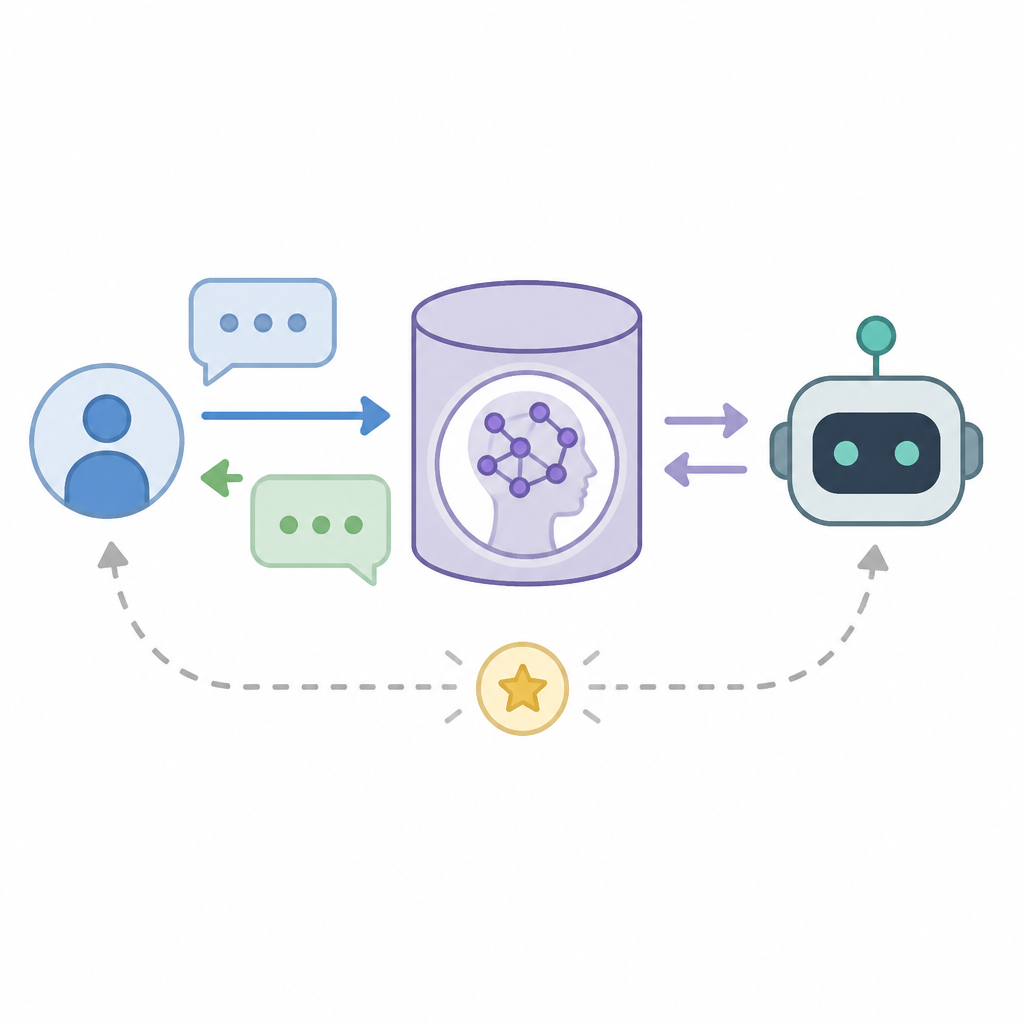
What the abstract does establish is the problem setting and the training direction: persistent user modeling for conversational LLM agents, using weak rewards derived from retrieval-augmented interaction. That is enough to understand the contribution at a high level, but not enough to assess how much it outperforms a baseline or whether it generalizes across domains.
For readers used to scanning papers for hard numbers, that absence matters. It means the abstract, as provided, is more of a problem-and-method statement than a results summary. Any real judgment about the paper’s effectiveness would require the full paper, especially the experiments section.
Why engineers should care
If you build assistants, copilots, or any conversational product with repeat users, preference persistence is one of the highest-leverage features you can add. It affects user trust, reduces repetitive prompting, and makes the system feel more adaptive without requiring a full agent architecture overhaul.
The weak-reward angle is also important from an implementation standpoint. Strong supervision is expensive. If you can learn user preferences from ordinary retrieval-augmented interactions, you may be able to bootstrap personalization from the product’s natural usage stream instead of inventing a separate labeling workflow.
That could matter for teams trying to ship personalization under practical constraints: limited annotation budgets, noisy user feedback, and the need to keep the assistant responsive. A weak-signal approach is not magic, but it is often the kind of compromise that makes a research idea deployable.
Limitations and open questions
The biggest limitation here is simple: the abstract does not provide enough detail to evaluate the method rigorously. We do not know what the weak rewards look like, how retrieval is integrated, what tasks were used, or whether the model was tested across multiple user types and conversation styles.
There is also a broader systems question. Persistent user models can improve personalization, but they can also introduce stale assumptions if the system overcommits to old preferences. The abstract does not address how the model handles preference drift, conflicts between short-term and long-term signals, or user control over stored preferences.
Another open question is reliability. Weak rewards are attractive because they are scalable, but they can also be noisy and biased by retrieval quality. If the retrieval layer surfaces the wrong context, the preference signal may be distorted. That makes the quality of the retrieval pipeline a first-class concern, not just a supporting detail.
Bottom line
This paper is about making conversational LLMs remember what users prefer, using weak rewards gathered through retrieval-augmented interaction. The concrete promise is a more persistent user model; the concrete limitation is that the abstract, as provided, does not include benchmark results or enough implementation detail to judge performance.
For developers, the value is in the framing: personalization does not have to wait for perfect labels. If the method holds up in the full paper, it points toward assistants that learn from ordinary use instead of forcing users to keep repeating themselves.
- Persistent user modeling is the core product problem this paper targets.
- Weak rewards are the key technical bet, especially when labels are scarce.
- Retrieval-augmented interaction is the mechanism that may expose usable preference signals.
// Related Articles
- [RSCH]
How VLMs Learned Complex Scene Descriptions
- [RSCH]
Visual Pretraining Beats Text-Only in Language Models
- [RSCH]
PHINN-EEG brings topology to dream-state EEG
- [RSCH]
Google’s Android Bench update exposes Gemini’s gap
- [RSCH]
Benchmarks should not pick your LLM in 2026
- [RSCH]
Rust Breaks Into TIOBE’s Top 10