OpenAI’s US privacy policy, explained
OpenAI’s US privacy policy explains what data it collects, how it uses it, and how users can control access across its services.

OpenAI’s US privacy policy explains what data it collects and how it uses it.
OpenAI has published a US privacy policy that spells out how it handles personal data across its website, apps, and services. The document is short on drama and long on intent: it says the company is committed to respecting privacy and keeping information secure, while also making clear that data collection is part of how its products work.
That matters because privacy policies are where product promises meet operational reality. If you use ChatGPT, browse OpenAI’s site, or interact with one of its apps, this policy is the legal map for what gets collected and how it can be used.
| Policy element | What OpenAI says | Why it matters |
|---|---|---|
| Scope | Website, applications, and services | Coverage extends across the full product stack |
| Data type | Personal data collected from or about users | Includes direct and indirect collection |
| Purpose | Use of data when you use the services | Signals that product activity drives processing |
What the policy actually says
Get the latest AI news in your inbox
Weekly picks of model releases, tools, and deep dives — no spam, unsubscribe anytime.
No spam. Unsubscribe at any time.
The policy opens with two plain claims: OpenAI respects privacy, and it keeps information secure. It then defines the scope in broad terms, covering personal data collected from or about users across its website, applications, and services.

That wording is important. “From or about you” usually means a privacy policy is not limited to what you type into a form. It can include data generated during use, metadata, device details, and other signals tied to your activity.
OpenAI also uses the policy to set expectations for how the company handles that information once it enters its systems. The policy does not frame data collection as an accident or side effect; it presents it as part of operating the service.
- It covers multiple product surfaces, not a single app.
- It applies to personal data collected directly and indirectly.
- It links data use to normal service operation.
Why this matters for users
For most people, privacy policies are easy to ignore until something changes. This one is worth reading because OpenAI products sit at the center of everyday work for a lot of users, from drafting emails to coding, research, and customer support.
If a service processes your prompts, account information, or usage data, the privacy policy tells you what category of information may be involved. It also gives you a baseline for comparing the company’s public privacy language with its product settings, enterprise terms, and user controls.
“Privacy is not an option, and it shouldn’t be the price we accept for just getting on the Internet.” — Gary Kovacs
That quote still fits this conversation because modern AI tools collect more context than older software did. The tradeoff is simple: the more useful the service, the more carefully users should read the rules around data handling.
How OpenAI’s policy compares with common practice
OpenAI’s wording is broadly in line with what major software companies publish, but the stakes feel higher because generative AI products can process long, sensitive, and highly specific inputs. A privacy policy for a chatbot is no longer a generic site notice; it is part of the product’s trust layer.
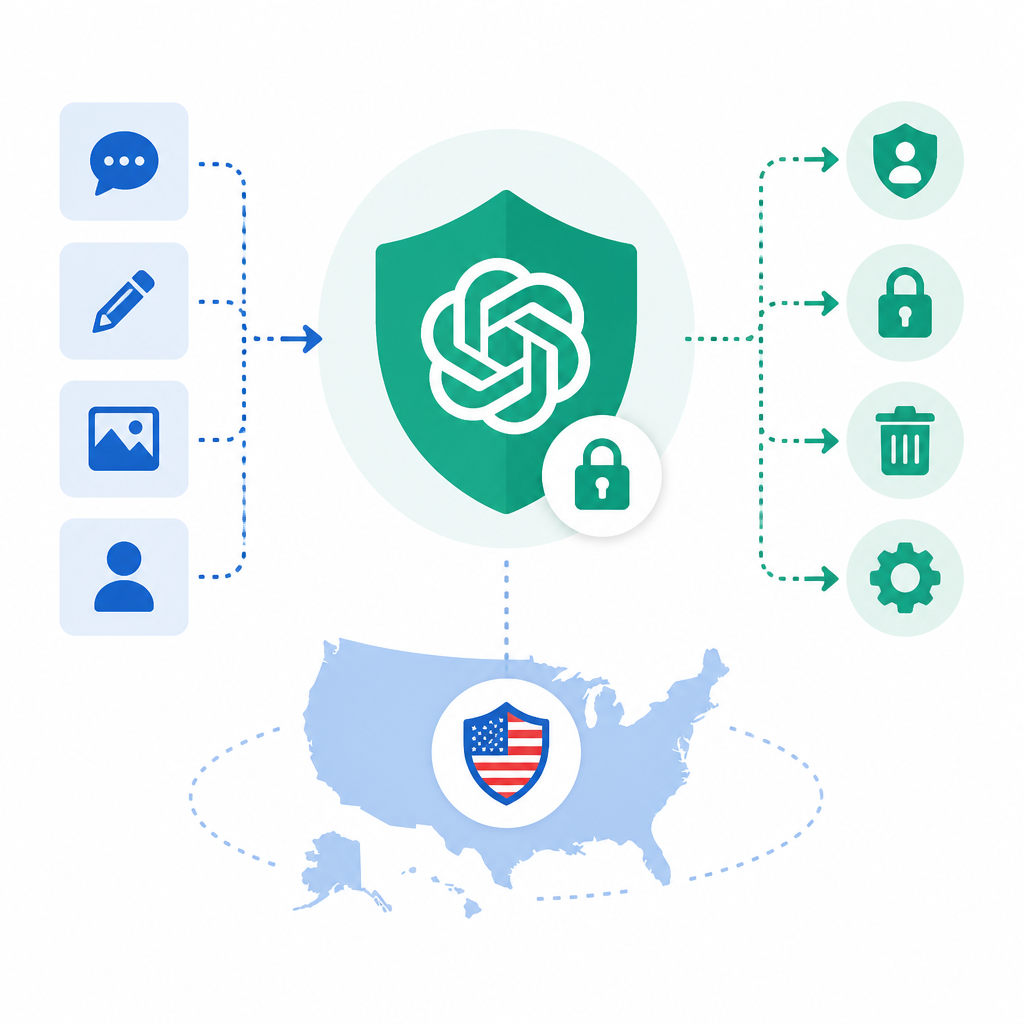
Compared with a static website or a basic mobile app, AI services often collect more context to improve responses, maintain sessions, and support abuse detection. That means the policy has to cover more than account creation and billing.
- Apple’s privacy policy focuses heavily on device and service data tied to its ecosystem.
- Google’s privacy policy spans ads, search, cloud tools, and account activity.
- Microsoft’s privacy statement covers consumer and enterprise services across a large product set.
- OpenAI’s policy hub groups privacy and other legal documents in one place.
The practical difference for users is not just legal language. It is how much control you get in settings, how long data sticks around, and whether business or consumer use cases are treated differently.
The real takeaway for developers and teams
If you are building with OpenAI tools, the privacy policy should be part of your implementation checklist, not an afterthought. Teams that send user content into AI systems need to know what data they are collecting, what they are sending upstream, and what their own obligations are under local privacy laws.
For developers, the smart move is to pair policy reading with product configuration. Check account settings, review enterprise terms if you are using a business plan, and limit the data you send when a workflow does not need it. If your app handles customer information, add your own disclosure layer instead of assuming the vendor policy covers everything.
OpenAI’s US privacy policy is short, but it sets the frame for a much bigger question: how much context should an AI service need to be useful, and how much should users be expected to hand over? The next useful step is simple — read the policy, check the settings, and decide whether your team’s current usage matches your risk tolerance.
// Related Articles
- [IND]
Korea’s Nvidia talks point to an AI factory push
- [IND]
OpenAI should not rush its IPO just to win the AI race
- [IND]
OpenAI updates its Europe privacy policy
- [IND]
OpenAI is right to keep ads out of sensitive chats
- [IND]
AI bootlegs are already draining streaming royalties
- [IND]
AMD and Microsoft push Windows ML on GPU and NPU