Spotify vs AI Music Slop: What Changes?
Spotify’s AI remix push trades open-ended fan creation for a licensed, paid, and controlled system.
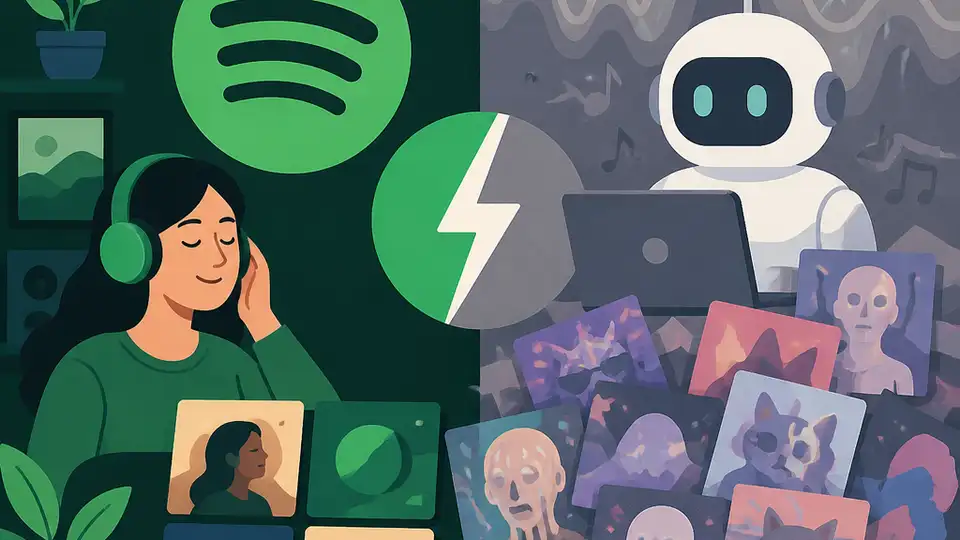
Spotify’s AI remix push trades open-ended fan creation for a licensed, paid, and controlled system.
Spotify’s new AI remix feature sits at the center of a bigger choice: licensed AI music inside a major streaming app, or the messier world of unregulated AI tracks and piracy. This comparison helps listeners, artists, and rights holders decide whether Spotify’s controlled model is a useful middle ground or a new threat to human-made music.
At a glance
Get the latest AI news in your inbox
Weekly picks of model releases, tools, and deep dives — no spam, unsubscribe anytime.
No spam. Unsubscribe at any time.
| Dimension | Spotify AI remix tool | Unregulated AI music | Human-made music only |
|---|---|---|---|
| Access | Premium users; extra paid feature | Often free or low-cost on open tools | Available through normal streaming and purchases |
| Rights model | Consent-based with participating artists and Universal Music Group | No clear consent or licensing in many cases | Traditional copyright and label licensing |
| Scale risk | Spotify says one song could become 10,000 remixes | Unlimited generation, easier to flood platforms | Limited by human production speed |
| Market signal | Spotify shares rose 16% after the deal | No direct rights-holder upside | Stable, but less platform growth upside |
| Discovery quality | Potentially curated, but labeling rules are unclear | High risk of spam and indistinguishable uploads | Easier to trust authorship, but less interactive |
| Artist upside | Possible revenue from approved uses | Usually no compensation | Direct royalties and fan support |
Spotify AI remix tool
Spotify’s pitch is not that AI music is harmless, but that it is better when it is licensed, paid, and bounded by rules. The company says artists can consent to use of their work and earn money from it, which makes the feature look more like a rights-managed product than a free-for-all generator.
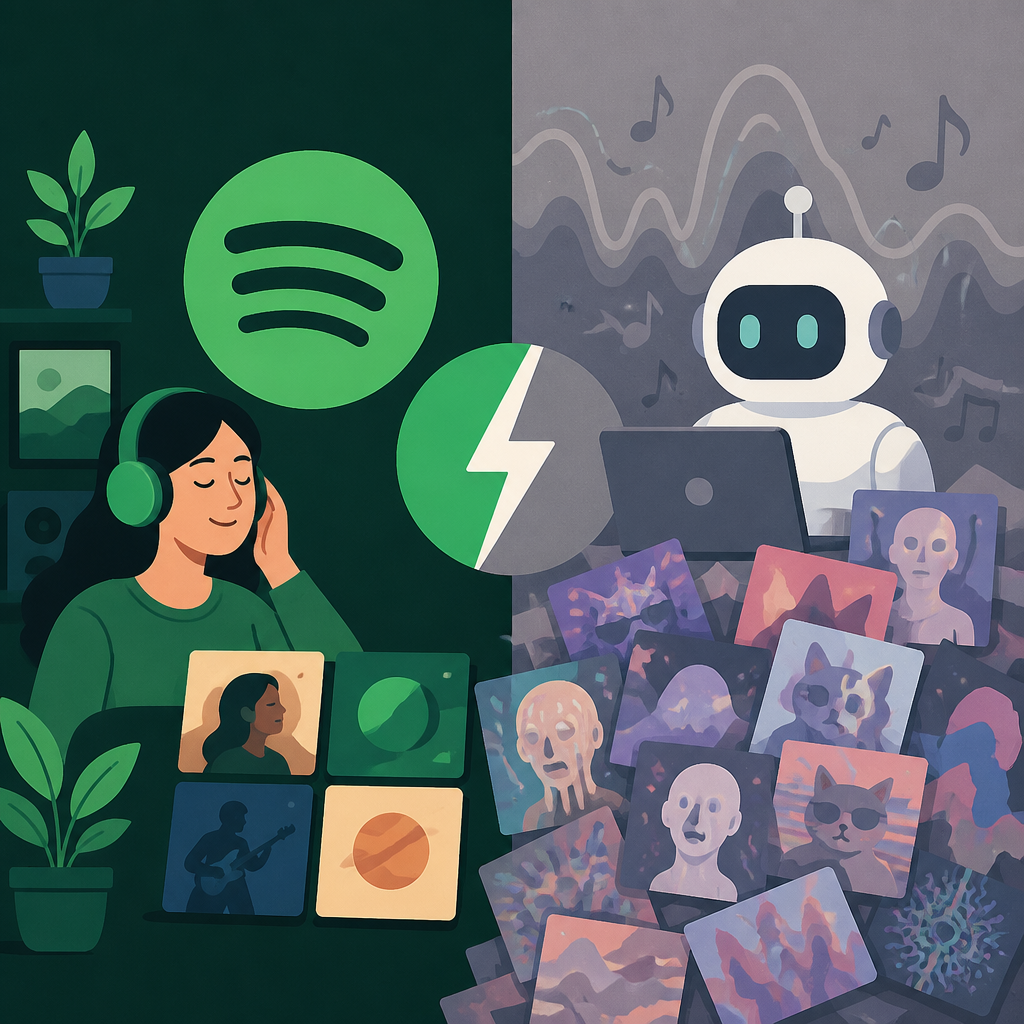
The catch is that the real user experience is still vague. Spotify has not said whether remixes will be shareable, private, or clearly labeled, and those details matter because they determine whether the feature stays a niche premium add-on or turns into a flood of AI tracks inside the app.
Unregulated AI music
This is the version critics fear most: fast, cheap generation with little consent and little accountability. It can produce huge volumes of music, and the Guardian report notes that AI songs are already reaching major charts, which shows how quickly synthetic tracks can compete with human artists.
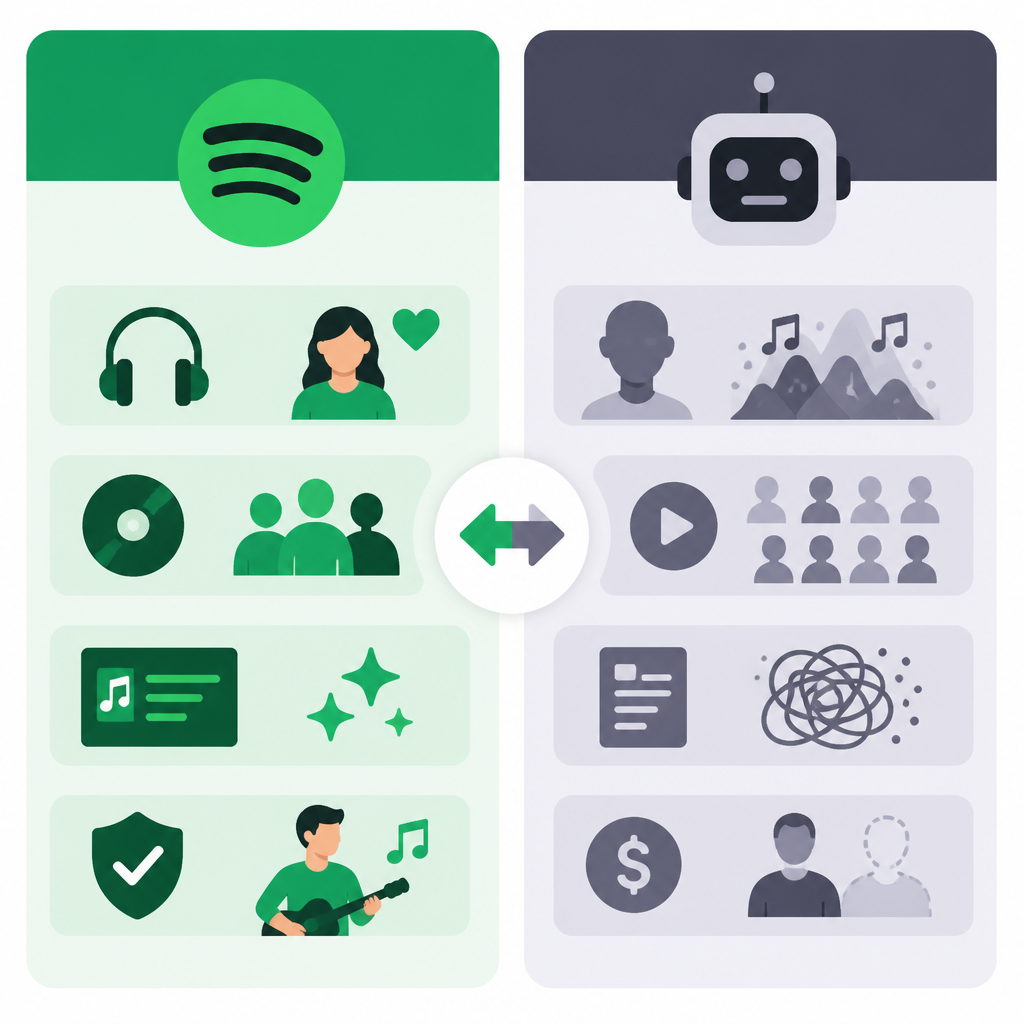
The upside is convenience, but the downside is scale. If anyone can generate and upload endless songs, platforms risk becoming clogged with low-quality or deceptive content, while artists lose control over how their work is used and whether they are paid at all.
Human-made music only
For artists and listeners who care most about originality, this is still the cleanest model. Human-made music avoids the consent problem at the heart of AI remixing and keeps the value chain straightforward: creators make the work, and fans support the creators directly or through standard royalties.
The trade-off is that it does not offer the same interactive novelty as AI tools. Fans cannot instantly spin one track into thousands of variations, and platforms cannot market the same kind of AI-powered experimentation that now drives headlines and investor enthusiasm.
When to pick what
If you are a listener who wants novelty but also wants artists to get paid, Spotify’s licensed remix model is the pragmatic choice, provided the platform clearly labels outputs and keeps sharing under control.
If you are a rights holder or artist who wants maximum protection, human-made music only is the safest default because it avoids the dilution and discovery problems that come with AI generation.
If you are a creator chasing speed, scale, and experimentation with little concern for licensing, unregulated AI music gives you the most freedom, but it also carries the most legal and reputational risk.
If you are a platform operator or investor, Spotify’s approach is the most commercially credible because it turns AI into a paid, licensed feature rather than a piracy magnet.
Default to Spotify’s controlled model, unless your top priority is avoiding any AI competition with human artists, in which case human-only listening and licensing remains the safer answer.
// Related Articles
- [IND]
Gemini lands inside Apple’s developer stack
- [IND]
Five AI coding IDEs that fit real workflows
- [IND]
Devin Desktop turns Windsurf into an agent hub
- [IND]
Korea’s Nvidia talks point to an AI factory push
- [IND]
OpenAI should not rush its IPO just to win the AI race
- [IND]
OpenAI updates its Europe privacy policy