Why Darren Bailey’s Chicago apology is a political trap
Darren Bailey’s Chicago apology is real politics, but it does not erase his record or solve his credibility problem.

Darren Bailey’s Chicago apology is real politics, but it does not erase his record or solve his credibility problem.
Darren Bailey was right to apologize for calling Chicago a “hellhole,” but he is wrong to think one apology can reset a record built on contempt, contradiction, and ideological hard edges.
At Wednesday’s City Council meeting, Bailey tried to recast himself as a candidate focused on affordability, public safety, and education, and he did it in the city he once insulted. That alone is a smart tactical move. Chicago is the state’s political center, and any Republican who wants to be more than a downstate protest candidate has to speak to Chicago voters directly. Yet the substance of his pitch showed the same problem that sank his 2022 run: he still wants the city to believe he has changed without offering enough evidence that his governing instincts have changed with him.
Bailey’s apology is necessary, but not sufficient
Get the latest AI news in your inbox
Weekly picks of model releases, tools, and deep dives — no spam, unsubscribe anytime.
No spam. Unsubscribe at any time.
Bailey’s apology matters because language is not decoration in politics. Calling Chicago a “hellhole” was not a stray insult; it was a signal about who he thought deserved respect and who did not. In a city where the electorate is overwhelmingly Democratic and deeply sensitive to being caricatured by statewide Republicans, that kind of language leaves a scar. His correction, “I should have been more clear,” is an admission that he misread the city and the moment.
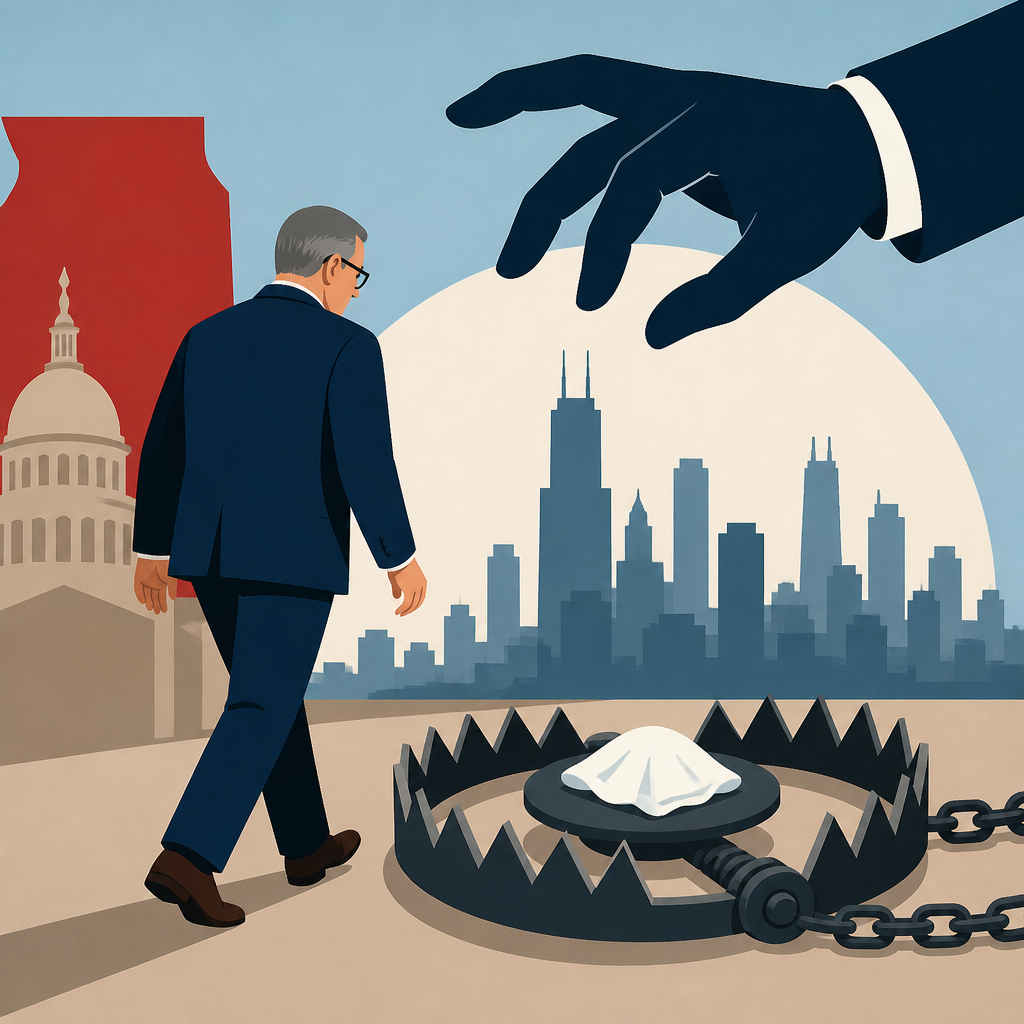
But apologies only work when they are paired with a consistent record of changed behavior. Bailey’s team may want the apology to stand as a clean break, yet the broader political memory is harder to erase. Pritzker’s campaign immediately called it a “glib apology” and pointed to Bailey’s previous comments on abortion, Trump, and even kicking Chicago out of Illinois. That response lands because the problem is not one sentence from years ago. The problem is a pattern that makes the apology feel strategic rather than transformative.
His Chicago message is still built on a narrow worldview
Bailey’s pitch centered on affordability, public safety, and education, which is exactly where a Republican challenger should go in Chicago. Those are real concerns, and his line that these pressures converge most urgently on the South and West Sides was a clear attempt to connect with communities that too often get talked about, not talked to. He also framed housing policy as a way to “turn renters into owners” and build generational wealth, which is a more concrete message than the usual partisan fog.
Still, the way Bailey talks about education exposes the limits of his appeal. He criticized Gov. JB Pritzker for rejecting a federal tax credit scholarship program and argued that every family deserves the freedom to choose the right school. That is a familiar conservative argument, but in Chicago it reads as a subsidy-first answer to a system problem. The city’s education crisis is not just about school choice; it is about funding, governance, transportation, safety, teacher retention, and neighborhood inequality. If Bailey wants Chicago voters to take him seriously, he has to show he understands the whole system, not just the ideological endpoint he prefers.
The “working-class Republican” pitch collides with his own baggage
Bailey is clearly trying to reposition himself as a candidate for affordability and family stability rather than culture-war grievance. His remarks about the loss of his son, daughter-in-law, and two grandchildren in a helicopter crash were the most human part of the speech, and they gave his emphasis on safety a personal anchor. That kind of vulnerability can matter. Voters often respond to candidates who speak from lived experience rather than abstraction, especially on issues like crime and school safety.

But empathy does not erase political memory, and Bailey’s baggage is unusually heavy. He is still the candidate who lost Cook County by large margins, and he is still running against an incumbent with a massive structural advantage in a state where Democrats dominate turnout. More importantly, his effort to sound like a practical problem-solver clashes with the record that Pritzker’s campaign is eager to remind voters about: provocative rhetoric, hard-right social positions, and a track record that invites doubt about whether he truly sees Chicago as a partner or just a target he now needs to court.
The counter-argument
The strongest case for Bailey is that voters should reward people who admit they were wrong. Politics is full of candidates who never apologize, never adjust, and never learn. Bailey did not hide from the “hellhole” comment. He walked into City Council, took the heat, and said the political class, not Chicago itself, was the real target of his anger. In a cynical era, that is not nothing.
There is also a practical argument for giving him a hearing. Chicago voters do not need to agree with Bailey on school choice or the size of government to benefit from a statewide race that forces a Republican to compete for urban votes. If he is serious about affordability, housing, and public safety, then the city should hear him out and judge the plan rather than the slogan.
That argument fails on one simple point: Bailey is not asking for patience, he is asking for trust, and trust is earned by consistency. A single apology does not outweigh years of rhetoric that treated Chicago as a punchline and an ideological battlefield. He can try to pivot, but he has not yet shown that the pivot is more than electoral convenience. Chicago voters are right to demand more than contrition. They should demand proof.
What to do with this
If you are an engineer, PM, or founder watching this race, the lesson is blunt: brand repair requires product change, not just messaging. If you want skeptical users to believe you have changed, stop leading with apology and start leading with specifics, receipts, and a record that matches the new promise. Bailey’s visit shows that audiences will listen to a course correction, but they will only believe it when the underlying behavior changes too.
// Related Articles
- [IND]
Korea’s Nvidia talks point to an AI factory push
- [IND]
OpenAI should not rush its IPO just to win the AI race
- [IND]
OpenAI updates its Europe privacy policy
- [IND]
OpenAI is right to keep ads out of sensitive chats
- [IND]
AI bootlegs are already draining streaming royalties
- [IND]
AMD and Microsoft push Windows ML on GPU and NPU