[RSCH] 6 min readOraCore Editors

AE-LLM aims to make LLMs more efficient

AE-LLM proposes adaptive efficiency optimization for large language models, but the provided source does not include benchmark details.

Share LinkedIn
AE-LLM aims to make LLMs more efficient

AE-LLM proposes adaptive efficiency optimization for large language models.

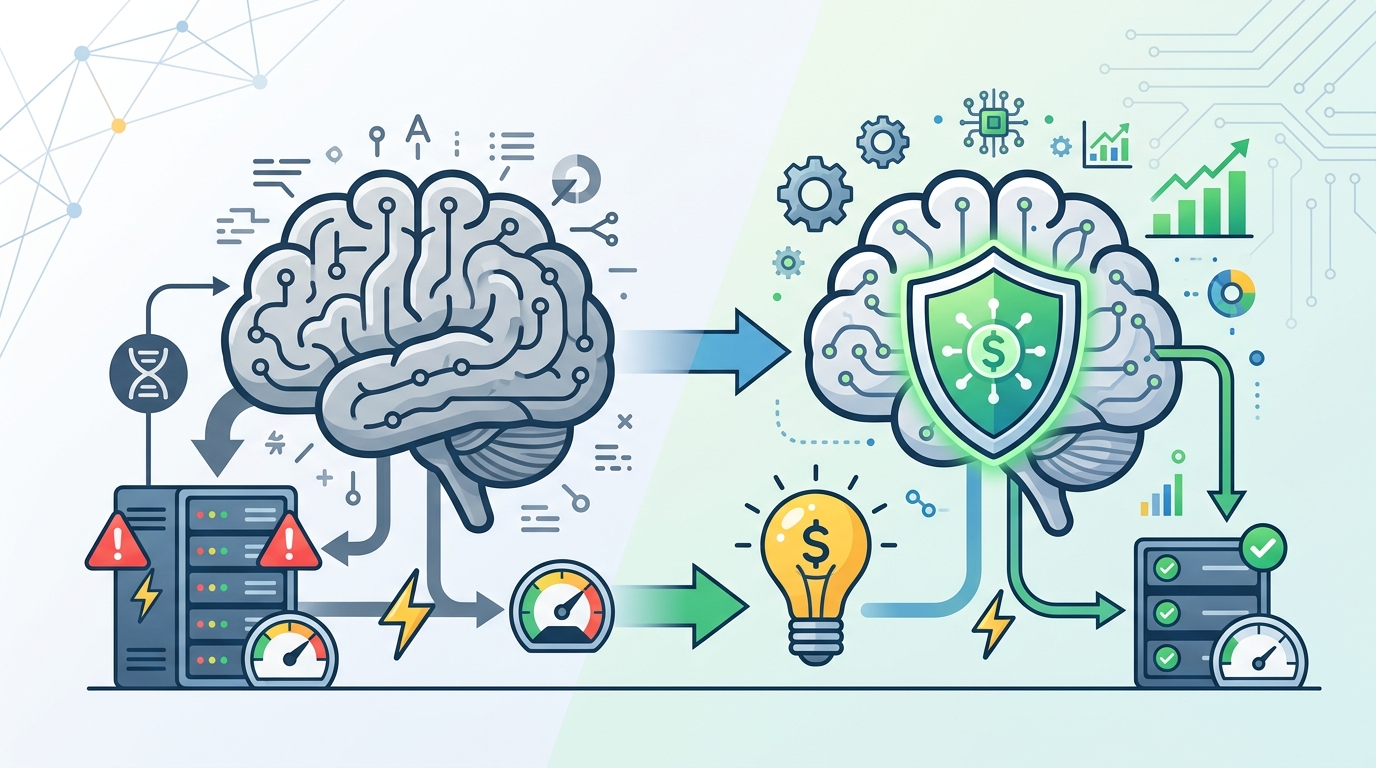
Large language models are powerful, but they are also expensive to run. AE-LLM: Adaptive Efficiency Optimization for Large Language Models is framed around that core tension: how to make LLMs more efficient without losing the benefits that make them useful in the first place.

The problem is straightforward for anyone shipping AI systems. Bigger models can improve quality, but they also increase compute cost, latency, and operational complexity. A method that adapts efficiency instead of treating every request the same could matter anywhere teams are trying to balance user experience against infrastructure spend.

What problem this paper is trying to fix

Get the latest AI news in your inbox

Weekly picks of model releases, tools, and deep dives — no spam, unsubscribe anytime.

No spam. Unsubscribe at any time.

The source material does not provide a full abstract, benchmark table, or method breakdown, so we need to stay close to what is actually visible: the paper is about adaptive efficiency optimization for large language models. That suggests the authors are targeting the common inefficiency of using one fixed inference or training strategy for all cases, even though not every prompt, task, or workload needs the same amount of compute.

AE-LLM aims to make LLMs more efficient

That is the practical pain point. In real deployments, some requests are simple and others are hard. If a system can adjust how much effort it spends based on the input or context, it can potentially save resources while keeping performance acceptable. The paper title alone does not tell us exactly how AE-LLM does that, but it clearly points at efficiency as a dynamic optimization problem rather than a static model property.

How the method works in plain English

Because the provided notes do not include the paper’s abstract text, we do not have the specific mechanism, architecture, or optimization objective. We also do not have enough information to describe whether AE-LLM changes token usage, routing, layer execution, decoding strategy, training schedule, or something else entirely.

What we can say is that the phrase “adaptive efficiency optimization” implies a system that responds to workload conditions instead of applying a one-size-fits-all policy. In practical engineering terms, that usually means some form of decision-making around when to spend more compute and when to spend less. For developers, that is the difference between a model that always runs at full cost and a model that can dial effort up or down depending on the request.

That kind of adaptation is attractive because it can be layered into existing AI stacks in different ways. It could influence serving policies, model selection, or internal computation paths. But again, the source here does not specify which of those approaches AE-LLM uses, so any deeper explanation would be speculation.

What the paper actually shows

The provided source does not include benchmark numbers, datasets, or evaluation metrics. So there are no concrete results to report here, and it would be misleading to invent any.

AE-LLM aims to make LLMs more efficient

That matters because efficiency papers are only useful if they show the tradeoff clearly: how much compute or latency is saved, and what happens to output quality. Without those numbers, the title tells us the direction of the work, but not the size of the gain. The notes also do not include a comparison against other methods, so we cannot say whether AE-LLM outperforms existing efficiency techniques.

In other words, the available evidence is limited to the paper’s existence and its stated topic. For a technical reader, that means the main takeaway is conceptual rather than empirical: the paper is about making LLMs adapt their efficiency more intelligently, but the source excerpt does not tell us how well that works.

Why developers should care

Even with sparse details, the topic is relevant. Efficiency is one of the biggest constraints on LLM deployment, especially when teams need to serve many users, control costs, or reduce latency. If a method like AE-LLM can optimize compute adaptively, it could help make production systems cheaper and more responsive.

Developers should also care because adaptive efficiency usually has architectural implications. A system that changes behavior based on input complexity can affect caching, batching, routing, observability, and failure modes. That means the value of this kind of research is not just theoretical; it can shape how AI services are built and monitored.

  • Potential upside: lower compute use on easier requests.
  • Potential upside: better latency-cost tradeoffs in serving.
  • Open question: what signal drives the adaptation?
  • Open question: how much quality is preserved under efficiency gains?
  • Open question: is this aimed at training, inference, or both?

Limitations and open questions

The biggest limitation is simple: the source text does not expose the paper’s actual abstract or results. That means we cannot verify the method, the scope, or the claims beyond the title and metadata.

There is also no publication venue listed in the provided notes, and the author list is incomplete in the source summary. Those gaps do not invalidate the paper, but they do limit how much a reader can infer from the raw material alone.

For practitioners, the right stance is cautious interest. AE-LLM sounds like it is aimed at a real and important problem, but the current source does not provide enough detail to judge whether it is a small incremental tweak or a genuinely new approach. Until the full paper is reviewed, the safest conclusion is that it explores adaptive efficiency as a first-class objective for large language models.