5 reasons VeChain sees blockchain for AI agents
5 reasons VeChain says blockchain can support AI agents, from verified records and smart contracts to stablecoin payments and compliance.

VeChain says blockchain can give AI agents trusted records, permissions, and payments.
VeChain’s latest quarterly report argues that autonomous AI systems need more than speed: they need proof, permissions, and payment rails. The company says its network is built for that use case, and $VET rose 6.94% to $0.006337 as trading volume hit $44.14 million.
| Item | What it adds | Key data point |
|---|---|---|
| Verified records | Immutable audit trail for AI actions | Supports accountability |
| Smart contracts | Rules and permissions for workflows | Automated approvals |
| Stable assets | Always-on micropayments | Cross-border, 24/7 settlement |
| Compliance tools | Regulatory fit for enterprises | Q1 2026 focus |
| Identity wallets | Verified user and agent identity | Growth reported in 2026 |
1. Verified records for autonomous decisions
Get the latest AI news in your inbox
Weekly picks of model releases, tools, and deep dives — no spam, unsubscribe anytime.
No spam. Unsubscribe at any time.
VeChain’s core claim is that AI agents need a place to leave a trustworthy trail. If an agent places an order, updates a record, or triggers a payment, a blockchain can preserve that history in a form that is harder to alter after the fact.
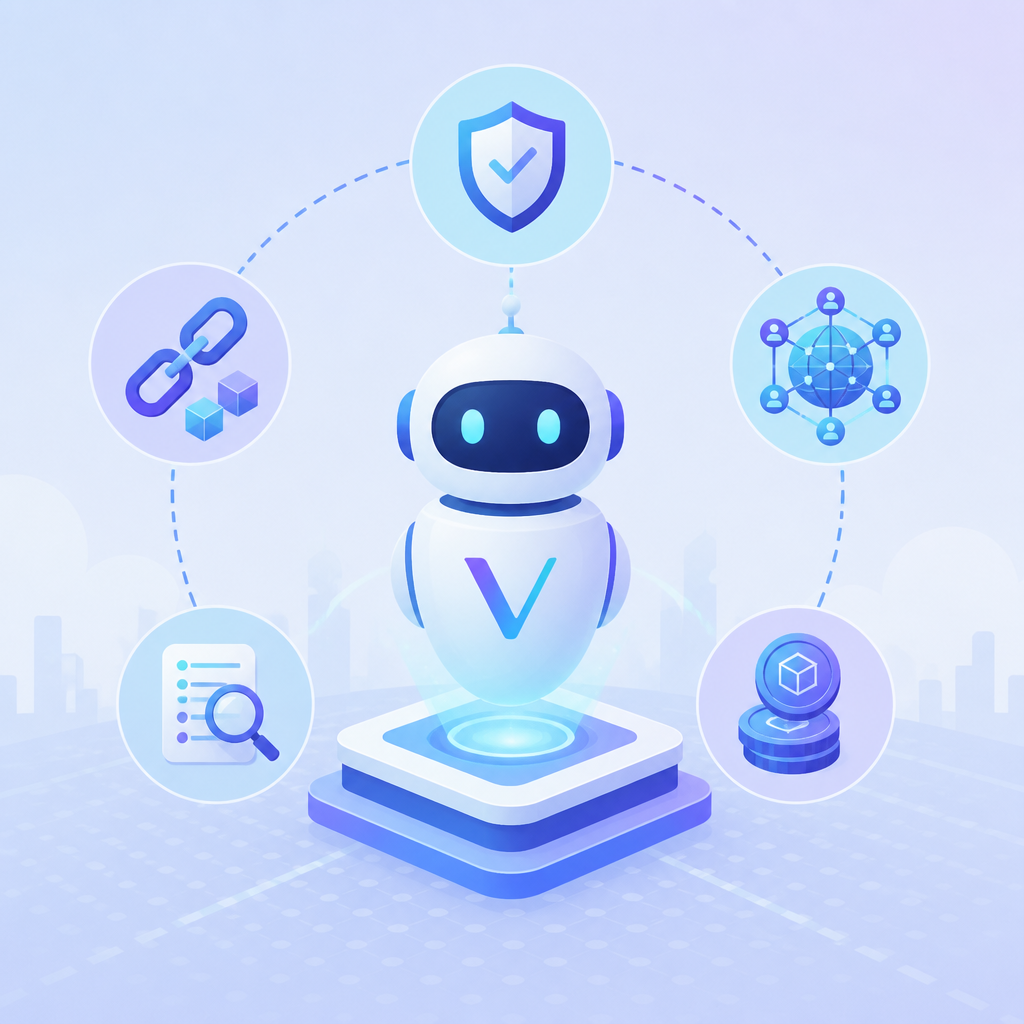
That matters for companies that want to review what an automated system did, when it did it, and which data it used. VeChain says this kind of traceability can help with accountability in supply chains, payments, and digital identity checks.
- Immutable logs for machine actions
- Data origin checks before approval
- Audit trails for internal review
2. Smart contracts for permissions and workflows
The report says smart contracts can give AI agents clear rules. Instead of letting an agent act freely across systems, companies can set permissions, limits, and approval steps in code.
VeChain says this is useful for organizations that want automation without losing control. A contract can record who approved a task, what the agent was allowed to do, and how the process unfolded over time.
- Role-based permissions
- Workflow triggers and approvals
- Recorded operational history
3. Stable assets for nonstop micropayments
VeChain also points to stable assets as a payment layer for the agent economy. AI agents may need to pay for data, services, or API access in small amounts, often across borders and outside banking hours.
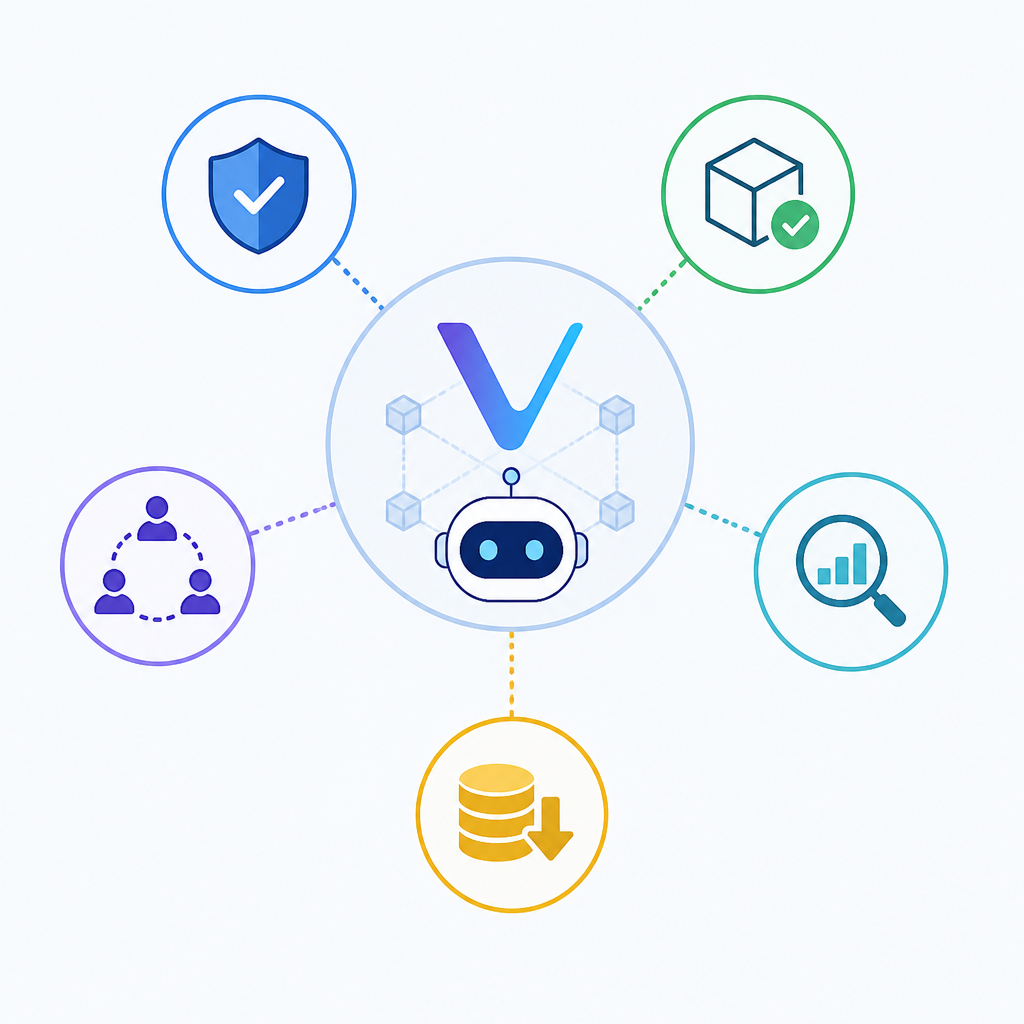
That is where blockchain settlement can matter most. VeChain says stable assets could let agents send and receive micropayments continuously, with less dependence on traditional banking schedules.
Example use cases:
- Pay per API call
- Settle machine-to-machine service fees
- Process cross-border transactions around the clock
4. Compliance tools for enterprise adoption
One reason VeChain says businesses still hesitate is perception. Many corporate buyers still connect blockchain with token speculation rather than business software, which slows adoption in areas like logistics and identity.
To address that, VeChain said it increased work on compliance tools during Q1 2026 to meet European regulatory requirements. The company is aiming for more technical integration modules for developers during the next audit period.
- European compliance focus
- Developer integration modules
- Enterprise-friendly onboarding
5. Identity wallets and credibility scoring
VeChain has also described blockchain-based identity systems and credibility scoring as part of the agent economy. In its view, AI services need a way to prove who or what is acting, especially when software can initiate transactions without human input.
The company said verified identity wallets are still growing on its network, even as broader activity has slowed. That suggests VeChain is betting that identity verification, not just token transfers, will be one of the main entry points for enterprise use.
- Verified identity wallets
- Credibility scoring for services
- Agent identity checks before action
How to decide
If you care most about auditability, start with VeChain’s verified records and smart contract model. Those are the features that fit enterprise controls, compliance reviews, and machine actions that need a paper trail.
If you are focused on payments or agent-to-agent commerce, the stable asset angle is the more relevant one. For companies evaluating deployment, the compliance tools and identity wallet work are the parts to watch next.
// Related Articles
- [IND]
Korea’s Nvidia talks point to an AI factory push
- [IND]
OpenAI should not rush its IPO just to win the AI race
- [IND]
OpenAI updates its Europe privacy policy
- [IND]
OpenAI is right to keep ads out of sensitive chats
- [IND]
AI bootlegs are already draining streaming royalties
- [IND]
AMD and Microsoft push Windows ML on GPU and NPU