AP’s Vatican AI story into a copyable brief
I break down AP’s Vatican-AI report into a copy-ready brief for writing about AI, dignity, and church messaging.
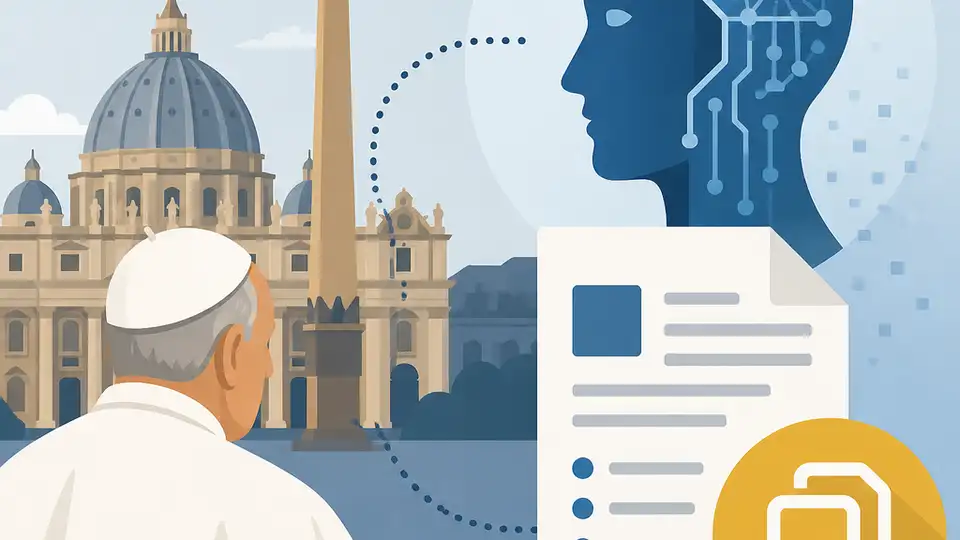
A copy-ready brief for writing about the Vatican’s AI message.
I’ve been reading a lot of AI coverage lately, and most of it has the same problem: it treats every new announcement like a product launch. This AP piece didn’t do that. It put Pope Leo XIV and Anthropic in the same frame, which is exactly why it felt worth slowing down for. The headline says “AI-focused encyclical,” but the real story is stranger and more useful than that. It’s not about a shiny demo or a policy memo. It’s about a pope using one of the church’s oldest communication formats to talk about human dignity in the middle of the AI mess.
That matters because a lot of teams still write about AI as if the only questions are speed, scale, and model quality. I’ve seen that fail in product docs, in internal memos, and in public-facing posts. People read the words, but they don’t know what the company actually thinks about labor, agency, consent, or trust. The Vatican, annoyingly enough, is doing a better job of forcing the issue than most tech orgs. And the fact that AP paired this with Anthropic co-founder Dario Amodei tells me the article is really about a collision: institutional moral language meeting AI industry language.
Source anchor: this breakdown is based on AP News’ report, “Pope Leo XIV to unveil AI-focused encyclical with Anthropic co-founder”. AP says the encyclical will launch on May 25 and center on human dignity in the era of AI. No view or bookmark numbers were provided in the source, so I’m not inventing any.
The pope isn’t “announcing AI.” He’s choosing a frame.
Get the latest AI news in your inbox
Weekly picks of model releases, tools, and deep dives — no spam, unsubscribe anytime.
No spam. Unsubscribe at any time.
“Pope Leo XIV and the co-founder of artificial intelligence company Anthropic will launch the pontiff’s first encyclical on May 25, a document on the care of human dignity in the era of AI.”
What this actually means is the Vatican is not talking about AI as a gadget problem. It’s talking about AI as a dignity problem. That’s a much harder category, because once you say dignity, you’re no longer debating model benchmarks. You’re arguing about what kinds of work should disappear, what kinds of decisions should be automated, and what a human being is for in a system that keeps trying to remove humans from the loop.
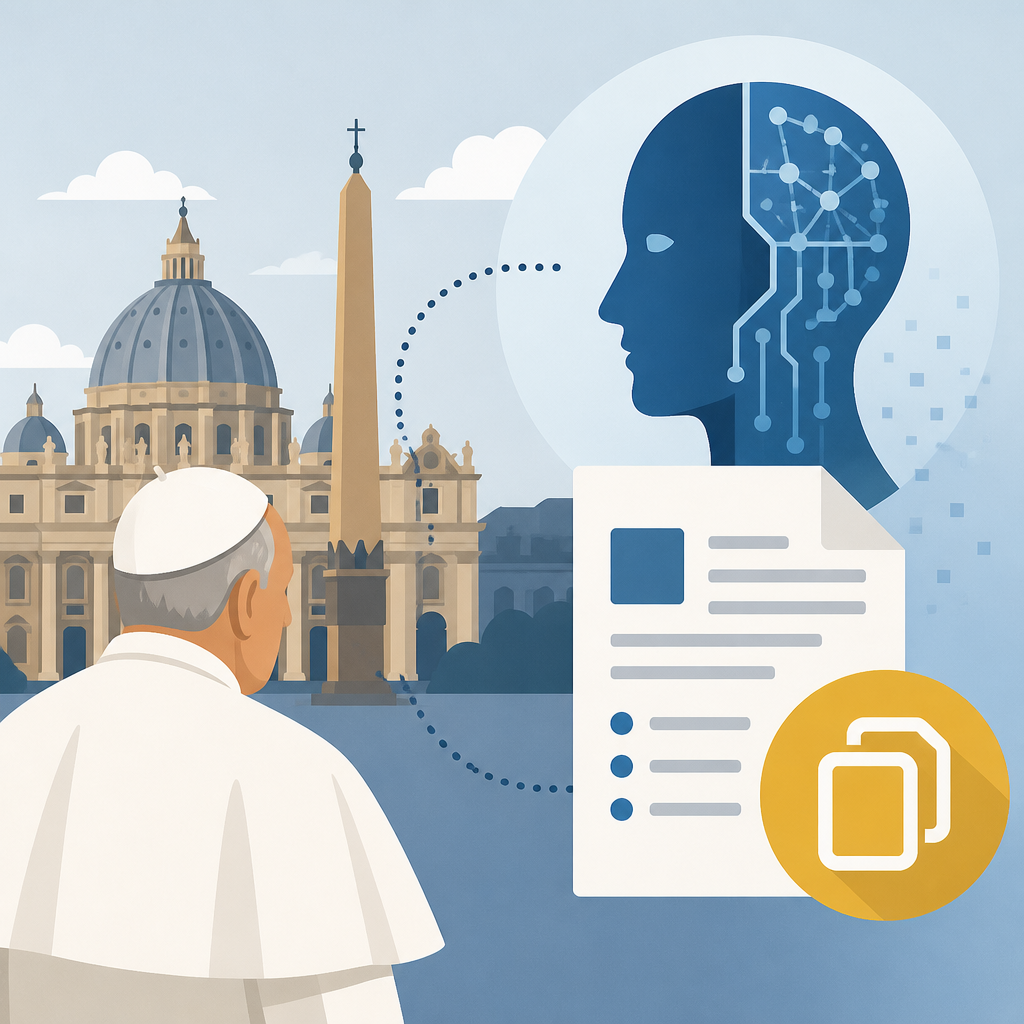
I’ve run into this exact mismatch when teams say they want “responsible AI” but then hand me a launch note that only mentions latency and safety filters. That’s not responsible AI. That’s risk management with nicer language. The Vatican’s move is useful because it forces the category up a level. An encyclical is not a blog post. It’s a formal teaching document, which means every word is supposed to carry weight, and every omission is also a statement.
How to apply it: if you’re writing about AI in your own org, stop opening with the model. Open with the human stake. Ask what the system changes for a person, not just what it outputs. If you can’t name the human stake in one sentence, your AI story is probably still too shallow.
- Replace “what can it do?” with “what does it change?”
- Write the human consequence before the technical feature
- Use one moral noun, not five vague adjectives
Anthropic is here because the church wants a real counterparty
Anthropic is not some random AI company dropped into the headline for drama. AP identifies Dario Amodei as the co-founder, and that matters because Anthropic has spent years trying to present itself as the “we think about safety” company. You can argue about how convincing that is, but the positioning is real. The Vatican didn’t pick a pure hype machine. It picked a company that already talks in the language of alignment, guardrails, and harm reduction.
That’s the part I find interesting. If you’re the church, and you want to talk about AI without sounding like you’re shouting at the clouds, you need someone in the room who can translate between moral concern and technical reality. Amodei is useful for that. He’s one of the few people in AI who can speak to policymakers, developers, and journalists without changing the subject every thirty seconds.
I’ve seen organizations make this mistake in reverse. They bring in a technologist to “explain AI,” but they actually want applause, not explanation. Then everyone leaves with a vague sense that the system is complicated and important, which is not a strategy. If the Vatican is smart here, it’s because it understands that a credible AI conversation needs a credible technical interlocutor, not just a priest with a microphone.
How to apply it: if you need to explain AI to a nontechnical audience, bring in someone who can talk about tradeoffs, not just features. And if you’re the nontechnical side, don’t let the technologist hide behind abstraction. Ask what gets optimized, what gets excluded, and who is accountable when the system gets it wrong.
- Pick one technical person who can explain tradeoffs plainly
- Keep one moral question in every AI discussion
- Don’t let “complex” become a conversation ender
An encyclical is old-school, and that’s the point
The Vatican could have issued a statement, a press release, or a social media thread. Instead, it’s an encyclical. That’s not accidental. An encyclical is one of the church’s most serious teaching tools, and using it for AI says the institution thinks this is not a side topic. It’s central enough to deserve formal doctrine-level attention.
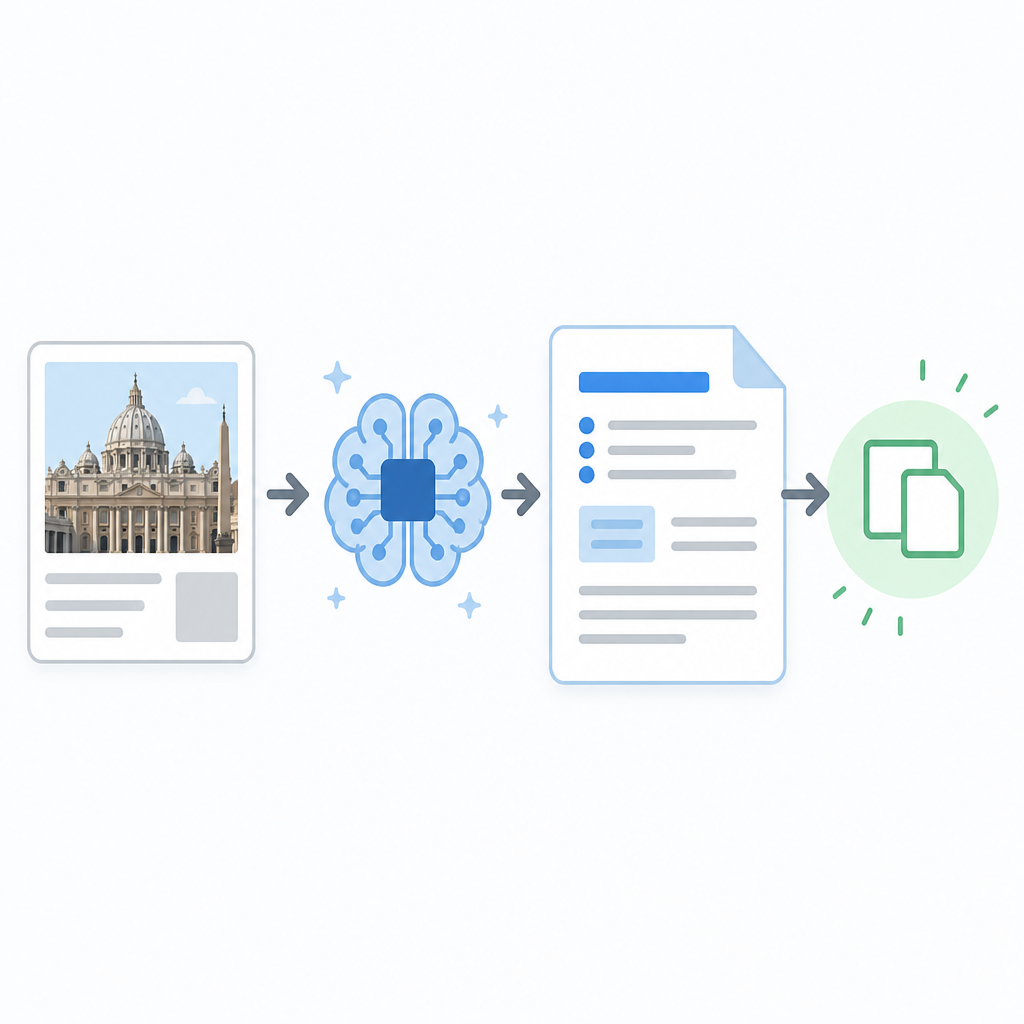
What this actually means is the Vatican is trying to create a durable reference point. Press releases age badly. Hot takes age worse. A formal document can be cited, argued with, and returned to later. That’s how institutions keep their own memory. Tech companies should be embarrassed by how often they fail at this. They publish a policy page, then bury it under three redesigns and a new PR cycle.
I’ve had to clean up enough “AI principles” pages to know the pattern. They start with noble language, then drift into vague compliance prose that nobody reads. The Vatican, for all its other problems, knows how to write something that is meant to outlive the news cycle. That’s why this matters to developers too. If you want your AI policy to matter, it has to be more than a banner on the website.
How to apply it: write your AI position like it will be quoted a year from now. Use durable language. Define terms. State what you will not do. If your team can’t stand behind the document after the launch hype dies, it’s not a policy, it’s marketing copy.
For reference, the broader church context is worth tracking through the Vatican’s official site, because this kind of statement usually gets discussed there after the headlines move on.
This story is really about dignity, not just regulation
AP’s summary says the encyclical is about “the care of human dignity in the era of AI.” That wording is doing a lot of work. It’s not saying “AI safety,” and it’s not saying “AI governance.” Those are narrower, more bureaucratic frames. Dignity is broader and messier. It includes labor, identity, agency, and the right not to be reduced to a data point.
That’s where a lot of tech communication falls apart. We love measurable harms because they’re easier to fix. Bias score? Fine. Latency issue? Fine. But dignity is the thing underneath the measurable harms. It’s why people get angry when a system replaces their judgment with a model score, even if the score is “accurate” most of the time. It’s why workers hate being managed by software that treats them like interchangeable parts.
I ran into this while working on a product team that kept insisting our AI feature was “just assistive.” Users didn’t care what we called it. They cared that it changed who got to decide, who got to speak, and who got to be believed. That’s the dignity layer. If you ignore it, you end up with tools that are technically fine and socially poisonous.
How to apply it: when you write about AI, add a dignity check. Ask whether the tool changes someone’s standing, not just their workflow. If it does, say so directly. If it removes judgment from a human role, admit that instead of hiding behind “efficiency.”
Why AP’s framing is better than the usual AI coverage
AP could have made this a novelty story: pope meets AI executive, everybody smiles, everyone leaves with a quote. Instead, the report keeps the center of gravity on the encyclical and its moral purpose. That’s a better editorial choice because it resists the easy trap of treating AI as the main character in every room it enters.
What this actually means is the article is less interested in hype and more interested in institutional response. That’s useful. We’re past the point where every AI story needs to ask whether the model is impressive. Of course it’s impressive. The question is whether the institutions around it have any idea what to do next.
That’s also why the AP piece is more useful for developers than it first looks. It gives you a clean example of how to write about AI without drowning in product language. The story has a subject, a purpose, and a consequence. That’s enough. You don’t need a demo reel every time you mention a transformer.
If you want to see how mainstream reporting handles this kind of institutional story, AP’s own newsroom is the right reference point: AP News. And if you want the AI side of the equation, Anthropic’s public material is here: Anthropic.
What developers should steal from this immediately
I’m not telling you to start writing encyclicals in your sprint docs. I am saying there’s a useful pattern here: define the moral frame before you define the technical object. The Vatican didn’t begin with model architecture. It began with dignity. That’s why the message lands at all.
What this actually means in practice is simple. If you’re shipping AI, your docs should answer a few questions before they brag about performance. What does the system do to the user’s agency? What decisions does it influence? What happens when it fails? Who gets blamed? If those questions aren’t in the room, you’re not doing serious AI work. You’re just moving fast and hoping the dashboard makes you look wise.
I’ve watched teams spend weeks polishing prompts and then five minutes on policy. That ratio is backwards. The AP story is a reminder that the public conversation is catching up to the real issue: AI isn’t only a technical system. It’s a social one. And social systems need language that can survive contact with power.
How to apply it: build a short AI position statement for your team and keep it visible. Use it in reviews. Use it in launch docs. Use it when someone says “we can always fix that later.” Later is when the damage hardens into process.
The template you can copy
# AI position note for a product team

## What we are building
We are building [feature name], an AI-assisted system that helps [user group] [task].

## Why this exists
This feature exists to reduce [pain point] while preserving human judgment in [critical decision area].

## What it changes for people
- It changes how users [act/decide/review].
- It may affect [work, access, trust, status].
- It must not remove human review from [specific step].

## What we will not do
- We will not use this system to make final decisions about [employment, housing, health, finance, discipline, access].
- We will not hide AI involvement from users.
- We will not ship if we cannot explain the failure mode in plain language.

## Human dignity check
Before launch, answer these in writing:
1. Who gains control?
2. Who loses control?
3. What happens when the model is wrong?
4. What is the user allowed to override?
5. What part of the experience must stay human?

## Review gate
This feature cannot ship until:
- Product signs off on the user impact
- Engineering documents the failure modes
- Legal reviews disclosure and retention
- A named owner approves the rollback plan

## Public-facing summary
We use AI to assist with [task], but a human remains responsible for [decision/approval].

## One-sentence policy
If the system changes someone’s agency, status, or access, we write that down before we ship.
That template is mine, not the Vatican’s. It’s derivative only in the sense that I stole the framing idea from a church document about dignity and turned it into something a product team can actually use without blushing.
For the original reporting, read the AP article here: AP News source URL. Everything above is my breakdown and adaptation, not a direct reproduction of the article.
// Related Articles
- [IND]
WebX 2026 turns speaker hype into a conference brief
- [IND]
AI Weekly: 2026-07-06 ~ 2026-07-13
- [IND]
The AI Act should be treated as Europe’s operating system for AI
- [IND]
Booz Allen’s OpenAI Deal Is Real Advantage, Not Hype
- [IND]
OpenSearch’s vector search benchmark in 5 parts
- [IND]
Vector Databases That Work in Production