China’s AI bet: open-source, efficiency, global sales
DeepSeek’s low-cost rise shows China is building AI around efficiency, open models, and overseas demand, not frontier-model supremacy.

China is building AI around cheap, open models and overseas demand, not frontier-model supremacy.
China’s AI sector is taking a different route from the U.S., using lower costs, open-source releases, and export-focused applications to scale. A Fortune essay published June 16, 2026 says DeepSeek’s January 2025 model, reportedly trained for $6 million, helped expose how far Chinese firms can go with leaner budgets and tighter chip access.
| 項目 | 數值 |
|---|---|
| DeepSeek training cost claimed by parent | $6 million |
| AI engineer salary in China | 402,000 RMB, about $57,000 |
| Chinese open-source LLM usage share | One-third of global usage |
| DeepSeek output cost cited in late 2025 | 3 RMB per one million units, about $0.50 |
| Private AI investment gap | U.S. investment was 12x China’s and 24x the U.K.’s |
What changed
Get the latest AI news in your inbox
Weekly picks of model releases, tools, and deep dives — no spam, unsubscribe anytime.
No spam. Unsubscribe at any time.
The article argues that the real story is not whether China can “catch up” to the U.S. in frontier AI. Instead, the two countries are optimizing for different outcomes: U.S. firms are pouring money into massive data centers, top-tier talent, and AGI research, while Chinese firms are pushing open-source models, lower compute use, and faster application deployment.

That split is reinforced by economics. Chinese AI teams face tighter capital, less access to high-end GPUs, and a smaller domestic market that pays less for software. But they also benefit from lower salaries, cheaper land and power, subsidies for compute, and a large pool of AI PhDs. The result is an ecosystem built to produce more output per dollar.
- DeepSeek’s parent said the model was trained for $6 million.
- China’s AI engineers earn about 402,000 RMB, or roughly $57,000, a year.
- By late 2025, Chinese open-source LLMs such as Qwen, MiniMax, and DeepSeek accounted for one-third of global usage.
- The article says Chinese models now appear in five of the top ten image-to-video systems and three of the top ten text-to-video and image-editing models.
Why it matters
For developers, the practical effect is more choice. Chinese models are spreading because they are open, cheap to run, and easy to adapt. That makes them attractive to startups, researchers, and enterprises in Southeast Asia, Africa, and even Silicon Valley teams that want lower inference costs or more control over model behavior.
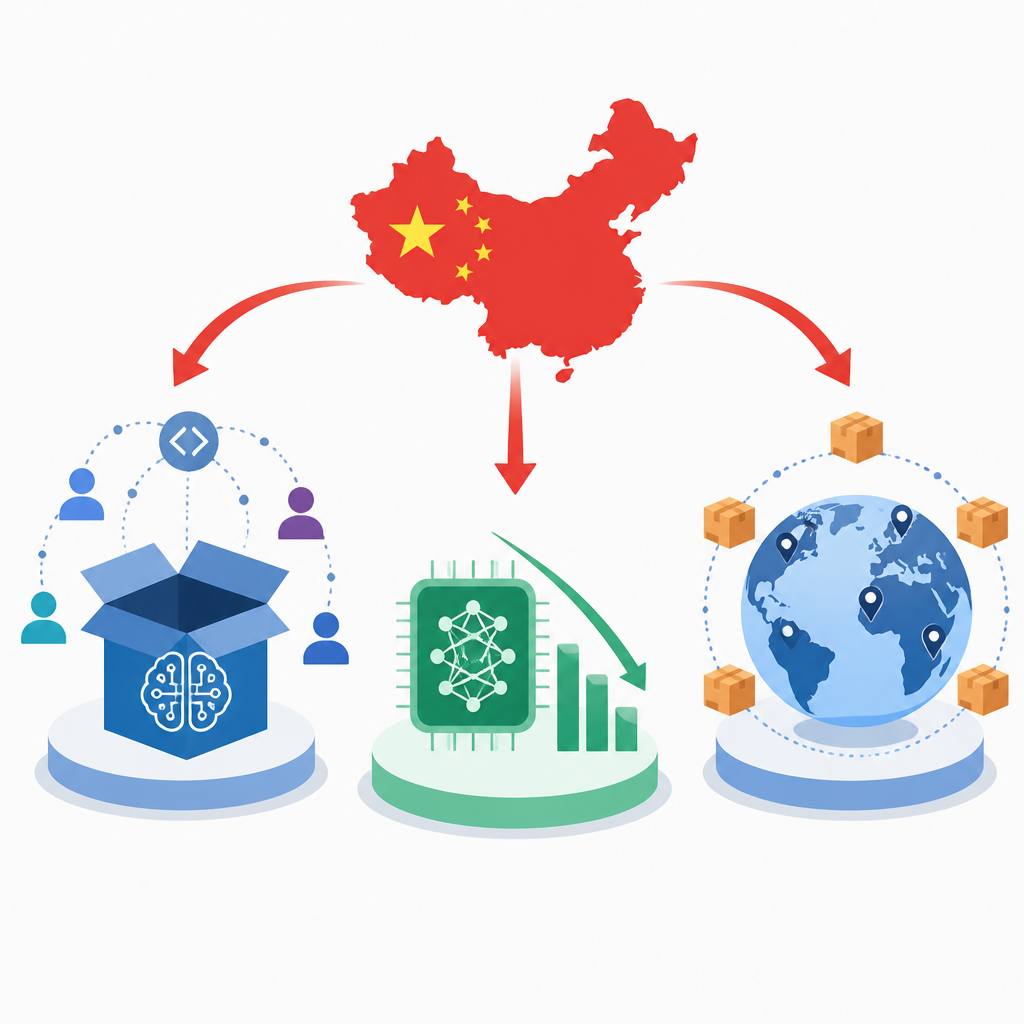
For the market, this creates a second AI distribution channel. Chinese firms are increasingly monetizing abroad through enterprise agents, localization, and industry-specific tools rather than waiting for domestic customers to pay premium prices. The article points to 01.AI, which shifted from pure LLM work to “super-employees” for insurance, procurement, logistics, and operations.
That model could pressure U.S. vendors that rely on closed systems and high margins. If Chinese AI keeps improving on cost and openness, competition may shift from who has the biggest model to who can deliver useful software at the lowest total cost.
The key question is not whether China will win the same AI race as the U.S. It is whether the rest of the world adopts China’s cheaper, open model stack as the default way to ship AI.
// Related Articles
- [IND]
$2 billion Nvidia-Coherent AI plant backs Huang's warning
- [IND]
Huang’s Marvell call turns AI hype into a thesis
- [IND]
ERGO Hestia cut pricing time-to-market with Databricks
- [IND]
OpenAI and Oracle Universal Credits Enter Enterprise Buying
- [IND]
Managed ChatGPT access is governed by 4 policy layers
- [IND]
OpenAI service terms put app risk on users