ERGO Hestia cut pricing time-to-market with Databricks
4 architecture moves helped ERGO Hestia cut pricing time-to-market and keep 100+ models governed in one lakehouse.

ERGO Hestia sped up real-time pricing by moving data, features, and model serving into one Databricks stack.
ERGO Hestia reduced pricing delays by consolidating data serving and model deployment in Databricks, after a system that managed 100+ models and 1,000+ variables hit 10x to 20x latency spikes.
| Item | What it changed | Operational effect |
|---|---|---|
| Lakebase | Online feature store on Delta tables | Continuous sync without extraction jobs |
| Mosaic AI Model Serving | Direct API access to models | Milliseconds-level request flow |
| Unity Catalog | Unified governance and lineage | Traceability across data and models |
| Azure DevOps CI/CD | Deployment orchestration | Safer staged rollout |
1. Lakebase as the online feature store
Get the latest AI news in your inbox
Weekly picks of model releases, tools, and deep dives — no spam, unsubscribe anytime.
No spam. Unsubscribe at any time.
Lakebase gave ERGO Hestia a relational serving layer on top of Delta tables, so pricing data could stay inside the lakehouse instead of being exported to PostgreSQL. That removed a major source of extraction overhead and made refreshes continuous rather than tied to batch windows.

The practical win is simpler operations. Sync Tables keep processed data aligned with serving data automatically, which means the pricing team spends less time babysitting pipelines and more time tuning models for market conditions.
- Processed data stays in Databricks
- Sync Tables handle automatic updates
- No manual export to an external database
2. Mosaic AI Model Serving for direct pricing calls
Mosaic AI Model Serving replaced the adapter layer that used to sit between the pricing engine and the serving database. Requests now go directly to managed endpoints, which keeps request logic close to the models and cuts out an entire hop.
That matters when pricing decisions need to happen in milliseconds. By removing the custom cache-and-adapter pattern, ERGO Hestia reduced the moving parts that could trigger latency spikes during the business day.
Pricing engine -> Model Serving Endpoint -> response in milliseconds
3. Unity Catalog for one governed plane
Unity Catalog gave the team a shared control plane for data, model versions, lineage, and retention. In a regulated insurance setting, that is not just an admin detail. It is what lets teams prove how a price was produced and which version of a model made the call.
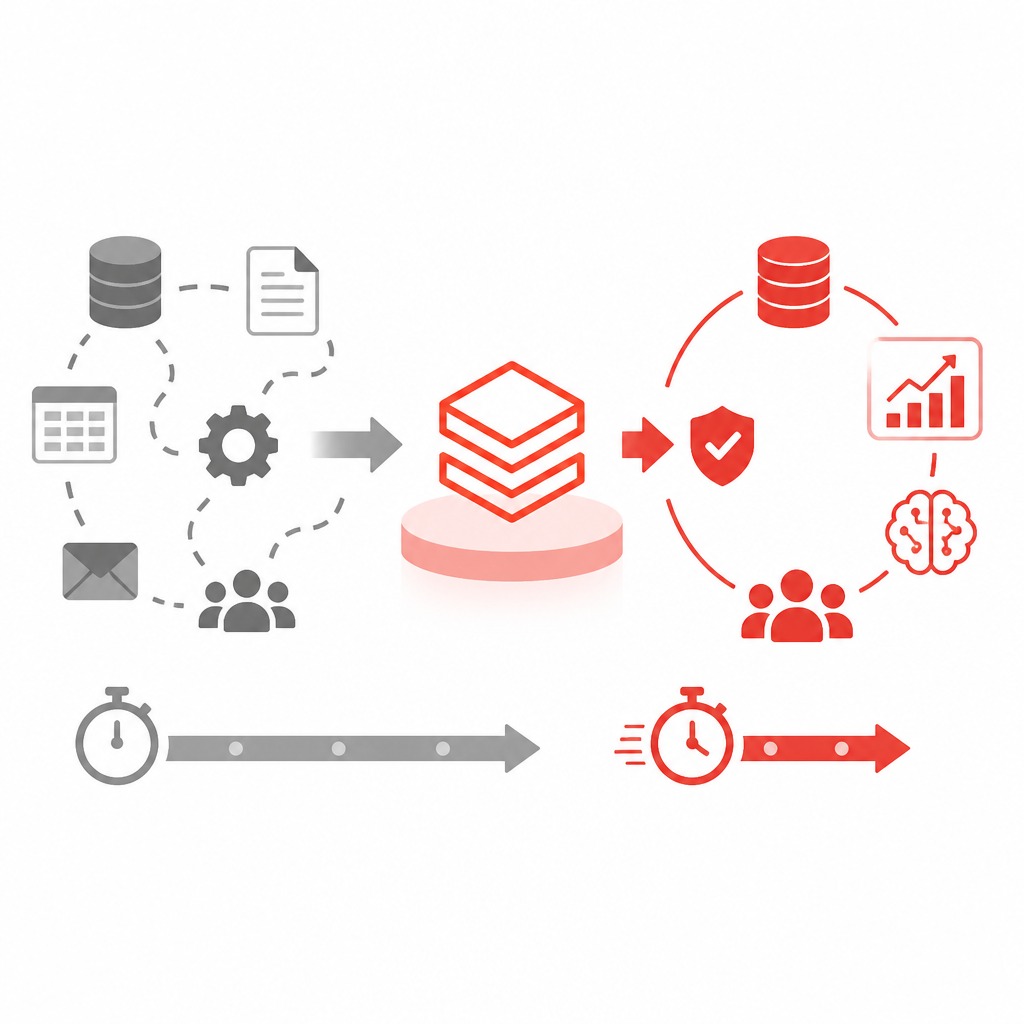
The article makes the governance benefit clear: pricing experts can validate models against live data while keeping the full lifecycle traceable. That reduces compliance risk and also makes experimentation safer, because A/B and regression testing happen inside the same governed environment.
- Model versions are registered before serving
- Historical training sets remain retained
- Lineage spans data and model layers
4. Incremental migration instead of a hard cutover
ERGO Hestia did not switch everything at once. It used a staged migration that preserved the existing ETL pipelines and redirected synchronized data to Lakebase instead of PostgreSQL. That lowered risk and let the team validate each step before expanding usage.
This approach is especially useful when the business cannot afford downtime. The company kept production stable while changing the serving path underneath, which is a cleaner way to modernize than a big-bang rewrite.
- Existing ETL pipelines stayed in place
- Data sync moved from PostgreSQL to Lakebase
- CI/CD in Azure DevOps handled deployment flow
5. A real-time pricing engine built for scale
The end result was a pricing stack that could respond to market changes throughout the day instead of waiting for scheduled refreshes. ERGO Hestia says the new setup helps ship pricing models faster and supports real-time B2C pricing without the operational trade-offs that came with the old multi-hop design.
For a business running more than 100 models across more than 1,000 variables, the gain is not just speed. It is the ability to turn pricing into an active growth system, with fewer handoffs and clearer accountability from data ingestion to customer-facing decision.
What to pick
If your biggest pain is data movement, start with Lakebase. If your bottleneck is model calls, focus on Mosaic AI Model Serving. If audits and version control are the main concern, Unity Catalog should be the first priority.
If you are modernizing a production system without room for a risky rewrite, ERGO Hestia’s staged migration is the best pattern to copy. It shows how to move faster by removing hops, not by adding more tooling.
// Related Articles
- [IND]
$2 billion Nvidia-Coherent AI plant backs Huang's warning
- [IND]
Huang’s Marvell call turns AI hype into a thesis
- [IND]
China’s AI bet: open-source, efficiency, global sales
- [IND]
OpenAI and Oracle Universal Credits Enter Enterprise Buying
- [IND]
Managed ChatGPT access is governed by 4 policy layers
- [IND]
OpenAI service terms put app risk on users