Midjourney Medical’s scanner is a spa, not a clinic
4 things Midjourney Medical changes about whole-body scans, from water-coupled ultrasound to spa-first operations and FDA risk.

Midjourney Medical is building a whole-body ultrasound scanner and spa around it.
Midjourney’s scanner pitch matters because it mixes a new imaging modality, a spa business, and a long FDA path. The prototype already uses 358,000 ultrasonic elements and about 2 PFLOPS of compute.
| Item | Current status | Notable number |
|---|---|---|
| Midjourney Scanner | Gen 1 prototype | 358,000 elements |
| Scan time | Current bottlenecked workflow | About 20 minutes |
| Data capture | Prototype throughput | 17 GB/s |
| Midjourney Spa | Planned first site | 25,000 sq ft |
1. A whole-body ultrasound scanner, not an MRI clone
Get the latest AI news in your inbox
Weekly picks of model releases, tools, and deep dives — no spam, unsubscribe anytime.
No spam. Unsubscribe at any time.
Midjourney’s first medical device is the Midjourney Scanner, a full-body ultrasonic CT system that uses ultrasound instead of MRI magnets or X-ray radiation. The pitch is simple: scan the body often, cheaply, and safely enough to make longitudinal health tracking normal.
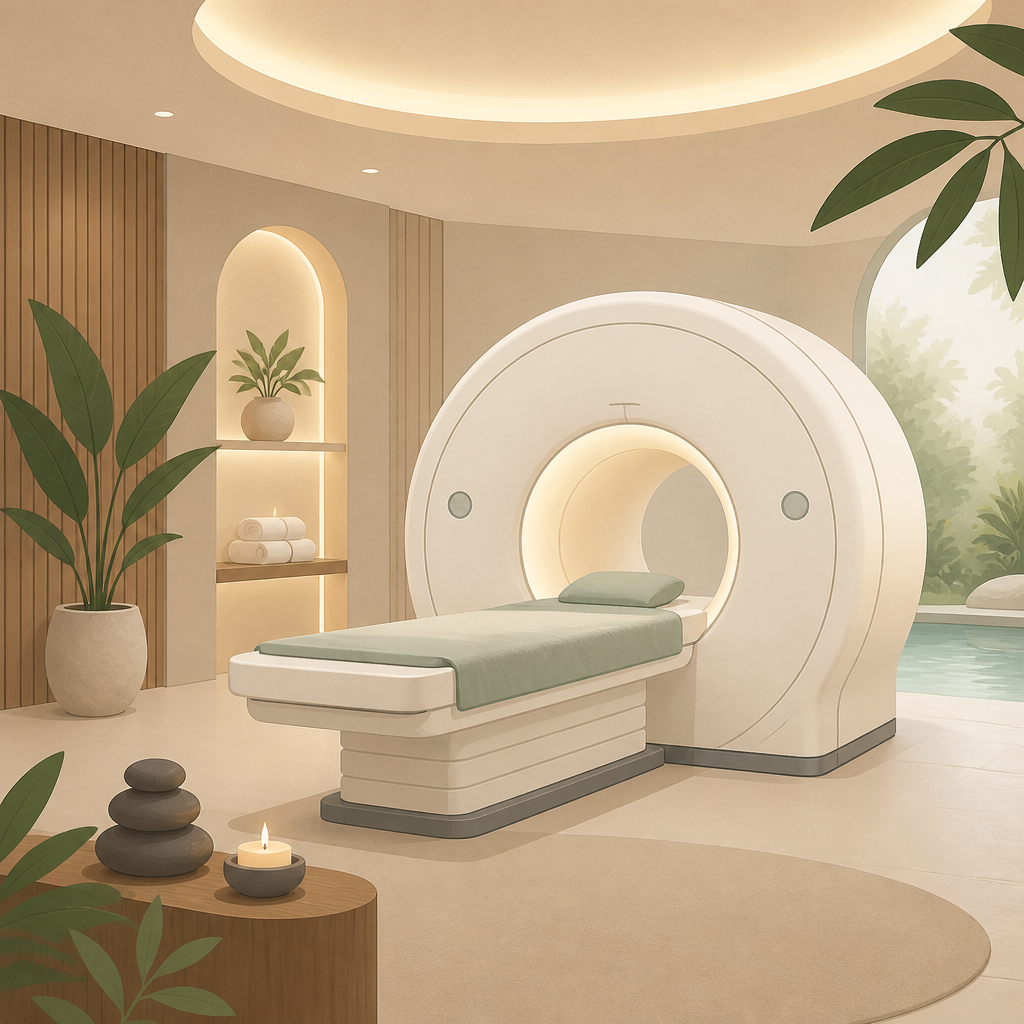
The company says the system is still a prototype and not yet using AI for the images shown. Even so, the hardware stack is already dense: 40 systems in a ring, a 70 cm diameter enclosure, and a target resolution around 0.5 mm. That makes the project feel less like a gadget and more like an imaging platform.
- 358,000 ultrasonic elements total
- 40 systems arranged in a ring
- 70 cm diameter ring
- About 0.5 mm claimed internal detail
2. The real bottleneck is not the image, it is the pipeline
Today’s scans reportedly take about 20 minutes, and Midjourney says the ceiling is being set by bandwidth, algorithms, DSP, and prototype data-transfer infrastructure. The raw numbers are large enough that the reconstruction stack matters as much as the sensor hardware.
That is why the company is talking about 21 servers, about 2 PFLOPS of compute, and roughly 806 TB of raw data. If the product ever gets to the claimed goal of several hundred slices in 60 seconds, the gain will come from the whole system, not just a nicer transducer.
- Data capture around 17 GB/s
- Around 40 GB per body slice
- 21 servers for reconstruction
- Current scan time: about 20 minutes
3. The spa is part of the product, not a side quest
Midjourney is not starting with a clinic. It is starting with a spa in Union Square, San Francisco, planned at about 25,000 square feet with hot tubs, saunas, cold plunges, a gym, and roughly 9 to 10 scanners. The site is meant to be a learning lab for how people actually use scans.
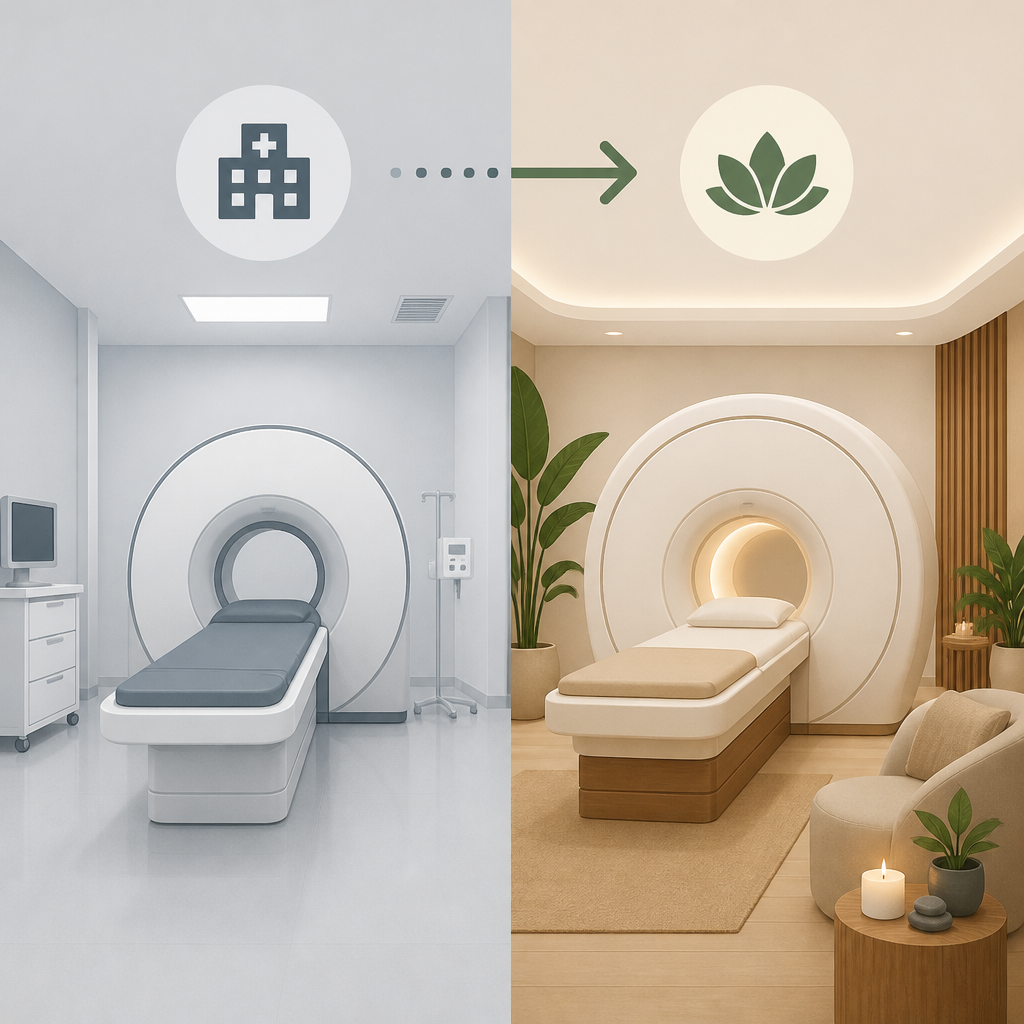
That choice changes the business model. Instead of selling a device to hospitals, Midjourney is testing memberships, walk-in scans, scan-only pricing, and spa bundles. The company says it can fund the first location itself and is aiming for an end-of-2027 opening.
- First location: Union Square, San Francisco
- About 25,000 sq ft across four floors
- Hot tubs, saunas, cold plunges, gym
- Target opening: end of 2027
4. The long-term bet is frequent health tracking
David Holz is framing the scanner as infrastructure for preventive medicine, not just diagnostics. The idea is that if scans become safe, frequent, and cheap enough, people could track body changes daily, weekly, or monthly and catch problems earlier.
That vision is ambitious, but the near-term path is narrower. Midjourney says it has started discussions with the FDA, and the initial commercial wedge may be body composition, which is easier than disease diagnosis. Therapeutic uses like focused ultrasound or incisionless procedures are much further out.
- Gen 2 scanner targeted for end of 2026
- Gen 3 may use custom silicon
- Long-term goal: 50,000 scanners
- Claimed aspiration: 1 billion scans per month
5. The open questions are bigger than the demo
The demo images are interesting, but the hard part is clinical proof. No sensitivity or specificity numbers were given, and no peer-reviewed validation was cited in the transcript. The difference between “can see something weird” and “can diagnose something reliably” is huge.
There are also practical risks: overdiagnosis, privacy, cleaning, staffing, liability, insurance billing, and what happens when a spa is also a medical device site. Midjourney may be able to build the stack, but proving it is useful in real care is the next test.
- FDA classification is still unclear
- Frequent scans may create incidental findings
- Data governance details were not spelled out
- Clinical workflow remains open
How to decide
If you care about imaging hardware, the scanner itself is the story. If you care about product strategy, the spa-first rollout is the more revealing move. If you care about healthcare adoption, watch the FDA path and the body-composition wedge before assuming diagnostics will follow.
The strongest read is that Midjourney is not just trying to make a better scan. It is trying to make a new habit around whole-body health data, and it is using a spa to see whether people will actually show up for it.
// Related Articles
- [IND]
2026 MSI lands in Daejeon with new formats
- [IND]
Midjourney’s body scanner is a bad pivot for a great AI brand
- [IND]
The Pentagon should not use Grok for wartime targeting
- [IND]
Grok’s latest controversies are now a regulation story
- [IND]
AIBOX 不是拼软件,关键在把 AX8850 的硬件吃满
- [IND]
AI coding assistant ROI is real, but only when you measure it