NBA MVP Race and the Infrastructure Edge
The MVP race is tight, but team continuity may be the hidden separator. Here’s why roster infrastructure matters for stars like SGA, Jokic, and Luka.

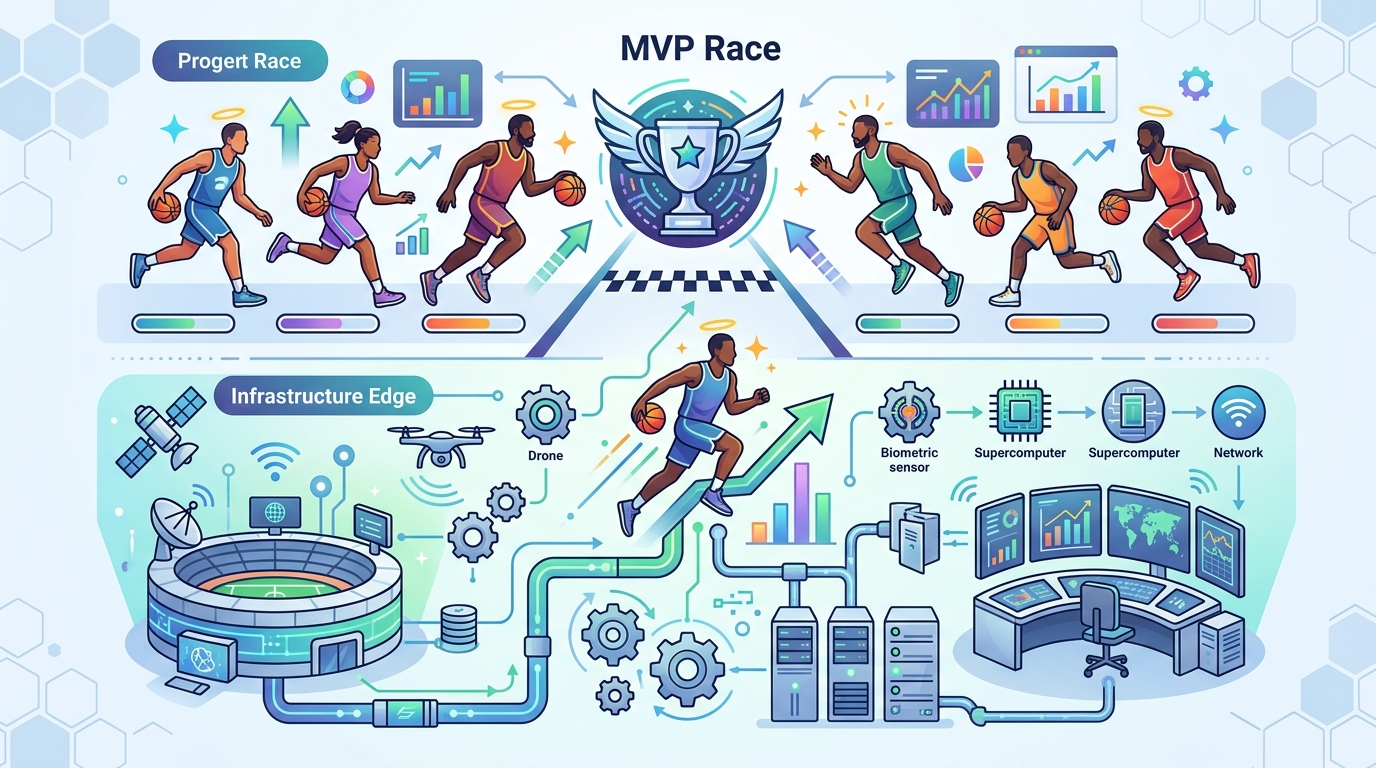
The NBA MVP race has four real contenders, and all of them are posting seasons that would win in many other years. The twist is that the gap between them may come down less to raw box-score brilliance and more to something quieter: roster infrastructure.
That word sounds dry, but it explains a lot. When a team keeps the same core, the same reads, and the same defensive habits in place for years, stars stop spending energy on guesswork and start cashing in on repetition.
Why continuity matters more than people admit
Get the latest AI news in your inbox
Weekly picks of model releases, tools, and deep dives — no spam, unsubscribe anytime.
No spam. Unsubscribe at any time.
In this race, the candidates are Shai Gilgeous-Alexander, Nikola Jokić, Victor Wembanyama, and Luka Dončić. All four have MVP-level numbers, and all four are attached to winning teams. But their team-building timelines are very different.

Oklahoma City Thunder have spent years building around SGA. Denver Nuggets have done the same for Jokić. San Antonio Spurs have spent the last two seasons stockpiling pieces around Wembanyama. Los Angeles Lakers are the odd case, because Dončić arrived into a roster that had been built for a different star and then patched together in-season.
- SGA is in his 7th season in Oklahoma City.
- Jokić is in his 11th season in Denver, and Jamal Murray has been there for 10.
- Wembanyama is in his 3rd season in San Antonio.
- Dončić joined a Lakers roster with major structural turnover and limited continuity.
The numbers behind that continuity matter. Denver’s Jokić-Murray pairing has logged more than 16,000 shared minutes. Oklahoma City’s core has had years to learn each other’s spacing, timing, and defensive rules. San Antonio has built a young, purpose-fit group around Wembanyama’s rim protection and transition pressure. Los Angeles, by contrast, had to figure out a new identity while the season was already running.
This is why MVP debates can get sloppy. People focus on who is carrying the biggest load, then ignore the fact that some stars are carrying that load inside a structure that has been stress-tested for years.
The best teams are built, not improvised
The top teams by point differential this season say a lot about how the league works right now. Oklahoma City, San Antonio, Boston, New York, and Detroit all have cores that have been together long enough for habits to harden into advantages. That does not mean every move was perfect. It means the teams had a base to build from instead of starting from scratch.
Look at the lineups. The Nuggets’ Jokić-Murray-Aaron Gordon trio is one of the cleanest examples of familiarity in the league, posting a strong plus-minus across a large sample. The Thunder’s combinations with SGA, Chet Holmgren, and Jalen Williams keep showing up near the top of the league in impact numbers. San Antonio’s best units with Wembanyama, Stephon Castle, and Devin Vassell have looked excellent in the minutes they’ve shared.
- Nuggets lineups with Jokić, Murray, and Gordon: +20.3 per 100 possessions on 880 possessions.
- Thunder lineups with SGA, Holmgren, and Cason Wallace: +20.9 per 100 possessions on 1,383 possessions.
- Spurs lineups with Wembanyama, Castle, and Vassell: +21.5 per 100 possessions on 1,437 possessions.
- Lakers lineups with Dončić, Austin Reaves, and Marcus Smart: +22.1 per 100 possessions on 976 possessions.
Those are not random numbers. They show that the best star lineups usually mix creation, defense, and role clarity. They also show how hard it is to manufacture that balance overnight. The Lakers’ best trio is good, but it came together inside a much messier roster build than the other MVP candidates enjoy.
That difference matters because MVP voting tends to reward the player whose team looks most stable by April. Stability often gets mistaken for pure individual dominance, when a lot of it is actually the result of years of shared reps.
What research says about chemistry
This idea is not just basketball intuition. Research presented at the MIT Sloan Sports Analytics Conference has shown that players tend to perform better when they share more minutes with the same teammates. Offenses get cleaner. Turnovers drop. Decision-making improves. The effect is small on a single possession, then meaningful over a season.
Dean Oliver and Ben Alamar explored teammate familiarity in their Sloan presentation, “Lessons in Chemistry: Impact of Teammate Familiarity on Shooting in the NBA.” Their work tracked how repeated connections affect shot efficiency, especially on passes into shots. The basic idea is easy to understand: if you know where your teammate likes the ball, you can get it there faster and with less hesitation.
“I think chemistry is a very powerful thing. It’s a very underrated thing.” — Gregg Popovich
That quote from Gregg Popovich gets at the heart of the argument. Chemistry is not some soft, unmeasurable bonus. It changes shot quality, defensive communication, and the speed of decisions. Over time, those gains pile up.
The Stanford work cited in the article makes a similar point from a machine-learning angle. Even when the model used only player combinations and historical co-occurrence, it still predicted outcomes with decent accuracy and stayed more stable across seasons than models built only on individual talent. That is a strong hint that who plays with whom matters almost as much as what a player can do alone.
Why Dončić’s Lakers run is easier to explain now
Los Angeles’ late-season surge makes more sense when you view it through this lens. Dončić did not arrive into a clean, long-built machine. He arrived into a team that had been shaped around LeBron James and Anthony Davis, then had to be reworked around a new lead creator. That meant more adjustment time, more lineup testing, and more uncertainty in the first half of the season.
But once the Lakers settled on better combinations, the results followed. Dončić, Reaves, and Smart gave them a functional offensive and defensive spine. The problem is that one strong trio does not erase the structural gap between Los Angeles and teams like Denver or Oklahoma City, where the stars have been learning the same reads for years.
- Dončić’s Lakers had to integrate new starters and buyout additions midstream.
- Thunder and Nuggets stars have had years of shared reps in core lineups.
- Spurs are building around Wembanyama with age-fit guards and wings.
- Boston’s top players have also benefited from long-term continuity and a fixed system.
That is why the MVP debate should include more than usage rate and scoring totals. A player who produces elite numbers inside a stable ecosystem has a different job than one who is constantly helping build the ecosystem at the same time.
It is fair to ask whether voters should reward the best individual season or the best individual season inside the cleanest team context. The answer may decide how much weight continuity gets in future MVP debates.
The real takeaway from this MVP race
If this race breaks toward SGA, Jokić, or Wembanyama, the story will be about excellence. If Dončić wins it, the story will be about carrying a less settled roster through a tougher adjustment period. Either way, the hidden variable is the same: infrastructure shapes how much of a star’s value becomes visible.
My guess is that future MVP arguments will lean harder into lineup stability, shared minutes, and team build quality, because those numbers explain why two equally brilliant players can produce different results. The next time a star looks “more impactful” on paper, the first question should be simple: what kind of team is actually around him?
That question may end up mattering more than the box score.
// Related Articles
- [IND]
3 Dev Adam vs Other Turksploitation Films
- [IND]
Why Big Slick’s celebrity rollouts still work
- [IND]
Adam DeVine’s Career and Net Worth, Explained
- [IND]
Why Jexi is wrong about AI comedy
- [IND]
Why AsiaStrategy’s stock looks cheap for a reason
- [IND]
Why Cricket Australia must stop pretending contract tension is normal