Why AI Job Cuts Are Dumb
AI productivity should expand teams and output, not justify layoffs.

AI productivity should expand teams and output, not justify layoffs.
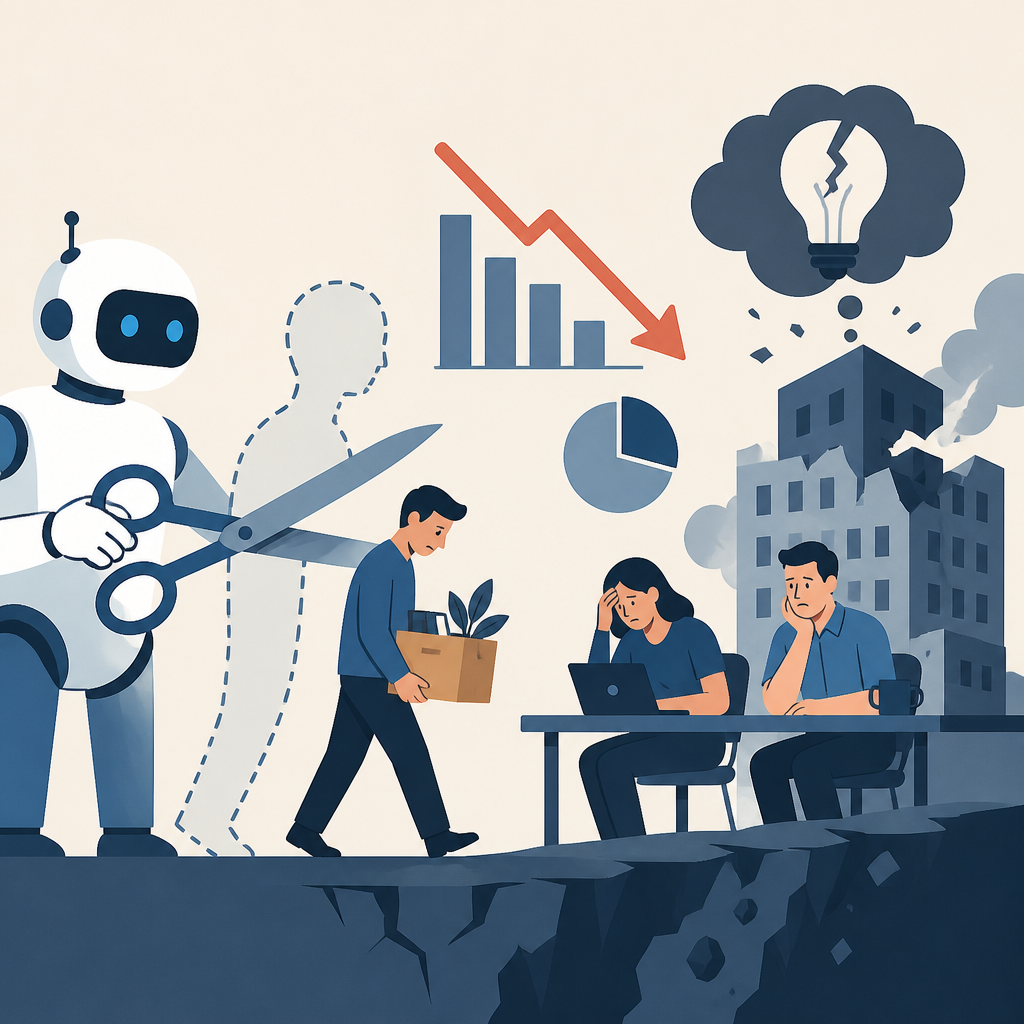
AI job cuts are dumb because they treat a productivity gain like a headcount target instead of a growth engine. Demis Hassabis is right to push back: if engineers become three or four times more productive, the rational move is to ship more software, attack more problems, and build more value. The companies already using AI to justify layoffs are confusing a tool that raises leverage with a strategy that shrinks ambition.
Productivity gains are not the same thing as labor elimination
Get the latest AI news in your inbox
Weekly picks of model releases, tools, and deep dives — no spam, unsubscribe anytime.
No spam. Unsubscribe at any time.
Hassabis’s core point is simple: if AI makes engineers faster, the company should do three or four times more work. That is not a sentimental defense of developers. It is basic operating logic. A team that can move faster can take on more product lines, more experiments, more internal tooling, and more customer problems. Cutting staff after a productivity jump means you have decided the ceiling of your company is fixed.
Google DeepMind is already framing Gemini 3.5 Flash around agentic coding tasks such as translating codebases, finding bugs, and writing operating systems. That is exactly the kind of capability that should widen the scope of what an engineering org can attempt. If a model can clear away repetitive coding work, the right response is not to fire the people who know the system. It is to redeploy them toward harder work that still needs judgment, architecture, and accountability.
Layoff-first thinking is usually a sign of weak imagination
Hassabis calls the layoff narrative a “lack of imagination,” and he is not wrong. The companies blaming AI for recent cuts often present automation as destiny, but the timing tells a different story. Amazon, Salesforce, and Block have all pointed to AI while trimming staff, yet none of those firms has exhausted the possible uses for the human talent they are shedding. They are optimizing for near-term cost optics, not for durable advantage.
The stronger case is visible inside Alphabet itself. Hassabis says he has “a million ideas,” from drug discovery to game design, and would love “free engineers” to pursue them. That is the real prize. When AI reduces the cost of routine coding, it frees capacity for adjacent bets that never get funded because engineering time is scarce. Companies that cut first will not suddenly become more innovative. They will simply become smaller and more cautious.
The market for AI coding still needs humans at the center
Even with the latest models, AI coding has not produced a blockbuster app or game on its own. Hassabis points to that gap as evidence that something is still missing. He is right. The industry is flooding the market with tools that can draft, refactor, and reason over code, but the leap from competent code generation to original, commercially successful software remains wide. A model can accelerate implementation without replacing the product taste, domain knowledge, and iteration loop that make software worth using.

The adoption numbers back this up. In the 2025 Stack Overflow survey, Anthropic and OpenAI led developer adoption with Claude and Codex, which shows that engineers want tools that help them work, not tools that erase them. That pattern matters. The winning products are not the ones promising a post-engineer world. They are the ones that slot into existing workflows and make teams better. The companies that interpret that demand as permission to slash payroll are reading the market backward.
The counter-argument
The strongest argument for AI-driven layoffs is blunt: if software output rises sharply, companies do not owe anyone the same staffing levels. Public markets reward margin expansion, not moral consistency. If one engineer can do the work of three, executives will say the responsible choice is to keep one and cut two. They will also argue that labor is always reorganized by automation, and that resisting this simply delays the inevitable.
There is also a real budget case. AI coding tools are getting faster and cheaper, and Google itself is pitching Gemini 3.5 Flash on those terms. For some routine work, especially maintenance and low-complexity feature development, a smaller team may genuinely be enough. A company that ignores that efficiency gain will waste money and lose to competitors that trim aggressively.
That counterargument fails on strategy, not arithmetic. Yes, some roles will shrink. But using AI as a pretext for broad layoffs confuses short-term savings with long-term strength. The companies that win this cycle will not be the ones with the leanest payroll; they will be the ones that convert AI leverage into more products, more experiments, and faster learning. Hassabis’s position is correct because it treats AI as capacity, not replacement. That is the only framing that creates durable advantage.
What to do with this
If you are an engineer, PM, or founder, stop treating AI adoption as a headcount exercise. Measure it as throughput: cycle time, bugs fixed, experiments shipped, customer issues resolved, and new bets launched. Use AI to remove the work that slows your team down, then reinvest that time into harder problems. If your plan for AI is only to cut payroll, you are not building a better company. You are just making a smaller one.
// Related Articles
- [IND]
WebX 2026 turns speaker hype into a conference brief
- [IND]
AI Weekly: 2026-07-06 ~ 2026-07-13
- [IND]
The AI Act should be treated as Europe’s operating system for AI
- [IND]
Booz Allen’s OpenAI Deal Is Real Advantage, Not Hype
- [IND]
OpenSearch’s vector search benchmark in 5 parts
- [IND]
Vector Databases That Work in Production