Why AWS is right to bet on USDC payments for AI agents
AWS is right to let AI agents pay with USDC through Coinbase and Stripe wallets.

AWS is right to let AI agents pay with USDC through Coinbase and Stripe wallets.
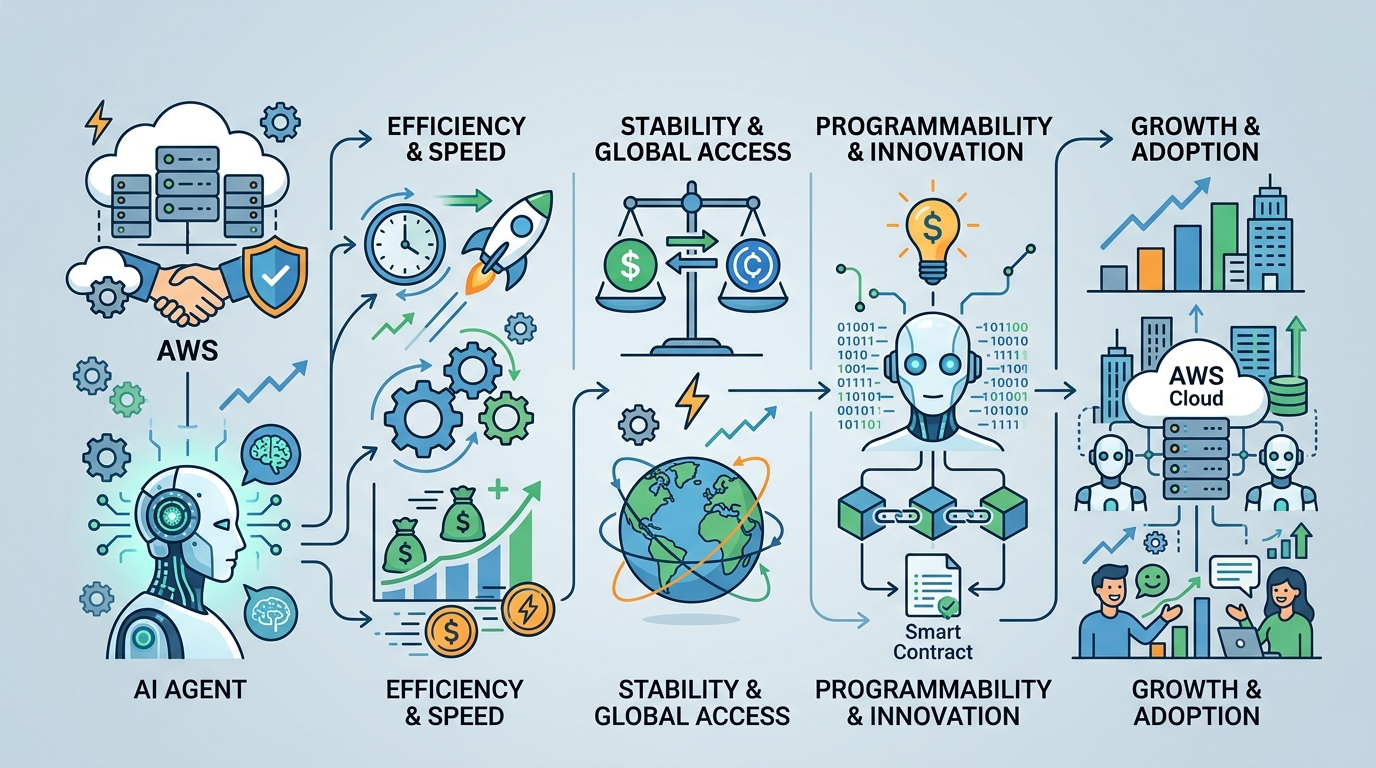
AWS is making the correct move by giving AI agents a real payment rail instead of forcing them to fake commerce through brittle API keys, manual billing, or human approval loops. The new setup for Amazon Bedrock AgentCore, paired with Coinbase or Stripe-powered wallets, turns agent actions into something closer to software buying software: an agent can pay a small amount, get a service, and keep moving. That matters because the next wave of automation will not be one giant model call. It will be thousands of tiny transactions, each too small to justify a human in the loop.
AI agents need money, not just permissions
Get the latest AI news in your inbox
Weekly picks of model releases, tools, and deep dives — no spam, unsubscribe anytime.
No spam. Unsubscribe at any time.
The core problem is simple: permissions do not solve payment. An agent that can call an API still cannot reliably pay for that API, meter usage, or settle costs across vendors without a separate billing layer. USDC changes that by giving the agent a stable, programmable unit of value. If an agent needs to buy a data lookup, a compute burst, or a premium tool invocation, it can do so directly instead of waiting for a monthly invoice or a pre-approved budget bucket.

This is not theoretical. Cloud services already run on metering, rate limits, and usage-based billing. The agent economy inherits those same mechanics but compresses them into far smaller increments. Micropayments are the missing primitive. By wiring Bedrock AgentCore to wallets from Coinbase or Stripe, AWS is acknowledging that agents are not just users with better autocomplete. They are economic actors that need a native way to transact.
Stablecoins fit the shape of agentic commerce
USDC is the right instrument because agent transactions need stability, speed, and predictable accounting. A payment rail for software agents cannot tolerate volatile token pricing or settlement delays that make a $0.02 action become a $0.07 headache by the time reconciliation happens. Stablecoins solve that by keeping the unit of account fixed while still giving developers a programmable payment layer that works across services and vendors.
Stripe and Coinbase also matter because they lower the integration burden for the companies that will actually build on this. Most teams do not want to manage private keys, custody workflows, or bespoke crypto plumbing just to let an agent purchase a tool call. If AWS can make USDC payments feel like a normal part of the Bedrock stack, it removes one of the biggest reasons agent commerce has stayed stuck in demos. The winning platform will not be the one with the most abstract vision. It will be the one that makes payment as boring as authentication.
The counter-argument
The best case against this approach is that agents do not need money at all. Enterprises can already expose APIs behind contracts, quotas, and internal chargeback systems. In that world, introducing wallets and stablecoins adds regulatory complexity, compliance questions, and another layer of risk that security teams will hate. There is also a real concern that agent payments could become a shiny workaround for problems that should be solved with better workflow design and clearer product boundaries.
That critique has force, but it only applies to closed systems. Inside a single company, chargeback may be enough. Outside the firewall, it breaks down fast. The moment an agent needs to buy from a third-party service, negotiate with a marketplace, or pay for usage across many independent providers, traditional billing becomes too slow and too manual. The limit is real: not every agent needs a wallet. But the category of agents that interact with external services does, and that category is exactly where the market is heading.
What to do with this
Engineers should stop treating payments as an afterthought in agent architecture. If you are building agent workflows, design for metered actions, explicit spend limits, audit logs, and reversible controls from day one. Founders should think about where an agent can create value only if it can complete a purchase or pay for access in the same flow. PMs should push teams to define which actions require human approval and which can safely be settled automatically. The companies that win will not just build smarter agents. They will build agents that can transact cleanly, cheaply, and at machine speed.
// Related Articles
- [IND]
OpenAI should not rush its IPO just to win the AI race
- [IND]
OpenAI updates its Europe privacy policy
- [IND]
OpenAI is right to keep ads out of sensitive chats
- [IND]
AI bootlegs are already draining streaming royalties
- [IND]
AMD and Microsoft push Windows ML on GPU and NPU
- [IND]
OpenAI’s IPO filing turns hype into scrutiny