Why Rust’s community threads still matter more than launch posts
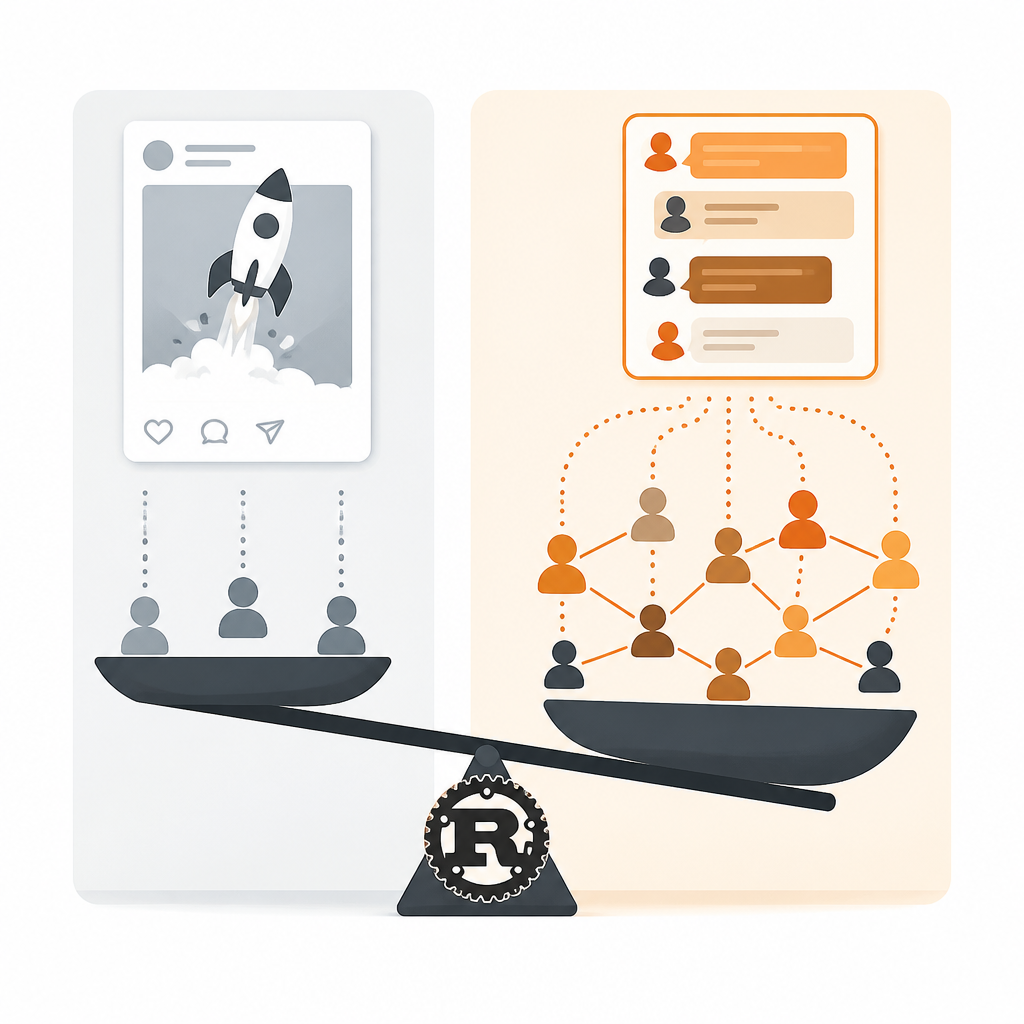
Rust’s weekly community threads matter because they reveal where the language is actually being used and tested.

Rust’s weekly community threads show where the language is actually being used and tested.
Rust’s weekly “what are you working on” threads matter more than polished release announcements because they expose the real center of gravity: embedded work, unsafe auditing, and experimental tooling. In this week’s thread, one developer is building embedded Rust on rp235xa and RP2040 with Embassy, another is shipping an LLVM-IR analyzer for FFI and unsafe boundaries, and a third is experimenting with an AI code roaster. That mix is not noise. It is a live map of Rust’s value proposition in 2026: systems work, correctness work, and tools that sit close to the metal.
Rust’s value is proven in the places that hurt
Get the latest AI news in your inbox
Weekly picks of model releases, tools, and deep dives — no spam, unsubscribe anytime.
No spam. Unsubscribe at any time.
The strongest signal in the thread is embedded development. One participant is working with Embassy on RP235xa and RP2040, then pushing into “unity 2d for embedded rust,” which is exactly the kind of project that shows Rust’s practical edge. Embedded systems punish weak memory discipline, unclear ownership, and sloppy concurrency. Rust keeps showing up there because it makes those failure modes harder to ship. That is not a theoretical win; it is a day-to-day productivity and safety win for people building on constrained hardware.

There is also a social proof effect here that release notes never capture. When a forum thread casually includes embedded control, math-heavy experimentation, and hardware ambition from someone who says they do not have the budget for robotics arms, it tells you the language has crossed from “interesting” into “accessible enough to build real things.” That matters. A language becomes strategically important when people use it to solve problems they could not afford to solve otherwise, not when a keynote says it is fast.
Rust’s ecosystem is being shaped by tool builders, not just app builders
The second standout is OmniScope, described as an LLVM-IR static analyzer for auditing heavy FFI and unsafe boundaries. That is a serious Rust-adjacent tool, and it points to a truth many teams ignore: the hardest part of adopting Rust is not syntax, it is proving correctness at the edges. FFI is where memory safety gets negotiated with the rest of the software stack. A tool that inspects those borders is more valuable than another generic linter because it attacks the exact place where Rust projects still fail in practice.
This is where community threads become more than status updates. They reveal the ecosystem’s self-correction loop. Users are not only writing applications; they are building analyzers, guardrails, and workflow tools that make Rust safer to use at scale. That is how a language matures. Python got notebooks, JavaScript got bundlers, and Rust is getting boundary analyzers and safety-focused tooling. The thread shows a community that understands the next bottleneck is not performance, it is trust.
Playful tools are not a distraction, they are a sign of health
The “AI roaster” project might sound frivolous next to embedded work and unsafe analysis, but it is actually another good sign. A language ecosystem stays healthy when people feel free to build weird, opinionated tools on top of it. A sarcastic peer that roasts bad code style is not infrastructure, but it is a proof of cultural confidence. The community is not trapped in survival mode. It has enough momentum to support experimentation, humor, and tooling that makes engineering habits more visible.
There is a deeper point here about Rust’s identity. The language has always attracted builders who care about discipline, and the thread shows that discipline does not have to be joyless. A project that critiques layout mess and code style is a small example, but it reflects a broader truth: people do better work when tools give immediate, concrete feedback. Rust’s community is increasingly building those feedback systems for itself, which is how a language moves from adoption to habit.
The counter-argument
The opposing view is simple: forum threads are anecdotal, self-selected, and easy to overread. A few posts about embedded projects and side tools do not prove anything about Rust’s broader trajectory. A release note, benchmark suite, or survey offers cleaner evidence than a community hangout. If you want to know whether Rust is growing, the skeptics say, look at adoption metrics and package downloads, not a handful of enthusiastic posts.
That objection is fair as far as it goes. Community threads do not replace hard metrics. But they do something those metrics cannot: they show what kinds of problems people think Rust is best at solving right now. That is a strategic signal, not a statistical one. If the same thread keeps surfacing embedded systems, unsafe auditing, and developer tooling, it means Rust’s reputation is becoming concrete in the exact areas where it can win. The thread is not the proof. It is the pattern.
What to do with this
If you are an engineer, use threads like this as a radar, not entertainment. Look for repeated project types, recurring pain points, and the tools people are building around those pain points. If you are a PM or founder, pay attention to where users are hacking around the edges of the language, because that is where product opportunities live. In Rust’s case, the opportunity is clear: make embedded workflows smoother, make unsafe boundaries more visible, and make safety tooling easier to adopt. The community is already telling you where the pressure is.
// Related Articles
- [IND]
WebX 2026 turns speaker hype into a conference brief
- [IND]
AI Weekly: 2026-07-06 ~ 2026-07-13
- [IND]
The AI Act should be treated as Europe’s operating system for AI
- [IND]
Booz Allen’s OpenAI Deal Is Real Advantage, Not Hype
- [IND]
OpenSearch’s vector search benchmark in 5 parts
- [IND]
Vector Databases That Work in Production