How AI and Maps Are Changing Navigation
MCP is turning maps into AI tools. Baidu, AutoNavi, and Tencent are exposing richer routing, POI, and live data through one protocol.

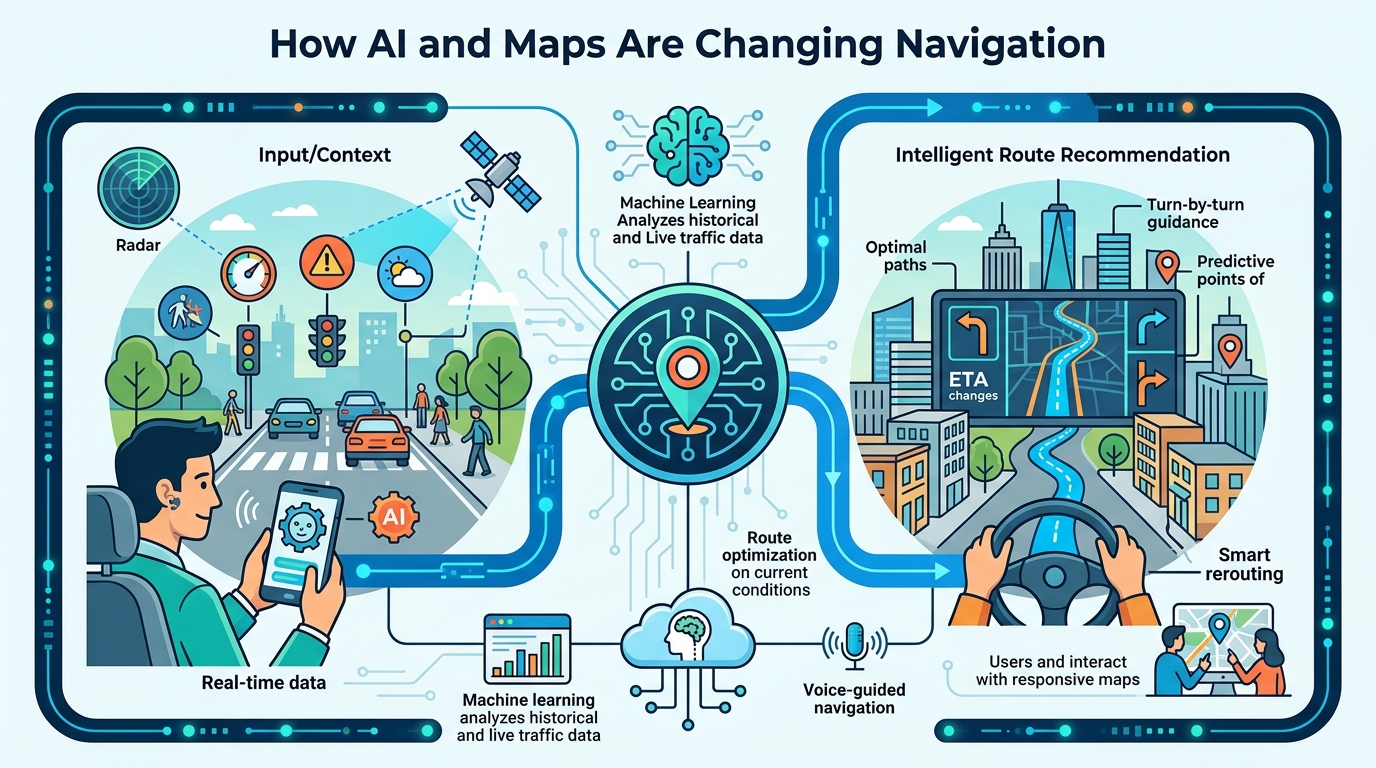
Maps used to answer one question: “How do I get there?” Now they can answer a much messier one: “Where should I go, when should I leave, what’s nearby, and can you book it for me?” That shift is already visible in the way Anthropic’s Model Context Protocol is being adopted by major map providers in China.
The interesting part is not that maps got smarter. It’s that map companies are turning routing, search, traffic, and local services into tools that AI agents can call directly. Once that happens, navigation stops being a static app feature and becomes something closer to a live operating layer for the physical world.
MCP turns maps into callable tools
Get the latest AI news in your inbox
Weekly picks of model releases, tools, and deep dives — no spam, unsubscribe anytime.
No spam. Unsubscribe at any time.
The Model Context Protocol, usually shortened to MCP, is an open standard for connecting AI models to external tools. Think of it as a common interface between an LLM and services like maps, weather, booking systems, or internal company data. Instead of writing one-off integrations for every model and every app, developers expose capabilities through a shared protocol.

That matters for maps because map data is already structured around actions: geocoding, route planning, nearby search, traffic lookup, and POI detail queries. MCP makes those actions easier for an AI agent to discover and use. The model can ask for a route, compare options, and combine that with other tools in the same session.
In practice, this changes the user experience in a few concrete ways:
- An agent can turn plain text into a route without forcing the user through menus.
- It can combine live traffic, weather, and transit timing in one request.
- It can extract locations from messy text, such as a long travel note or meeting invite.
- It can hand off the result to another app for booking, sharing, or voice guidance.
The best part is that MCP reduces the glue code problem. Developers no longer need a custom connector for every AI product they want to support. They publish a tool server, describe the functions, and let the model decide when to call them.
Baidu, AutoNavi, and Tencent are taking different paths
China’s three big map players are all moving into MCP, but they are not doing the same thing. Baidu Maps, AutoNavi Maps, and Tencent Location Service each bring a different business model and product angle to the table.
Baidu is pushing map capabilities into AI infrastructure and enterprise use cases. AutoNavi is tying maps to Alibaba’s local-life ecosystem. Tencent is leaning into cloud delivery and intelligent driving. The common thread is MCP, but the value proposition differs quite a bit.
- Baidu Maps: exposes functions such as route planning, POI search, real-time traffic, and intelligent POI extraction from text. It also has open-source MCP server code on GitHub and supports zero-code workflows through Baidu’s AI tooling.
- AutoNavi Maps: offers route planning across driving, walking, cycling, and transit, plus nearby search, distance measurement, weather, and one-click handoff into the AutoNavi app. Its pitch is app-to-app continuity inside Alibaba’s ecosystem.
- Tencent Location Service: uses an SSE-based MCP server, which means cloud delivery, automatic upgrades, and live updates without local deployment. It also emphasizes advanced route planning and semantic output that is easier for models to read.
What jumps out here is that maps are no longer competing only on coverage or ETA accuracy. They are competing on how well they plug into AI workflows.
Why this matters for developers and product teams
For developers, the biggest change is that maps become composable. A product team building a travel assistant, logistics dashboard, or in-car copilot can ask an LLM to call map functions without hard-coding every branch of the workflow. That cuts integration work and makes it easier to ship features that feel natural in chat.
There is also a real product advantage in the details. Baidu’s intelligent POI extraction can pull structured location data out of messy text. Tencent’s semantic results are friendlier to model reasoning. AutoNavi’s app handoff reduces friction when a user wants to move from planning to action.
“The map is a mirror of the city, and the city is a mirror of the map.” — Jack Dangermond, Esri founder
That quote lands here because AI is turning the mirror into an interface. Instead of just showing roads, the map can now help interpret intent. “Find a lunch spot near my next meeting” becomes a multi-step task: infer the meeting location, check travel time, compare nearby places, and route the user there.
If you want the practical takeaway, it is this: teams that already depend on maps should start thinking in terms of tool access, not just SDKs. The companies that expose clean MCP servers will be easier to plug into AI agents, copilots, and voice interfaces.
The numbers behind the feature gap
The differences between these map stacks are easier to see when you line up the concrete details. None of these numbers tells the whole story, but together they show how each company is positioning itself.
- Baidu Maps MCP: up to 14 service interfaces in the first batch, including geocoding, route planning, POI search, intelligent POI extraction, traffic lookup, and IPv6 positioning.
- AutoNavi Maps MCP: 12 core functions, including multiple route types, IP location, weather, nearby search, keyword search, and POI detail lookups.
- Tencent Location Service MCP: cloud-based SSE delivery, automatic reconnection, live updates, and route planning features such as future route planning and waypoint sorting.
- Baidu developer flow: Node.js and Python code are open-sourced, and the mcp-server-baidu-maps package simplifies Python access.
- AutoNavi deployment flow: NPX-based quick setup is promoted as a fast way to connect apps to the AutoNavi map experience.
Those numbers matter because they show different product philosophies. Baidu is selling breadth plus AI tooling. AutoNavi is selling consumer-facing continuity. Tencent is selling live cloud delivery and driving-oriented logic.
There is another layer here too: business model. Baidu is aiming at government and enterprise projects, AutoNavi is monetizing local-life services and app traffic, and Tencent is tying location services to autonomous driving and cloud subscriptions. So the same protocol is feeding three different revenue engines.
What eye-opening features actually look like
If you strip away the buzzwords, the most eye-opening features are the ones that reduce friction in everyday tasks. A user can ask for a meeting point in natural language, get it turned into a route, and then push it into a map app without manual copy-paste. A visually impaired user can get voice-guided navigation with obstacle awareness. A driver can get live route updates that react to traffic in real time.
There is also a much bigger product idea hiding in plain sight: the map can become the place where intent gets resolved. A person may start with a vague goal such as “find a family-friendly dinner spot near the hotel,” and the AI can turn that into a concrete place, a route, a booking action, and a shareable itinerary.
That is why MCP matters more than another API wrapper. It makes the map available to the model in a standard way, which means map features can be mixed with weather, calendars, ride-hailing, ticketing, and local search in one session. Once that happens, navigation becomes part of a larger action loop.
My read: the next competitive edge in maps will come from who can expose the cleanest tool surface for agents, not who can draw the prettiest map. The companies that do this well will make navigation feel less like switching apps and more like asking a very capable assistant for help.
For product teams, the actionable move is simple. If your app depends on location, test whether your map provider has an MCP server, a clear tool schema, and cloud delivery options. If it does, you can build AI-driven flows much faster than with a traditional SDK-only setup.
The real question now is not whether maps and AI belong together. It is which teams will turn that pairing into daily behavior before everyone else does.
// Related Articles
- [IND]
WebX 2026 turns speaker hype into a conference brief
- [IND]
AI Weekly: 2026-07-06 ~ 2026-07-13
- [IND]
The AI Act should be treated as Europe’s operating system for AI
- [IND]
Booz Allen’s OpenAI Deal Is Real Advantage, Not Hype
- [IND]
OpenSearch’s vector search benchmark in 5 parts
- [IND]
Vector Databases That Work in Production