Why Nebius’s AI Pivot Is More Real Than Hype
Nebius’s Nvidia-backed AI pivot is a real business shift, not just a stock pop.

Nebius’s Nvidia-backed AI pivot is a real business shift, not just a stock pop.
Nebius Group’s jump is justified because the company has turned a speculative AI infrastructure story into one backed by major contracts, outside capital, and a clearer operating plan. The combination of a US$2 billion Nvidia investment, a US$27 billion Meta deal, a US$19.4 billion Microsoft agreement, and the Eigen AI acquisition changes the business from a generic cloud provider into a focused AI capacity platform with visible demand.
The contracts changed the quality of the story
Get the latest AI news in your inbox
Weekly picks of model releases, tools, and deep dives — no spam, unsubscribe anytime.
No spam. Unsubscribe at any time.
The biggest difference is that Nebius now has proof of demand at a scale that matters. A US$27 billion contract with Meta and a US$19.4 billion agreement with Microsoft are not the kind of numbers that support a “maybe it works” narrative. They tell investors that hyperscalers and AI buyers are willing to lock in capacity for years, which reduces the core uncertainty around whether Nebius can fill its data centers.

That matters because infrastructure businesses are usually punished for building first and hoping demand arrives later. Nebius is moving in the opposite direction: contracted backlog is arriving before the full build-out is complete. That is why the stock can re-rate even before the company proves GAAP profitability. The market is not paying for current earnings here. It is paying for the credibility of future utilization.
Nvidia’s capital is strategic validation, not just cash
Nvidia’s US$2 billion investment is more than a financing event. It is a signal that the most important supplier in the AI stack sees Nebius as a serious deployment partner. In AI infrastructure, endorsement from Nvidia carries practical weight because it can influence access to GPUs, ecosystem alignment, and customer confidence. That is especially important for a neocloud operator trying to compete against better-capitalized incumbents.
The Eigen AI acquisition strengthens that same thesis. Spending about US$643 million on a capability acquisition suggests Nebius wants to move up the stack, not just rent out raw compute. If the company can pair infrastructure with higher-value AI platform services, it gains more pricing power and a better chance of turning massive capex into durable margins. That is the difference between being a commodity host and being a strategic AI layer.
Scale is now the asset, but scale is also the trap
The bullish case works only if Nebius can convert its backlog into sustained utilization. AI infrastructure is capital intensive by design, and the company’s own narrative still depends on heavy spending, expanding capacity, and narrowing losses over time. The near-term test is not whether demand exists. Demand clearly exists. The test is whether Nebius can deliver it fast enough and efficiently enough to avoid turning growth into dilution and margin pressure.
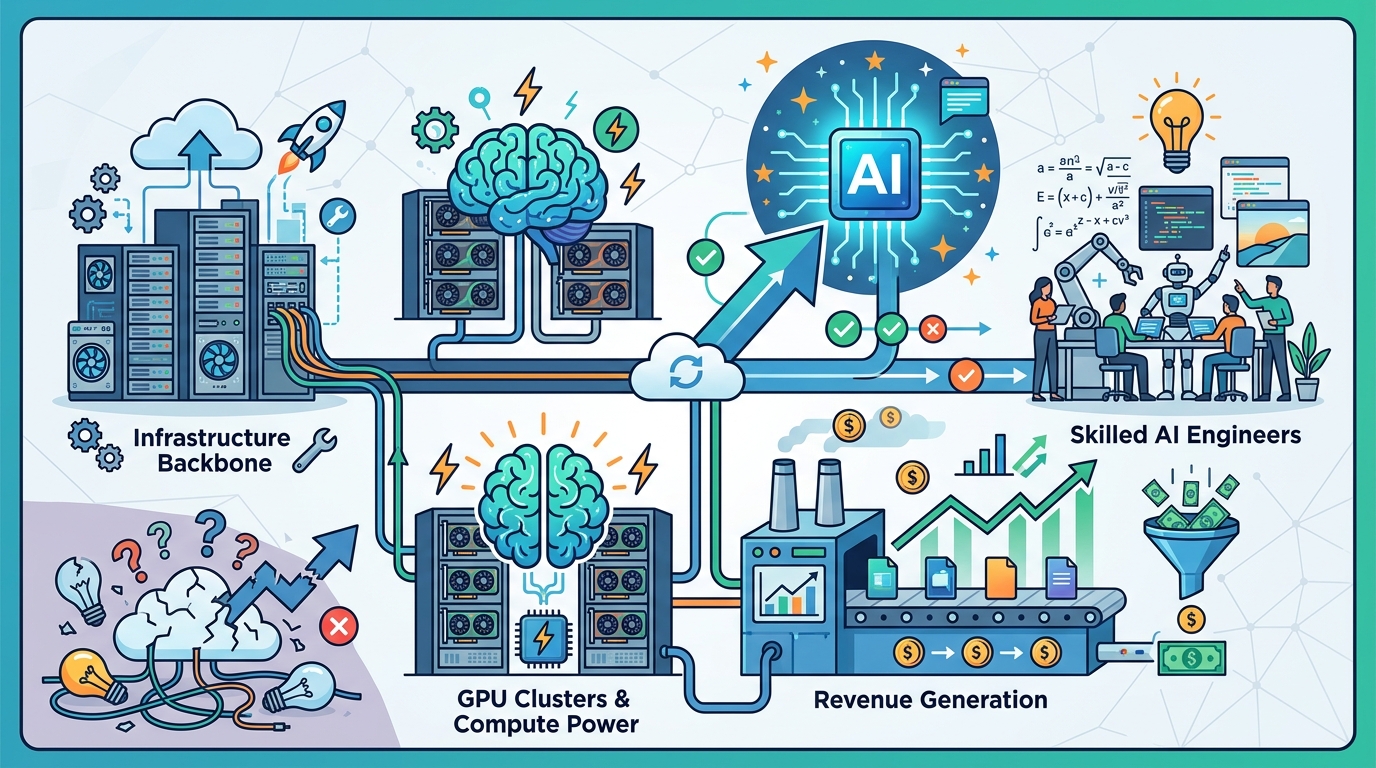
That is why the market is watching operating leverage so closely. If the company’s cost structure improves as capacity comes online, the stock has room to keep moving higher. If it misses deployment timelines or keeps burning cash without visible efficiency gains, the same deal announcements will start to look like expensive obligations rather than strategic wins. In cloud and AI infrastructure, scale creates optionality, but it also magnifies execution risk.
The counter-argument
Critics have a strong case: Nebius is still a young, loss-making infrastructure company in a brutally competitive market. Hyperscalers, specialized cloud providers, and vertically integrated AI giants all want the same customers, and many of them have deeper balance sheets. The company’s valuation also depends on assumptions about future revenue, margins, and financing conditions that are far from guaranteed.
There is also a real concern that big contracts do not automatically translate into attractive economics. Long-term agreements can lock in demand, but they can also lock in pricing pressure if the customer has leverage. If Nebius must keep raising capital to fund expansion, shareholders may face dilution before the business reaches self-sustaining profitability.
That counter-argument is valid, but it does not defeat the bull case. It simply defines the hurdle. Nebius is no longer a story stock built on vague AI enthusiasm; it is a financed growth platform with tangible backlog and strategic support. The risk is execution, not thesis. For investors, that is a better problem to have than the old one, which was whether anyone would pay for the capacity at all.
What to do with this
If you are an investor or operator watching Nebius, treat this as a case study in how AI infrastructure companies earn credibility: secure demand first, then prove deployment discipline and margin improvement. Do not focus on the headline stock move. Focus on utilization, capex efficiency, backlog conversion, and whether partnerships like Nvidia’s actually reduce financing risk. That is where the real signal lives.
// Related Articles
- [IND]
WebX 2026 turns speaker hype into a conference brief
- [IND]
AI Weekly: 2026-07-06 ~ 2026-07-13
- [IND]
The AI Act should be treated as Europe’s operating system for AI
- [IND]
Booz Allen’s OpenAI Deal Is Real Advantage, Not Hype
- [IND]
OpenSearch’s vector search benchmark in 5 parts
- [IND]
Vector Databases That Work in Production