Anthropic backs AI consulting venture with Wall Street
Anthropic is backing a new AI-native services firm with Blackstone, Hellman & Friedman, and Goldman Sachs to challenge consulting giants.

Anthropic is backing a new AI services company with Blackstone, Hellman & Friedman, and Goldman Sachs.
Anthropic says the new venture is backed by about $1.5 billion in committed capital. It is aimed at mid-size businesses, and it puts the maker of Claude into a direct fight with consulting firms that sell AI transformation by the hour.
The pitch is simple: instead of paying a large consulting team to design and implement AI projects, companies would get a standalone firm with Anthropic engineering support inside the operation. That model is a sharp response to a market where services spending still dwarfs software spending.
| Item | Figure | Why it matters |
|---|---|---|
| Committed capital | $1.5 billion | Shows the venture has real scale from day one |
| Services to software spend | 6:1 | Explains why consulting is such a large target |
| AI factor in PE valuations | 85% | Signals how strongly buyers now price AI capability |
| Target customer | Mid-size businesses | Points to a market that often lacks in-house AI talent |
Why Anthropic is going after consulting
Get the latest AI news in your inbox
Weekly picks of model releases, tools, and deep dives — no spam, unsubscribe anytime.
No spam. Unsubscribe at any time.
The consulting market has a familiar weakness: it sells expertise, but the hard part of enterprise AI is execution. Companies do not just need strategy decks or pilot programs. They need engineers who can connect models to messy internal systems, fix data problems, and keep projects moving after the kickoff meeting ends.

That is where Anthropic is trying to change the economics. The company is not pitching Claude as another software subscription sitting on top of an existing workflow. It is moving toward a services business that packages the model, the implementation team, and the operating know-how together.
Fortune’s reporting says the target is a market where companies spend six dollars on services for every dollar they spend on software. That ratio explains why the opportunity is so large and why the consulting firms are vulnerable if AI can do more of the work faster and cheaper.
- Anthropic is pairing model access with embedded engineering support.
- The venture is structured as a standalone company.
- Its backers include Blackstone, Hellman & Friedman, and Goldman Sachs.
- Additional support comes from General Atlantic, Leonard Green, Apollo Global Management, GIC, and Sequoia Capital.
Blackstone and Goldman are buying implementation, too
Private equity is the obvious starting point. Firms backed by Blackstone and its peers already face pressure to prove that AI is more than a buzzword in finance teams, forecasting, and reporting. If a portfolio company can adopt AI faster, the sponsor can point to better margins, better controls, and better exit optics.
Blackstone President and COO Jon Gray said the venture is meant to address “one of the most significant bottlenecks to enterprise AI adoption,” which he described as the shortage of engineers who can implement frontier AI systems quickly. That quote matters because it gets to the real problem: most companies do not lack ambition, they lack people who can ship.
“One of the most significant bottlenecks to enterprise AI adoption” is the shortage of engineers who can implement frontier AI systems quickly, said Blackstone President and COO Jon Gray.
Fortune reported in November 2025 that 85% of buyers now factor AI-enabled finance capabilities into company valuations. That is a strong signal that AI is no longer treated as a side project in private equity. It is part of the asset’s price tag.
Anthropic CFO Krishna Rao framed the new venture as an answer to demand that is already larger than one delivery model can handle. Goldman Sachs’ Marc Nachmann added that the goal is to democratize access to forward-deployed engineers for companies that cannot afford them on their own.
How this compares with the old consulting model
The old model is familiar to anyone who has sat through a big transformation project. A firm sells strategy, then staffing, then implementation, then a long tail of support. The new Anthropic venture tries to collapse that chain into one productized offer with AI at the center.
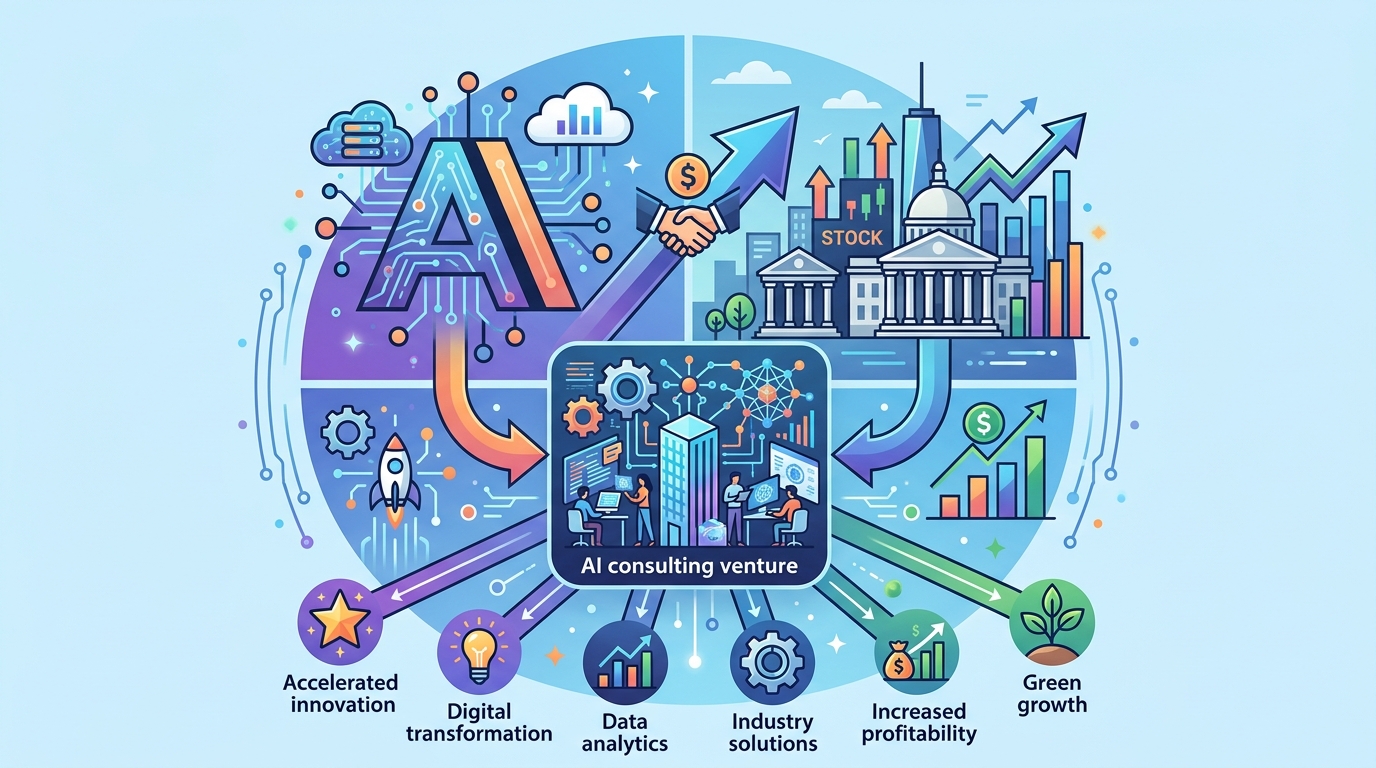
That matters because the economics are different. Traditional consulting depends on billable hours and large teams. An AI-native services company can bundle model usage, process redesign, and execution into a single delivery motion. If it works, the value shifts from advice to output.
- Traditional consulting sells people first and software second.
- Anthropic’s model sells output with the model built into the delivery team.
- Private equity buyers want faster adoption because AI now affects valuation.
- Portfolio companies can use a shared services partner instead of building everything in-house.
The structure also echoes Palantir’s forward-deployment style, where engineers work close to the customer instead of handing off a tool and walking away. The difference is that Anthropic controls the model layer too, which gives it a tighter grip on the full stack of value creation.
There is also a competitive angle. The article notes that OpenAI is reportedly pursuing a similar setup with TPG and Bain Capital. If that happens, the consulting fight stops being about who has the best slide deck and starts being about who can deliver AI outcomes faster.
What this means for buyers and consultants
For enterprise buyers, the appeal is obvious. They get access to frontier models, implementation talent, and a partner with a financial stake in making the system work. For consultants, the threat is less subtle: the most profitable part of the AI services boom may move away from strategy firms and toward model companies that can package execution themselves.
That does not mean consulting disappears. It means the work gets split. Firms that are good at change management, process redesign, and domain-specific operations can still win. But generic AI transformation pitches will get harder to defend when a model provider can show up with engineers and a delivery structure attached.
If Anthropic can prove this model with mid-size businesses and private equity portfolios, the next question is whether it expands into regulated industries, manufacturing, or healthcare. Those sectors have bigger implementation hurdles, but they also have some of the highest willingness to pay for working AI systems.
For now, the smartest takeaway is simple: AI revenue is starting to look less like software licensing and more like services sold around the model. If that trend holds, the companies that control both the model and the implementation layer will have a clear advantage over firms that only sell advice.
Related reading: AI enterprise services are becoming the new battleground.
// Related Articles
- [IND]
WebX 2026 turns speaker hype into a conference brief
- [IND]
AI Weekly: 2026-07-06 ~ 2026-07-13
- [IND]
The AI Act should be treated as Europe’s operating system for AI
- [IND]
Booz Allen’s OpenAI Deal Is Real Advantage, Not Hype
- [IND]
OpenSearch’s vector search benchmark in 5 parts
- [IND]
Vector Databases That Work in Production