Bezos Bets on Physical-World AI with Prometheus
Jeff Bezos’ Project Prometheus hired xAI cofounder Kyle Kosic, signaling a $6.2B push into AI for engineering, manufacturing, and aerospace.

Jeff Bezos is back in an operating role, and he is spending like someone with a point to prove. His new AI company, Project Prometheus, has reportedly raised $6.2 billion and hired Kyle Kosic, a former infrastructure lead at xAI who also spent time at OpenAI.
That hire matters because Prometheus is not chasing another chatbot. It is aiming at engineering, manufacturing, computer systems, cars, and spacecraft, which is a much harder target and a much bigger market if it works.
The move also says something about where the AI talent war is headed. The fight is no longer just about model researchers and product people. It is about people who can build the infrastructure that keeps large systems alive when they are deployed in factories, labs, and industrial pipelines.
What Project Prometheus is trying to build
Get the latest AI news in your inbox
Weekly picks of model releases, tools, and deep dives — no spam, unsubscribe anytime.
No spam. Unsubscribe at any time.
Project Prometheus is still secretive, but the reporting around it is clearer than the company itself. The New York Times reported that Bezos will be a co-CEO, his first formal operating role since stepping down as Amazon CEO in 2021. The company is reportedly focused on AI that can simulate and understand the physical world, not just generate text.

That distinction matters. A system that writes emails is useful. A system that helps optimize a turbine, a robot arm, or a spacecraft workflow is a different class of tool entirely. If Prometheus gets even part of that right, it could sit closer to industrial software than consumer AI.
There is also a pattern here. Bezos has spent years building businesses around logistics, cloud infrastructure, delivery, and space. Prometheus fits that instinct. It looks like an attempt to apply AI to the parts of the economy where atoms still matter more than tokens.
- Reported funding: $6.2 billion
- Leadership: Jeff Bezos as co-CEO
- Hiring footprint: San Francisco, London, and Zurich
- Target domains: engineering, manufacturing, automotive, aerospace
Why Kyle Kosic is the kind of hire that signals intent
Kyle Kosic is not a celebrity AI name in the way Sam Altman or Dario Amodei is, but that is exactly why the hire is interesting. He worked on infrastructure at xAI and had previously joined OpenAI after leaving xAI in 2024. In other words, he is the kind of engineer who knows how to keep large AI systems running when the stakes are high.
Prometheus does not need another polished demo. It needs people who understand distributed systems, training stability, model serving, and the ugly reality of running large-scale AI in production. That is where Kosic’s background fits.
There is a real quote that helps explain why infrastructure talent matters so much in this phase of AI. OpenAI CEO Sam Altman said, “There will be a lot of things that are better than me at some things.” That line, from a 2023 interview, captures a basic truth of the current market: the bottleneck is shifting from idea generation to execution at scale.
“There will be a lot of things that are better than me at some things.” — Sam Altman
When a company like Prometheus hires someone with xAI and OpenAI experience, it is buying more than a résumé. It is buying pattern recognition from two of the most aggressive AI shops in the world, plus the ability to translate research ambition into systems that do not fall over under load.
- Kosic worked on infrastructure at xAI
- He joined OpenAI in 2024 after leaving xAI
- His background spans both model-heavy and systems-heavy environments
- Prometheus needs exactly that mix for industrial AI
How Prometheus compares with OpenAI and xAI
OpenAI and xAI are still mostly associated with general-purpose AI assistants, foundation models, and consumer or enterprise software. Prometheus appears to be aiming one layer deeper into the stack, where AI is used to reason about machines, materials, and physical processes.
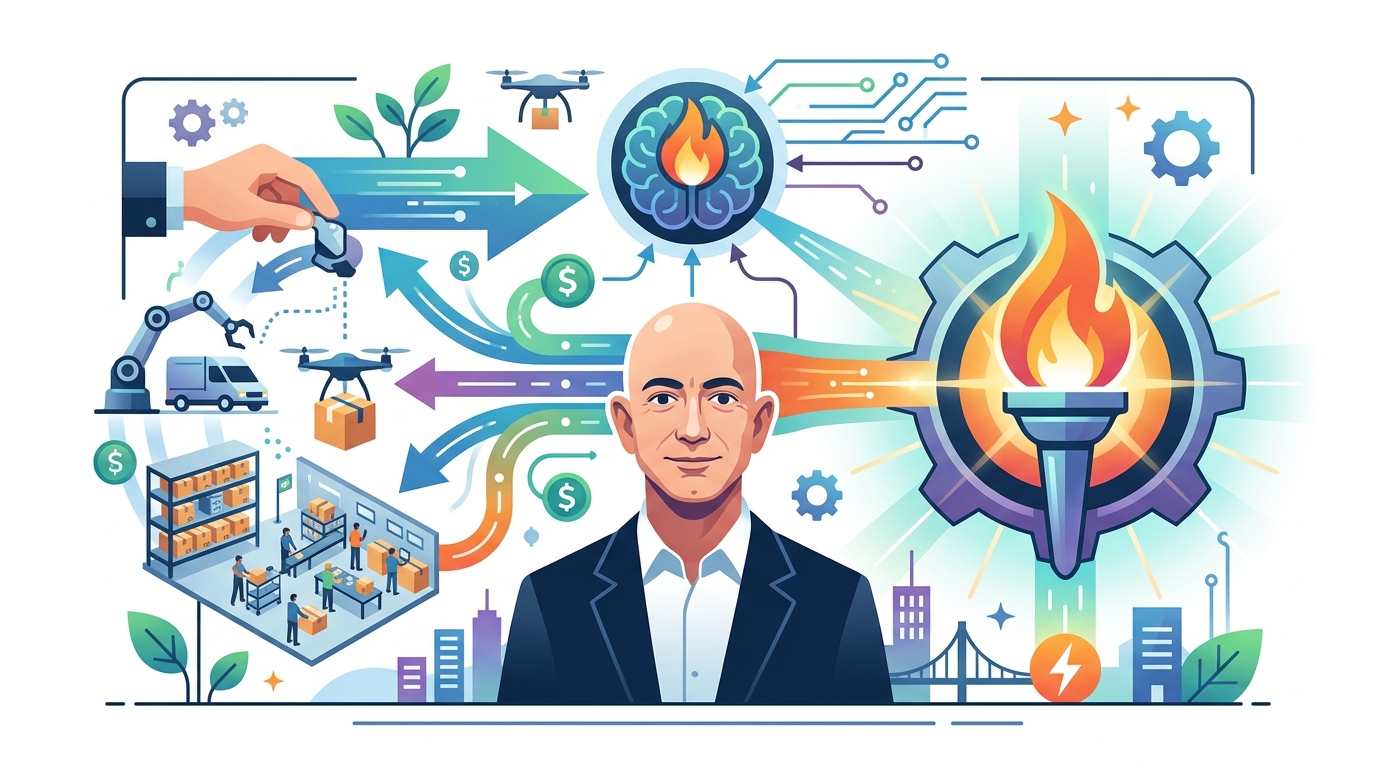
That creates a different competitive set. Prometheus is closer to industrial AI, robotics software, and simulation than to a chat product. It also means the company may care more about data pipelines from sensors, digital twins, and operational constraints than about benchmark scores on language tasks.
Here is the clearest comparison available from the public reporting so far:
- OpenAI: broad general-purpose AI, massive consumer and enterprise attention, enormous model-training spend
- xAI: fast-moving model company with a strong infrastructure appetite and a public-facing assistant strategy
- Project Prometheus: industrial and physical-world AI, with reported focus on manufacturing, aerospace, and engineering systems
- Reuters: reported in March that Bezos was exploring a $100 billion manufacturing fund, which would fit Prometheus’ direction
The money also tells its own story. A $6.2 billion war chest is huge for a startup, even by AI standards. It gives Prometheus room to hire aggressively, buy compute, and experiment with long-horizon industrial use cases that may take years to mature.
That is a very different bet from the usual AI product cycle. Consumer AI can ship fast and iterate in public. Industrial AI has to survive procurement, safety reviews, integration work, and real-world failure modes. Those hurdles are slower, but they can also create stickier businesses once a system is embedded in operations.
Why “physical-world AI” is suddenly getting money
The phrase “physical-world AI” sounds vague until you map it to actual use cases. It can mean simulation for factories, optimization for supply chains, control systems for robots, or design assistance for aircraft and vehicles. In each case, the AI has to deal with constraints that are far less forgiving than a text prompt.
This is also where Bezos’ broader strategy becomes easier to read. He built Amazon by obsessing over logistics, infrastructure, and scale. If he applies that same instinct to AI, the result is likely to be less flashy and more operational than the average startup pitch.
There is a reason investors and founders keep circling this category. Software that helps design, run, or repair physical systems can attach to expensive workflows and long contracts. If Prometheus can become useful inside manufacturing lines or aerospace engineering teams, its value could be tied to real economic output rather than user engagement.
Still, the hard part is obvious. Physical systems are messy, data is fragmented, and deployment errors are expensive. A model that looks strong in a lab can fail when it meets real equipment, real operators, and real deadlines.
That is why this hire is more than a talent headline. It is a signal that Prometheus is building for the hard part first: the infrastructure, the systems, and the operational depth needed to make AI useful outside screens.
What to watch next
If Bezos keeps hiring from OpenAI, xAI, DeepMind, and Tesla, Prometheus will start to look less like a stealth project and more like a full-stack industrial AI company. The next meaningful signal will be whether it announces partnerships, product pilots, or acquisitions tied to robotics, simulation, or manufacturing software.
My read is simple: the real competition is moving from model quality to deployment quality. The company that can make AI reliable inside factories, labs, and engineering teams may matter more over the next five years than the company with the flashiest demo today.
So the question is not whether Bezos can assemble a strong team. He already is. The question is whether Project Prometheus can turn that talent into systems that actually change how physical industries work.
If it can, the next big AI story may come from a factory floor, a design lab, or an aerospace program, not a chatbot tab.
// Related Articles
- [IND]
WebX 2026 turns speaker hype into a conference brief
- [IND]
AI Weekly: 2026-07-06 ~ 2026-07-13
- [IND]
The AI Act should be treated as Europe’s operating system for AI
- [IND]
Booz Allen’s OpenAI Deal Is Real Advantage, Not Hype
- [IND]
OpenSearch’s vector search benchmark in 5 parts
- [IND]
Vector Databases That Work in Production