Cloudflare and Mastercard team up on cyber defense
Cloudflare and Mastercard are joining forces to map attack surfaces, grade risk, and automate defenses for businesses, governments, and critical infrastructure.

Cloudflare and Mastercard just announced a partnership aimed at one of the messiest problems in security: organizations often do not know what is exposed to the internet until an attacker finds it first. The pitch is simple and pretty compelling. Combine threat intelligence, attack-surface monitoring, and application security so smaller organizations can spot risk faster and act on it without hiring an army of analysts.
The timing makes sense. Cloudflare says the tools are being built for small businesses, critical infrastructure, and governments, three groups that usually have the least room for error and the least budget to fix mistakes after they happen. Mastercard brings in its Recorded Future and RiskRecon capabilities, while Cloudflare contributes its Application Security portfolio and Security Insights dashboard.
What makes this interesting is not the partnership branding. It is the workflow they are trying to build: discover exposed assets, score the risk, then push protection into place from the same interface. If they pull it off, that could shrink the gap between “we found the problem” and “we fixed the problem,” which is where a lot of breaches get their opening.
What the partnership is trying to fix
Get the latest AI news in your inbox
Weekly picks of model releases, tools, and deep dives — no spam, unsubscribe anytime.
No spam. Unsubscribe at any time.
Security teams have spent years dealing with shadow IT, outsourced services, forgotten subdomains, and old systems that never got retired. Each one adds a little more surface area for attackers to probe. The problem is especially sharp for smaller organizations, which often run lean IT teams and have to prioritize survival over continuous security tuning.
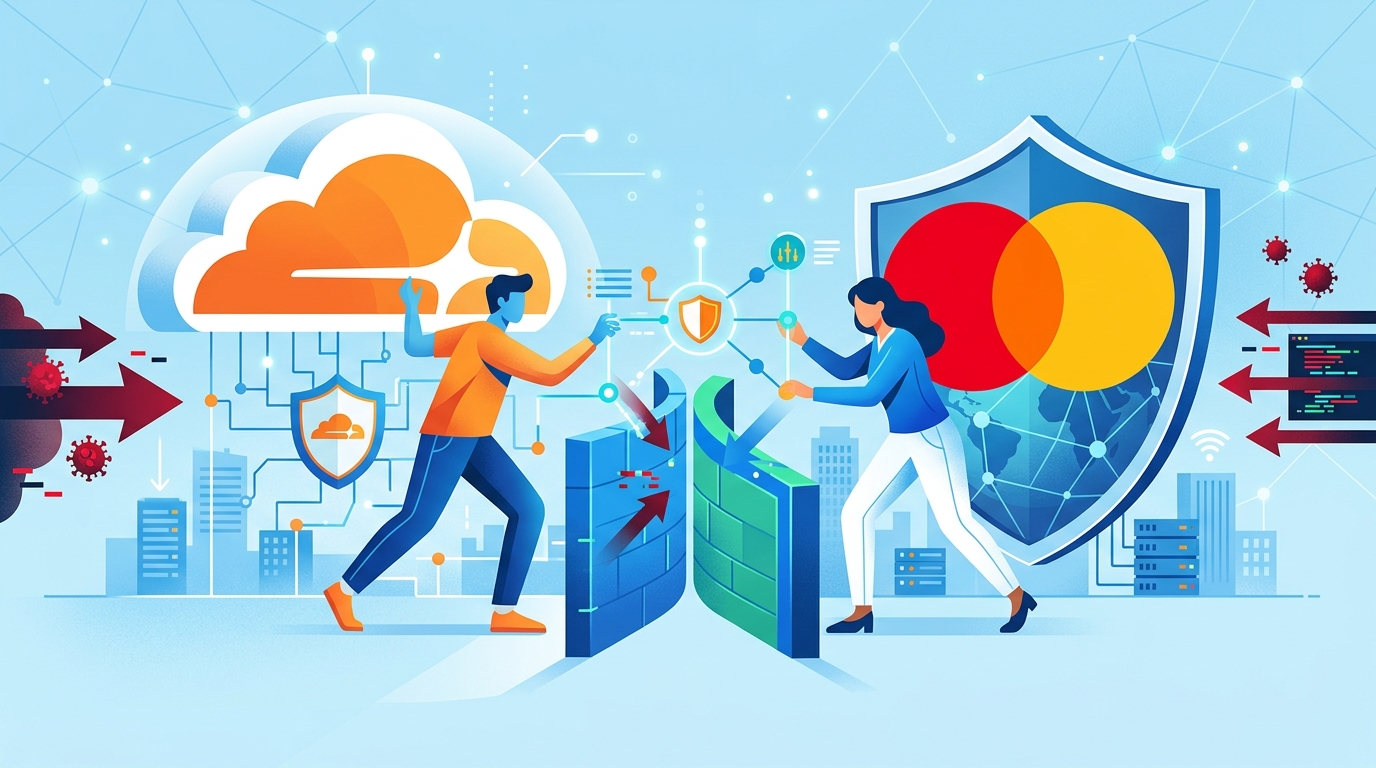
Cloudflare and Mastercard are aiming at that exact pain point. Their joint tools are designed to discover internet-facing domains and software stacks, identify unprotected assets, and then connect those findings to controls that can be turned on quickly. That is a much more practical promise than yet another dashboard that tells you things are bad and leaves the rest to you.
- Recorded Future will help discover internet-facing domains and software stacks.
- Cloudflare will let users extend application security controls to exposed assets.
- Security Insights will show an A–F security rating tied to vulnerabilities, authentication weaknesses, exposed infrastructure, and third-party risks.
- Findings will be prioritized by asset criticality, so the riskiest items rise to the top.
That A–F grading system is a smart move. Security teams do not need more raw telemetry; they need a fast way to separate “urgent” from “someday.” A simple score can help non-specialists make decisions, especially in organizations where the person handling cyber risk is also wearing five other hats.
There is also a broader business angle here. Mastercard framed the effort around the digital ecosystem, while Cloudflare framed it around helping organizations innovate without slowing down. In plain English, both companies are betting that security products win when they reduce friction instead of adding another layer of process.
Why the public sector cares
This partnership is not aimed only at private companies. Governments and critical infrastructure operators are part of the target market, and that matters because these groups deal with systems that can affect public safety, financial stability, and national continuity. A vulnerability in a water utility or a municipal portal is not just an IT issue. It can become a service outage, a trust problem, or a national security headache.
Dan Cimpean, director of the Romanian National Cyber Security Directorate, put that reality plainly in a statement included with the announcement:
“Improving critical infrastructure cybersecurity and reducing cyber risk is an ongoing, challenging mission,” said Dan Cimpean, Director of the Romanian National Cyber Security Directorate. “As society and global economies increasingly rely on digital networks, we must combine our efforts across the public and private sectors, across nations and international organizations, to build resilience and prevent cyber incidents. The protection of critical infrastructure is and must be a joint effort.”
That quote lands because it matches the actual operating environment. Cyber defense for public institutions has never been something one vendor can fully solve. The best tools still need policy support, procurement discipline, and coordination across agencies, contractors, and operators.
Cloudflare’s Stephanie Cohen made the same point from a different angle, saying that small businesses, critical infrastructure, and governments are often “target rich but resource poor.” That phrase is blunt, but it is accurate. Attackers do not need every target to be weak, only enough of them to be underprotected and poorly monitored.
How it compares with today’s security stack
Most organizations already have some mix of scanners, firewalls, endpoint tools, and cloud security platforms. The problem is that these tools often sit in separate silos. A scanner may find a risk, a threat-intelligence feed may confirm exposure, and a firewall team may never hear about either until a ticket is filed.

The Cloudflare-Mastercard approach tries to compress that chain. Instead of leaving discovery, prioritization, and remediation in separate systems, the companies want to connect them inside one workflow. That matters because security teams lose time every time they have to export data, reconcile asset names, or translate one vendor’s terminology into another’s.
- Traditional setup: scanner finds exposure, analyst validates it, another team remediates it, and the ticket may sit for days.
- Cloudflare-Mastercard model: exposure is discovered, scored, and tied to controls from the same interface.
- Security posture view: instead of a static report, users get a continuously updated rating and prioritized risk list.
- Protection layer: web application firewall, encryption, and automated defenses can be applied faster.
There is still a big question here: how much of this will be truly automated, and how much will still require human review? In security, full automation sounds great until a false positive blocks the wrong service or a misclassification hides an urgent issue. The announcement leans toward “assistive automation,” which is probably the right place to start.
For context, Mastercard has been expanding deeper into digital security for years, while Cloudflare has been building a broader security and connectivity stack around its global network. The partnership makes sense because each company brings a different kind of signal. One is strong on risk intelligence; the other is strong on enforcement at the edge.
What to watch next
The real test is whether this partnership produces a product that smaller teams can actually use under pressure. A good demo is easy. A good Monday morning after a weekend incident is harder. If Cloudflare and Mastercard can turn asset discovery, risk scoring, and remediation into a short, readable workflow, they may give overworked security teams something genuinely useful.
I would watch for three things over the next few quarters: which customer groups adopt it first, whether the A–F scoring becomes trusted enough to drive action, and how deeply the remediation controls integrate with existing infrastructure. If the product stays limited to a nice executive view, it will fade into the background. If it helps a city, hospital network, or small bank close a real exposure faster, then it will have earned attention.
For now, the partnership feels like a practical answer to a very old problem: security teams cannot protect what they cannot see. The companies are betting that discovery, scoring, and response belong in one place. That is the right bet to test next, and the market will quickly show whether users agree.
// Related Articles
- [IND]
WebX 2026 turns speaker hype into a conference brief
- [IND]
AI Weekly: 2026-07-06 ~ 2026-07-13
- [IND]
The AI Act should be treated as Europe’s operating system for AI
- [IND]
Booz Allen’s OpenAI Deal Is Real Advantage, Not Hype
- [IND]
OpenSearch’s vector search benchmark in 5 parts
- [IND]
Vector Databases That Work in Production