DTCC’s Stellar deal turns stocks into tokens
I break down DTCC’s Stellar rollout, why the SEC’s no-action letter matters, and the exact template for tokenized securities.

I break down DTCC’s Stellar rollout and the template behind tokenized securities.
I've been watching tokenization pitches for years, and most of them have the same smell: a slick demo, a giant promise, and then a whole lot of hand-waving when you ask who actually keeps the books. That’s why this DTCC and Stellar announcement grabbed me. It’s not another “what if markets moved on-chain” thread. It’s the Depository Trust Company, the plumbing behind U.S. market settlement, saying it wants DTC-custodied securities on a public blockchain. That’s a very different sentence.
What felt off in older tokenization efforts was the split between the story and the operations. The story said faster settlement, better liquidity, cleaner lifecycle management. The operations usually said: permissioned chain, closed pilot, limited assets, and a roadmap that never quite leaves the sandbox. Here, the weird part is that the public-chain piece is not an afterthought. Stellar is the first public network named in DTCC’s multi-chain plan, and the first live deployment is targeted for the first half of 2027. That gives me something concrete to unpack instead of another glossy future-tense pitch.
Source anchor: the trigger here is Genfinity’s report at genfinity.io, which summarizes DTCC’s May 27, 2026 announcement with the Stellar Development Foundation.
DTCC is not “exploring blockchain.” It’s moving the ledger
Get the latest AI news in your inbox
Weekly picks of model releases, tools, and deep dives — no spam, unsubscribe anytime.
No spam. Unsubscribe at any time.
“For the first time, DTC-custodied securities will live on a public blockchain.”
What this actually means is that we’re not talking about a sidecar app or a cute NFT wrapper. We’re talking about securities that already sit inside the DTC system getting a tokenized representation on Stellar. DTC still keeps the authoritative records. The chain becomes the mirrored operational layer for digital settlement and lifecycle handling.

I’ve seen a lot of teams pretend that tokenization means “we put the asset on-chain and the old system disappears.” That’s not what’s happening here, and honestly, that’s the only sane way to do it. You don’t rip out the rails that already clear trillions and hope the market shrugs and follows. You add a digital layer that can move faster, settle cleaner, and keep the legal record intact.
DTCC matters because it sits at the center of U.S. post-trade infrastructure. Genfinity says DTCC oversees more than $114 trillion in assets across U.S. capital markets. That number is the point. If a player that size is willing to map securities onto a public chain, then tokenization has moved from “crypto experiment” to “institutional integration problem.”
How I’d apply this if I were building in fintech: stop pitching tokenization as a replacement story. Pitch it as a record-synchronization and settlement-story. The buyer is not asking, “Can you make the old world vanish?” The buyer is asking, “Can you keep the books straight while letting value move faster?”
- Keep the authoritative registrar where the regulator expects it.
- Use the chain for mirrored settlement state, not fantasy ownership claims.
- Design every workflow around corporate actions, transfer restrictions, and auditability.
The SEC no-action letter is the real unlock
“Today, the Division of Trading and Markets issued a no-action letter to the Depository Trust Company (DTC) regarding DTC’s voluntary securities tokenization pilot program.”
The legal detail matters more than the marketing. In December 2025, the SEC’s Division of Trading and Markets issued a no-action letter to DTC. That gave DTC room to run a tokenization service for custodied assets without immediately tripping over the usual regulatory tripwires. In other words, the chain choice was never just a technical choice. It was a regulated choice.
What I take from that is simple: public-chain tokenization for real securities only gets interesting after custody, recordkeeping, and compliance are already mapped. Otherwise you just have a blockchain demo with securities-shaped nouns. The no-action letter also says the ledgers DTC uses have to meet operational, security, and compliance standards. That is the gating function. Stellar didn’t get picked because it looked cool. It got picked because it could survive the checklist.
I ran into this exact issue when evaluating tokenized fund infrastructure for a client. Everyone wanted to talk about transaction speed. Nobody wanted to talk about the boring stuff: who can mint, who can freeze, who can claw back, who can reconcile, and what happens when a transfer violates policy. That’s the real product. The chain is just the execution layer.
How to apply it: if you’re designing a tokenized asset system, write the compliance rules first and the chain integration second. If the rules can’t be expressed cleanly, your architecture is not ready. And if your vendor can’t explain how the legal record and the on-chain record stay aligned, walk away.
- Define the authoritative record before you choose a ledger.
- Map transfer restrictions and identity checks into the workflow.
- Document who can reverse, freeze, attest, or delegate rights.
Stellar got picked because it behaves like infrastructure, not a vibe
“Stellar’s emphasis on compliance, throughput, and low-cost operations meets DTCC’s rigorous standards.”
That line from DTCC’s Nadine Chakar is doing a lot of work. Stellar’s appeal here is not speculative upside. It’s that the network already has features institutions care about: issuer-controlled assets, authorization flags, clawback functions, and a built-in decentralized exchange. That’s the kind of boring machinery you need if you’re handling regulated assets instead of meme coins.
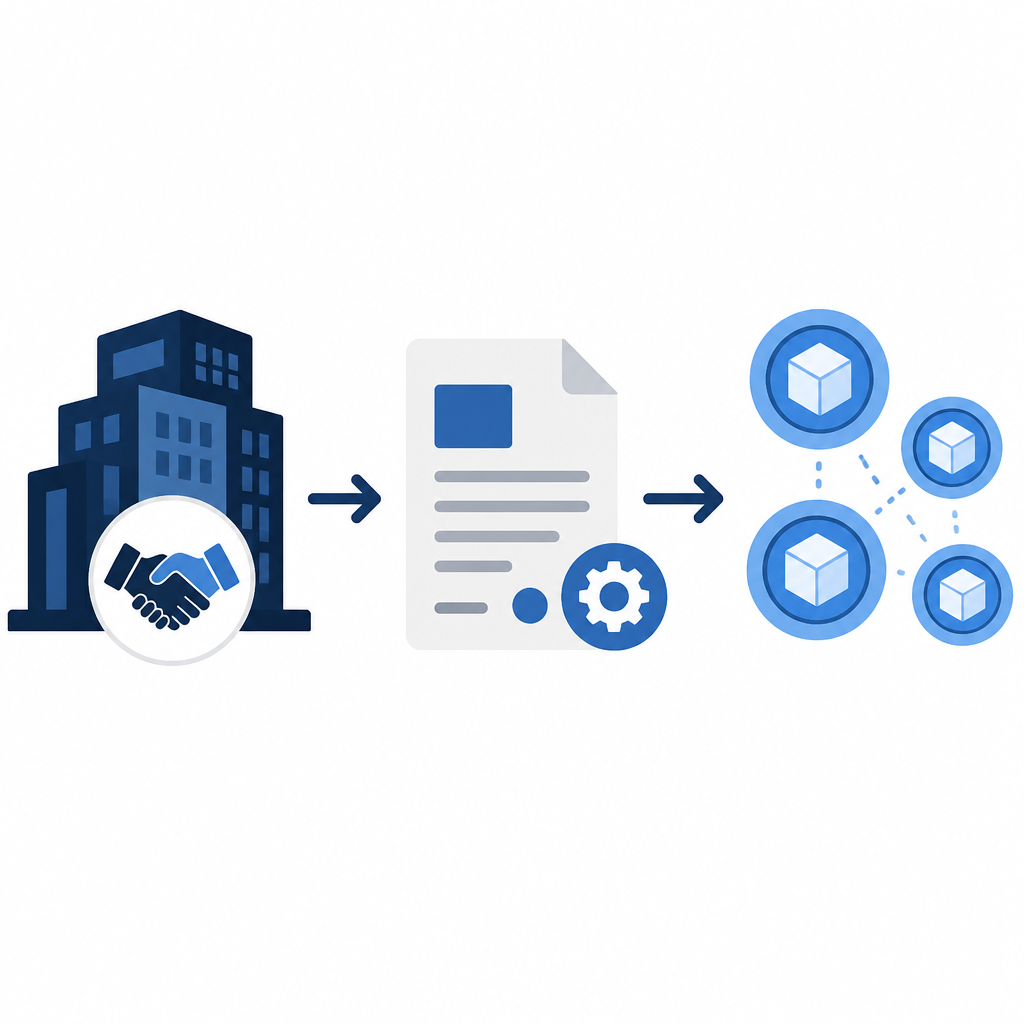
What this actually means is that Stellar is being treated like a production rail for controlled value movement. It already hosts institutional stablecoins like USDC, and it has years of operational history in payments and tokenized transfers. That history matters because DTCC is not going to start with a chain that needs hand-holding every time someone asks for asset controls.
I’ve always thought a lot of tokenization debates confuse “public” with “permissionless in the most chaotic sense.” That’s lazy. A public blockchain can still have tight issuer controls, compliance gates, and policy enforcement. The public part just means the ledger is open and broadly inspectable. It does not mean the asset model is anarchic.
How I’d use this lesson in a product spec: don’t describe your chain by ideology. Describe it by operational properties. Can it handle restricted assets? Can it support policy-based transfers? Can it integrate with identity and attestation systems? If the answer is no, it’s not an institutional rail. It’s a hobby network.
Russell 1000 stocks, ETFs, and Treasuries are the right first assets
“DTCC and SDF will evaluate Russell 1000 constituents for early tokenization. Additionally, ETFs tracking major indices sit within the initial scope. U.S. Treasury bills, bonds, and notes round out the target asset list.”
This is the part that tells me the team is thinking like operators. They’re not starting with some exotic private-credit structure nobody can price. They’re starting with liquid, standardized, heavily held instruments that already move through DTC infrastructure all day long. Russell 1000 names, major ETFs, and Treasuries are perfect starter assets because the market already knows how to value them and how to process their lifecycle events.
That matters because tokenization is not just about putting a price on a blockchain. It’s about preserving all the annoying stuff that makes securities real: dividends, splits, redemptions, maturity, coupon flow, and transfer rules. If you can’t handle those, you don’t have a securities system. You have a spreadsheet with a chain logo on it.
I’ve seen teams try to begin with illiquid assets because they think complexity proves sophistication. It usually proves the opposite. Start with assets that already have institutional workflows and high turnover. That gives you a cleaner test of whether the digital layer actually reduces friction or just adds another API to babysit.
How to apply it: if you’re building tokenized finance products, start with assets that already have standardized lifecycle events and obvious settlement pain. Treasuries and ETFs are boring for a reason. Boring is what lets you prove the machinery.
DTCC’s patent was the roadmap hiding in plain sight
“It outlines a framework for managing Digital Liquidity Tokens across multiple distributed ledgers.”
Genfinity points to DTCC’s May 22, 2025 patent, US20250078162A1, and that patent is the kind of document I wish more people read before they start guessing about strategy. It names both the XRP Ledger and Stellar as compatible networks and describes a multi-ledger settlement architecture. That tells me DTCC has been thinking in chain-specific roles, not chain tribalism.
What this actually means is that DTCC is not betting on one ledger to do everything. It’s building a model where different networks can play different roles in the same institutional system. The patent reportedly positions XRP for high-throughput cross-border settlement and Stellar for low-cost transfers, fiat ramps, and stablecoin integration. That’s a very grown-up way to think about chain selection.
The patent also talks about token-in-token structures, bridge nodes, zero-knowledge proofs, policy enforcement, and identity delegation. That’s not decorative. That’s the machinery needed when you want interoperability without turning compliance into a mess. I like this part because it shows the architecture is modular. It’s not “pick the winner.” It’s “assign the right job to the right rail.”
How to apply it: if your product spans multiple ledgers, define roles per chain. One network can handle issuance, another can handle settlement, another can handle liquidity routing. Stop pretending a single chain has to be magical at everything. It never does.
Multi-chain is not indecision. It’s how institutions reduce risk
“This collaboration advances DTCC’s multi chain strategy and expands how traditional assets move across digital ecosystems.”
The phrase “multi-chain strategy” usually gets people rolling their eyes because crypto has spent years turning chain choice into a personality test. But in institutional infrastructure, multi-chain is mostly risk management. Different assets, jurisdictions, and workflows need different controls. One network is rarely enough.
DTCC already has history here. Genfinity notes its earlier work with Digital Asset on tokenizing Treasury securities on the Canton Network. That effort leaned permissioned. Stellar is the public-chain counterpart. Put those together and you get a clearer picture: DTCC is testing where openness helps and where tighter control still makes sense.
I think that’s the real lesson for builders. Stop asking whether public or private is “better” in the abstract. Ask what the asset, the regulator, and the workflow need. Sometimes you want a permissioned environment for collateral and institutional privacy. Sometimes you want a public network because distribution and interoperability matter more.
How to apply it: build your architecture so chain choice is a configuration decision, not a religion. If you can’t swap environments without rewriting the business logic, you’ve made the ledger too important and the product too fragile.
The template you can copy
# Tokenized Securities Architecture Template

Use this when you want to move regulated assets onto a blockchain without breaking custody, compliance, or settlement.

## 1) Define the legal record
- Authoritative registrar: [name the entity]
- Legal ownership source of truth: [system]
- On-chain record role: mirrored settlement state only
- Transfer finality rule: [rule]

## 2) Define the asset scope
Start with assets that already have standardized lifecycle events:
- Treasury bills, notes, and bonds
- Large-cap equities or index constituents
- ETFs with established redemption and corporate-action workflows

Avoid exotic assets until the control model is proven.

## 3) Define chain roles
Pick chains by function, not ideology:
- Issuance chain: [network]
- Settlement chain: [network]
- Liquidity / routing chain: [network]
- Audit / attestation layer: [system]

If one chain cannot do everything cleanly, split responsibilities.

## 4) Define compliance controls
Your token model should support:
- Issuer authorization flags
- Transfer restrictions
- Whitelisting / allowlisting
- Freeze and clawback controls
- Identity verification hooks
- Attribute attestations
- Policy enforcement rules

If a control cannot be expressed in code and reviewed by compliance, it is not ready.

## 5) Define lifecycle events
Map every securities event before launch:
- Issuance
- Transfer
- Settlement
- Redemption
- Dividend / coupon distribution
- Split / reverse split
- Maturity
- Corporate actions
- Reconciliation

## 6) Define interoperability boundaries
If you use multiple ledgers:
- Specify bridge-node responsibilities
- Define message formats
- Set proof requirements
- Document failure handling
- Define rollback / reversal policy

Do not rely on “we’ll figure out the bridge later.” That’s how systems get brittle.

## 7) Define operational acceptance criteria
Do not go live until you can answer yes to all of these:
- Can the authoritative record stay synchronized?
- Can compliance block invalid transfers?
- Can lifecycle events be processed end to end?
- Can auditors trace every state change?
- Can the system survive network or bridge failure?

## 8) Implementation prompt
Build a tokenization service for regulated securities where the blockchain is a mirrored settlement layer, not the sole record of truth. The system must preserve custody integrity, support issuer controls, enforce transfer policies, and handle lifecycle events for securities like Treasuries, ETFs, and large-cap equities. Design the architecture so chain selection is modular and can support multiple ledgers with distinct roles.
I’d actually use that template as a starting spec for a product brief, a technical RFC, or a vendor evaluation checklist. It keeps you honest. It forces you to answer the questions that matter before you start chasing chain branding or demo polish.
And honestly, that’s the part I trust most in this whole DTCC-Stellar story. Not the PR framing. Not the tokenization buzz. It’s the fact that the architecture appears to have been shaped by custody, regulation, and operational reality first. That’s rare enough to be worth paying attention to.
Source attribution: the original reporting is Genfinity’s article at https://genfinity.io/2026/05/27/dtcc-stellar-tokenization-dtc-custodied-assets-2027/. My breakdown is derivative of that reporting and the cited public materials, including the SEC no-action letter, DTCC’s announcement, and the referenced patent filings.
// Related Articles
- [IND]
Korea’s Nvidia talks point to an AI factory push
- [IND]
OpenAI should not rush its IPO just to win the AI race
- [IND]
OpenAI updates its Europe privacy policy
- [IND]
OpenAI is right to keep ads out of sensitive chats
- [IND]
AI bootlegs are already draining streaming royalties
- [IND]
AMD and Microsoft push Windows ML on GPU and NPU