How to Read a Solana Price Forecast
A practical guide to reading a Solana price forecast and testing its assumptions.

A practical guide to reading a Solana price forecast and testing its assumptions.
This guide is for crypto readers, analysts, and developers who want to turn a headline-driven SOL prediction into a structured review. After following the steps, you will have a repeatable way to check the claim, map the drivers, and separate narrative from signal.
We will use the ICOBench article as the source example, along with the official Solana docs at solana.com/docs and the Solana GitHub repo at github.com/solana-labs/solana for protocol context. The goal is not to predict price, but to assess whether the forecast is grounded in network fundamentals, adoption data, and market structure.
Before you start
Get the latest AI news in your inbox
Weekly picks of model releases, tools, and deep dives — no spam, unsubscribe anytime.
No spam. Unsubscribe at any time.
- A web browser and a stable internet connection
- A Solana wallet such as Phantom or Solflare
- A basic crypto market data source such as CoinGecko or TradingView
- Access to the source article and its cited claims
- Optional: Node 20+ if you want to script price and on-chain checks
- Optional: Git 2.40+ if you want to clone Solana-related repos or sample code
Step 1: Capture the forecast headline
Goal: create a clean record of the exact claim before you evaluate it. Start by writing down the forecast target, the time horizon, and the stated reasons, such as Visa settlement, DePIN adoption, or Firedancer adoption.

For this example, the core claim is that SOL could reach $350 to $500 by the end of 2026. Save the article URL, the publication date, and any named drivers so you can compare them against later evidence.
Verification: you should be able to restate the prediction in one sentence without adding your own interpretation.
Step 2: Check the network claims
Goal: verify whether the article’s technical claims match Solana’s current capabilities and roadmap. Review Solana’s documentation for finality, fees, throughput, and validator behavior, then compare those details with the article’s language.
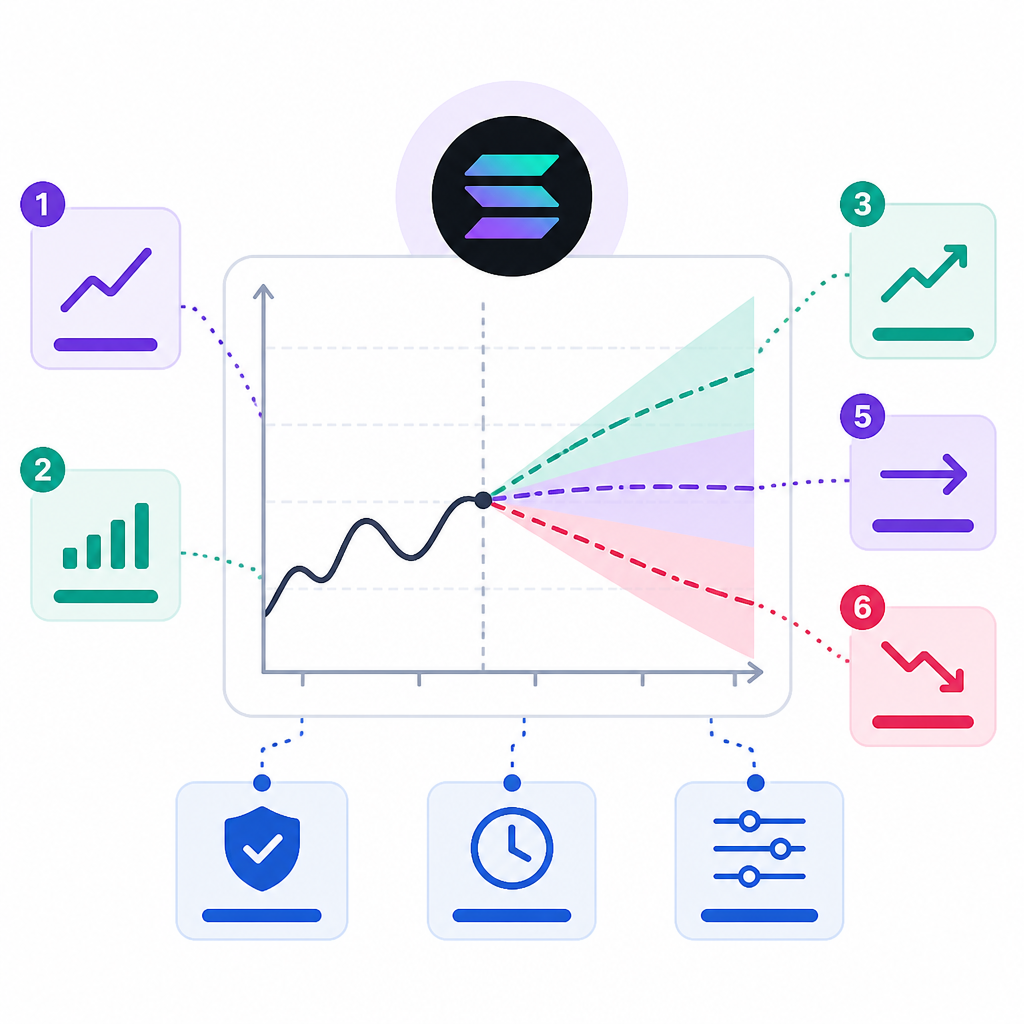
Look for evidence that supports or weakens the claim that Solana already offers sub-second finality and low fees. If the article mentions Firedancer, confirm whether the client is live, in testing, or still rolling out in limited form.
Verification: you should know which claims describe current production behavior and which ones are forward-looking.
Step 3: Compare adoption signals
Goal: test whether the forecast has real usage behind it. Check public indicators such as active addresses, transaction volume, DePIN project activity, stablecoin settlement, and developer growth.
In the source article, Visa USDC settlement and ecosystem apps like Helium and Render are used as demand drivers. Confirm whether those examples are still relevant and whether they translate into sustained on-chain activity rather than one-time news flow.
Verification: you should be able to list at least three adoption signals and say whether each one is growing, flat, or unclear.
Step 4: Map the price structure
Goal: connect the forecast to the actual chart so the target is not treated as a standalone number. Review the current SOL trend, key support zones, and the breakout levels that would need to clear before a higher target becomes plausible.
The article points to a $95 to $100 resistance band and a $78 to $82 support zone. Use a charting tool to confirm whether those levels still matter, then note what volume or momentum would be required for a clean breakout.
Verification: you should be able to name the nearest support, resistance, and breakout confirmation level.
Step 5: Separate bull case from bear case
Goal: turn the forecast into a balanced scenario analysis. Write down the upside thesis, then list the specific risks that could block it, such as outages, regulation, competition, or a risk-off macro cycle.
A useful check is to ask whether the downside case is concrete enough to be falsifiable. If the bear case only says “market conditions worsen,” it is too vague; if it names a range like $120 to $180 or specific failure modes, it is more testable.
Verification: you should have one bull case, one bear case, and one neutral case that all depend on observable events.
Step 6: Set a review cadence
Goal: make the forecast actionable as a monitoring exercise instead of a one-time read. Schedule a monthly review of price, ecosystem news, and protocol updates so you can see whether the thesis is strengthening or fading.
If you want to automate the process, use a simple script to pull SOL price data, then compare it with news events and on-chain metrics. Even a basic spreadsheet works if you update it on a fixed date each month.
Verification: you should have a recurring checkpoint and a short list of metrics to revisit.
| Metric | Before/Baseline | After/Result |
|---|---|---|
| SOL forecast target | Headline-only claim | Documented $350 to $500 by end-2026 |
| Technical status | Unverified narrative | Checked against Solana docs and roadmap |
| Adoption signals | Single source mention | Reviewed Visa, DePIN, and app activity |
| Chart levels | Unknown support and resistance | Mapped $78 to $82 support and $95 to $100 resistance |
Common mistakes
- Confusing a forecast with evidence. Fix: verify the underlying data and protocol status before repeating the target.
- Using only price action. Fix: combine chart levels with adoption, network reliability, and macro context.
- Ignoring time horizon. Fix: always compare the claim to the stated end date, not to today’s price movement.
What's next
If you want to go deeper, build a simple dashboard that tracks SOL price, network activity, and major ecosystem announcements in one place. That gives you a reusable framework for evaluating future crypto forecasts without relying on headlines alone.
// Related Articles
- [CHAIN]
UAE Web3 setup turns crypto rules into a checklist
- [CHAIN]
Five AI Futurist features shaping Futurist 2026
- [CHAIN]
Regulation Now Moves Bitcoin and Ethereum More Than War
- [CHAIN]
The SEC Crypto Rule Proposal Will Clean Up Crypto, Not Kill It
- [CHAIN]
Web3 platforms need fee discipline, not token theatrics, to make money
- [CHAIN]
Riyadh’s blockchain show proves Web3 is now infrastructure