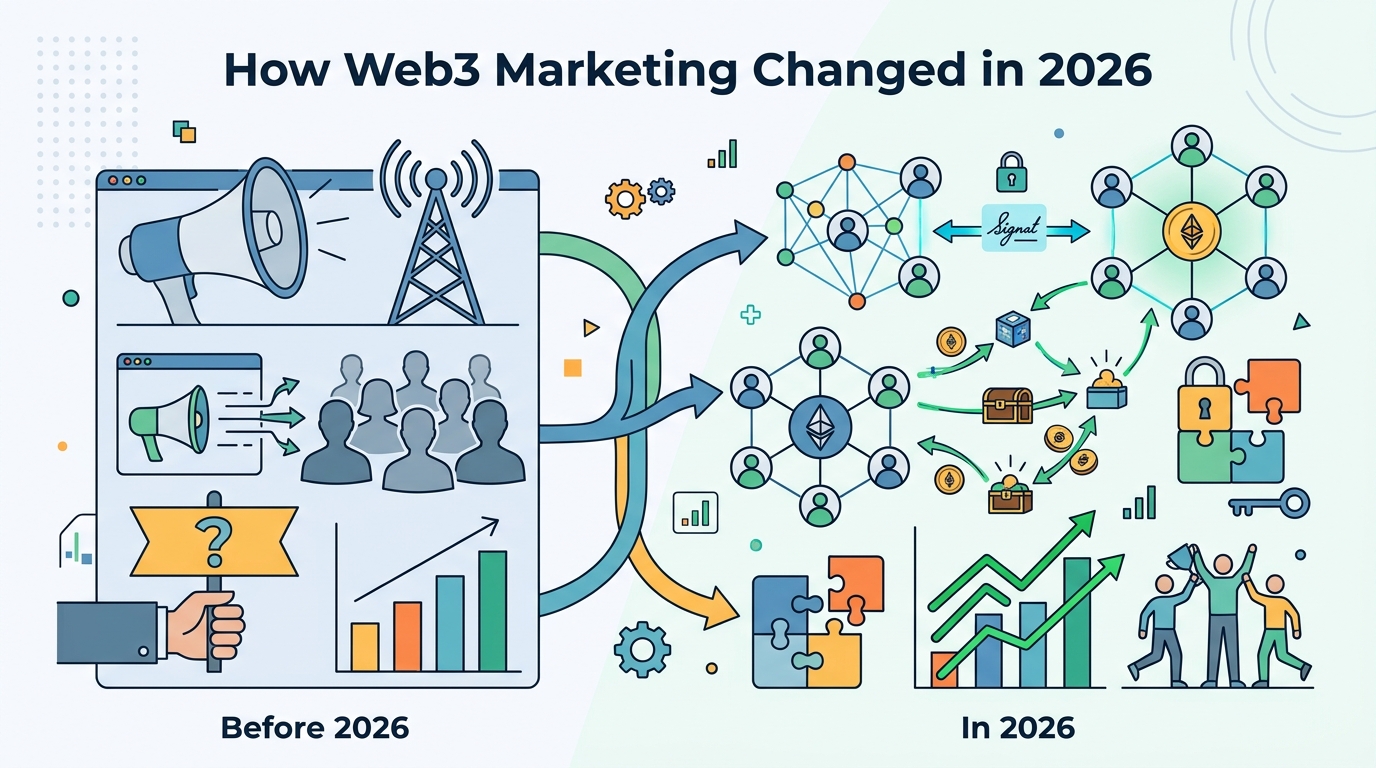
How Web3 Marketing Changed in 2026
AI now drives Web3 marketing, with Coinbase and Binance using behavioral data, personalization, and on-chain analytics to boost conversion.
Web3 marketing in 2026 looks a lot less like a hype machine and a lot more like a data operation. The shift is easy to see in the numbers: the article points to more than 700 million crypto users worldwide and an estimated $80+ billion market, which means projects are marketing to people who have already seen the cycle before.
That matters because audiences have changed. The average user is more skeptical, more selective, and far less impressed by flashy token launches or big promises. In that environment, marketing teams are being pushed toward measurable utility, clearer messaging, and a tighter connection between what a project says and what it actually ships.
The big change is that Web3 marketing is no longer just about getting attention. It is about using AI, behavioral data, and on-chain signals to find the right users, keep them active, and prove that growth is real.
AI is now the default marketing layer
Get the latest AI news in your inbox
Weekly picks of model releases, tools, and deep dives — no spam, unsubscribe anytime.
No spam. Unsubscribe at any time.
The article makes a strong case that artificial intelligence has moved from a nice-to-have tool to the core infrastructure of Web3 marketing. That is a big statement, but it matches what we are seeing across crypto products: campaigns are being built around user behavior, wallet activity, and product usage instead of broad audience buckets.
Coinbase is cited as a clear example. The company uses machine learning to personalize onboarding flows and user communication, which reduces friction when new users enter crypto. In a market where many people still drop off during signup or first purchase, that kind of optimization matters more than a louder ad campaign.
Binance is taking a similar approach with AI-driven segmentation across its ecosystem. Instead of sending the same message to everyone, it targets users based on trading behavior and wallet activity, then adjusts campaigns around staking, trading, and other product features.
- AI-driven targeting is linked to 20% to 30% conversion improvements when campaigns use behavioral signals
- Personalization is being tied to transactions, staking, and governance participation, not vanity metrics
- Onboarding optimization is now a direct growth lever, especially for first-time crypto users
- Campaign performance is being judged by real economic activity, not impressions alone
Narrative beats reach when users have seen it all
One of the more useful ideas in the piece is that reach has lost some of its power. In earlier Web3 cycles, a project could win attention with a big launch, a splashy thread, and a few paid placements. That playbook is weaker now because the audience has seen too many empty promises and short-lived token stories.
Ethereum is the best example of narrative-led growth. It has spent years framing itself as the base layer for decentralized innovation, developer freedom, and open infrastructure. That story has held up because it is backed by a large ecosystem and continuous development activity.
Solana also gets a mention for rebuilding its message after the 2022 downturn. The focus shifted toward developer activity, ecosystem resilience, and real use cases, which helped restore momentum around the chain. The lesson here is simple: a strong narrative works when it matches what users can verify on-chain.
“A brand is no longer what we tell the consumer it is — it is what consumers tell each other it is.” — Scott Cook
That quote from Scott Cook fits Web3 unusually well. In crypto, communities talk fast, compare notes publicly, and punish weak claims quickly. If your story is thin, the market finds out. If your story matches product reality, it spreads on its own.
Personalization and community data are doing the heavy lifting
Web3 has always had a data advantage compared with many other sectors because wallet activity is visible and product usage leaves on-chain traces. In 2026, that advantage is being used more aggressively. The article argues that hyper-personalization is now necessary, not optional, because users expect experiences that reflect what they have already done.
Uniswap is a good example. Its interface and ecosystem tools can highlight tokens, pools, and opportunities based on past behavior. That makes the product feel more useful without requiring users to dig through everything manually.
MetaMask has also added contextual prompts and onboarding flows that respond to what users are trying to do. For newer users, that lowers confusion. For experienced users, it gets out of the way faster and lets them move into deeper functionality.
- Behavioral personalization is associated with up to 2.5× higher engagement
- Onboarding drop-off can fall by up to 60% with tailored flows
- Discord remains a core community hub, but sentiment and contribution now matter more than raw member counts
- Uniswap DAO and Aave governance are treated as health signals, not side channels
- Projects with active community analysis report up to 40% higher retention than acquisition-only teams
This is where Web3 marketing starts to look less like brand advertising and more like product analytics. Community is no longer a passive audience. It is part of the growth engine, and the best teams measure it that way.
AI content helps, but human voice still decides trust
The article also makes a point that many teams will probably learn the hard way: AI can scale content, but it cannot fake a believable brand voice for long. Drafts, campaign concepts, and messaging variants can all be produced faster with tools from OpenAI, but automated content alone tends to flatten a project’s identity.
That is why the strongest Web3 campaigns still mix machine output with human editing and narrative control. The article points to RTFKT, the digital fashion and collectibles project associated with Nike, as a case where cultural storytelling mattered as much as the drop itself. The product got attention because it fit a larger identity and community story.
The data in the piece is pretty direct: campaigns that combine AI-generated drafts with human refinement see 20% to 40% higher engagement. That gap makes sense. AI can speed up production, but people still respond to tone, timing, and a point of view that feels alive.
What is changing is the role of the marketer. In 2026, the best Web3 marketers are part analyst, part editor, and part community reader. They are not just publishing content; they are testing narratives against user behavior and adjusting fast when the data says the message is off.
If you want a useful mental model, think of Web3 marketing now as a feedback loop: on-chain data informs segmentation, segmentation shapes messaging, messaging changes behavior, and behavior feeds back into the next campaign. That loop is tighter than it was even a year ago.
Unified analytics is where the real edge sits
The last major shift in the article is the move toward unified marketing intelligence across channels. This is one of the least flashy changes and one of the most important. If users discover a project on X, join Discord, connect a wallet, and then interact on-chain, you need a way to see all of that as one journey.
Dune helps teams track on-chain activity in real time, while Nansen gives wallet-level insight that can highlight high-value users and behavior patterns. Together, they make attribution and campaign analysis much less guessy than it used to be.
- Unified analytics improves attribution accuracy across on-chain and off-chain touchpoints
- It gives teams clearer ROI visibility for paid, organic, and community channels
- It aligns marketing metrics with product usage, which helps teams make faster decisions
- It reduces the old habit of treating marketing as a top-of-funnel island
That matters because many Web3 teams still waste money by optimizing for the wrong metric. A campaign that brings in 50 wallet connections is not automatically better than one that brings in 20 users who actually stake, vote, or trade. The better metric is the one tied to durable activity.
For readers who want more context on how AI is moving into crypto operations, see our earlier coverage of AI in crypto operations in 2026. The common thread is the same: the teams getting ahead are the ones connecting data, product, and messaging instead of treating them separately.
Web3 marketing now rewards proof, not volume
The core message here is pretty clear. Web3 marketing in 2026 is being rewritten by AI, but the deeper change is cultural: audiences now expect proof. They want to see utility, product traction, governance participation, and a believable reason to stay.
My read is that the next winners will be the teams that treat marketing as an operating system, not a campaign calendar. They will use AI for speed, on-chain data for accuracy, and human judgment for voice. The projects that still chase raw reach without a clear narrative or measurable activity will keep burning budget.
If you are building in Web3 right now, the practical question is simple: can you show that your marketing changes user behavior, or does it only change impressions?
// Related Articles
- [CHAIN]
UAE Web3 setup turns crypto rules into a checklist
- [CHAIN]
Five AI Futurist features shaping Futurist 2026
- [CHAIN]
Regulation Now Moves Bitcoin and Ethereum More Than War
- [CHAIN]
The SEC Crypto Rule Proposal Will Clean Up Crypto, Not Kill It
- [CHAIN]
Web3 platforms need fee discipline, not token theatrics, to make money
- [CHAIN]
Riyadh’s blockchain show proves Web3 is now infrastructure