Why Base’s x402 Protocol Matters More Than the $100M Milestone
Base’s x402 milestone matters because it shows stablecoins are becoming the payment rail for AI agents.

Base’s x402 milestone shows stablecoins are becoming the payment rail for AI agents.
Base’s x402 protocol crossing $100 million in quarterly stablecoin payments is not just a vanity metric; it is proof that the first serious market for autonomous on-chain payments is already forming on Coinbase’s Layer 2.
That matters because the most important question in crypto right now is not whether stablecoins work, but where they become indispensable. Base says more than 90% of on-chain stablecoin transactions by AI agents now happen on its network, and that is the kind of concentration you only see when a protocol solves a real problem faster than its rivals. In this case, the problem is machine-to-machine settlement: agents need a low-friction way to pay for compute, APIs, data, and services without waiting for a human to click approve. x402 gives them that path, and the volume suggests developers are already using it.
First, x402 is winning because it turns stablecoins into infrastructure, not speculation
Get the latest AI news in your inbox
Weekly picks of model releases, tools, and deep dives — no spam, unsubscribe anytime.
No spam. Unsubscribe at any time.
The cleanest reading of the $100 million figure is that stablecoins are moving from trading venues into operational plumbing. A payment rail that can settle small, repeated transactions for software agents is far more valuable than one that only moves capital between exchanges.
That is why Base’s lead matters. If more than 90% of AI agent stablecoin transactions are happening on one network, then developers have already chosen a default. In infrastructure markets, defaults compound. Once a team builds around a standard like x402, the next team copies the stack, the next wallet supports it, and the next service provider prices around it. The result is not just adoption, but lock-in.
Second, Base has the right distribution advantage for this moment
Coinbase gives Base something most Layer 2s do not have: a direct route from product discovery to on-chain usage. That distribution edge matters more than ideology in a market where the users are not hobbyists but software agents embedded inside products.
The comparison is simple. Many chains can offer cheap transactions. Fewer can connect those transactions to a large, trusted, compliance-aware ecosystem that developers already recognize. Base benefits from Coinbase’s brand, its developer attention, and its role as a familiar bridge between traditional finance and crypto. For AI agents making payments in stablecoins, that combination lowers the adoption barrier in a way pure performance claims do not.
The counter-argument
The strongest critique is that $100 million is tiny next to the scale of global stablecoin activity, and the AI-agent angle may be more narrative than reality. A protocol can post impressive growth inside a narrow niche and still fail to become a real standard. In other words, the number is meaningful, but not decisive.
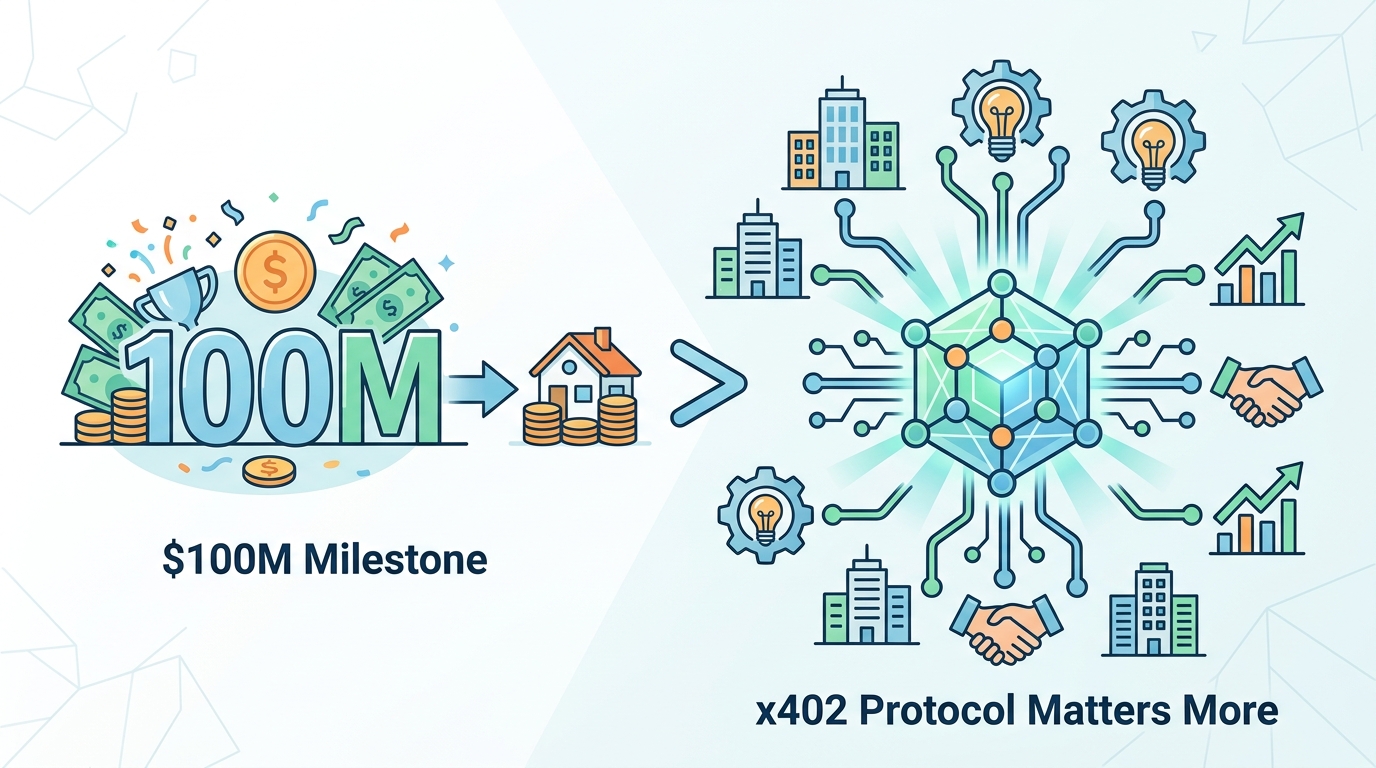
That critique is fair. The market is still early, and a lot of “AI agent” volume in crypto is marketing dressed up as category creation. But the right rebuttal is not to dismiss the milestone. It is to recognize what it actually proves: x402 has found product-market fit in a specific, high-value use case. Standards do not begin by serving everyone. They begin by owning one workflow so well that others have no reason to switch.
What to do with this
If you are an engineer, build for agent-native payments now: support stablecoin settlement, minimize confirmation friction, and design APIs that assume software will pay software. If you are a founder, stop treating AI payments as a future feature and start treating them as a distribution wedge. If you are a PM, measure success by repeat autonomous transactions, not by headline volume. The lesson from Base is blunt: the next breakout crypto product will not be a token narrative, but payment infrastructure that machines use without asking permission.
// Related Articles
- [CHAIN]
Crypto exchanges should show up in LATAM, not just advertise there
- [CHAIN]
UAE Web3 setup turns crypto rules into a checklist
- [CHAIN]
Five AI Futurist features shaping Futurist 2026
- [CHAIN]
Regulation Now Moves Bitcoin and Ethereum More Than War
- [CHAIN]
The SEC Crypto Rule Proposal Will Clean Up Crypto, Not Kill It
- [CHAIN]
Web3 platforms need fee discipline, not token theatrics, to make money