Why Lace 2.0 Matters More Than Cardano’s Next Hard Fork
Lace 2.0 is the real Cardano story because wallet UX will decide adoption before protocol upgrades do.

Lace 2.0 shows Cardano is betting on wallet UX to drive adoption.
Cardano’s next hard fork will matter, but Lace 2.0 matters more right now because users experience a chain through its wallet, not its governance slides. A protocol upgrade that improves Plutus performance and node security is useful only if people can actually connect, migrate, and transact without friction. Lace’s latest releases fix a blank-screen bug, improve DApp connection stability, add clearer loading states, and bring Cardano, Midnight, and Bitcoin into one interface. That is the kind of product work that changes whether a chain feels usable or merely promising.
Wallets are the distribution layer that decides whether upgrades matter
Get the latest AI news in your inbox
Weekly picks of model releases, tools, and deep dives — no spam, unsubscribe anytime.
No spam. Unsubscribe at any time.
Most blockchain upgrades are invisible to ordinary users. They do not wake up caring about reference input rules or VRF key uniqueness. They care whether their wallet opens, whether migration works, and whether they can sign into a DApp without getting stuck on a white screen. Lace 2.0.3 specifically fixed that failure mode, which is not a cosmetic issue. A wallet that blocks migration blocks retention.
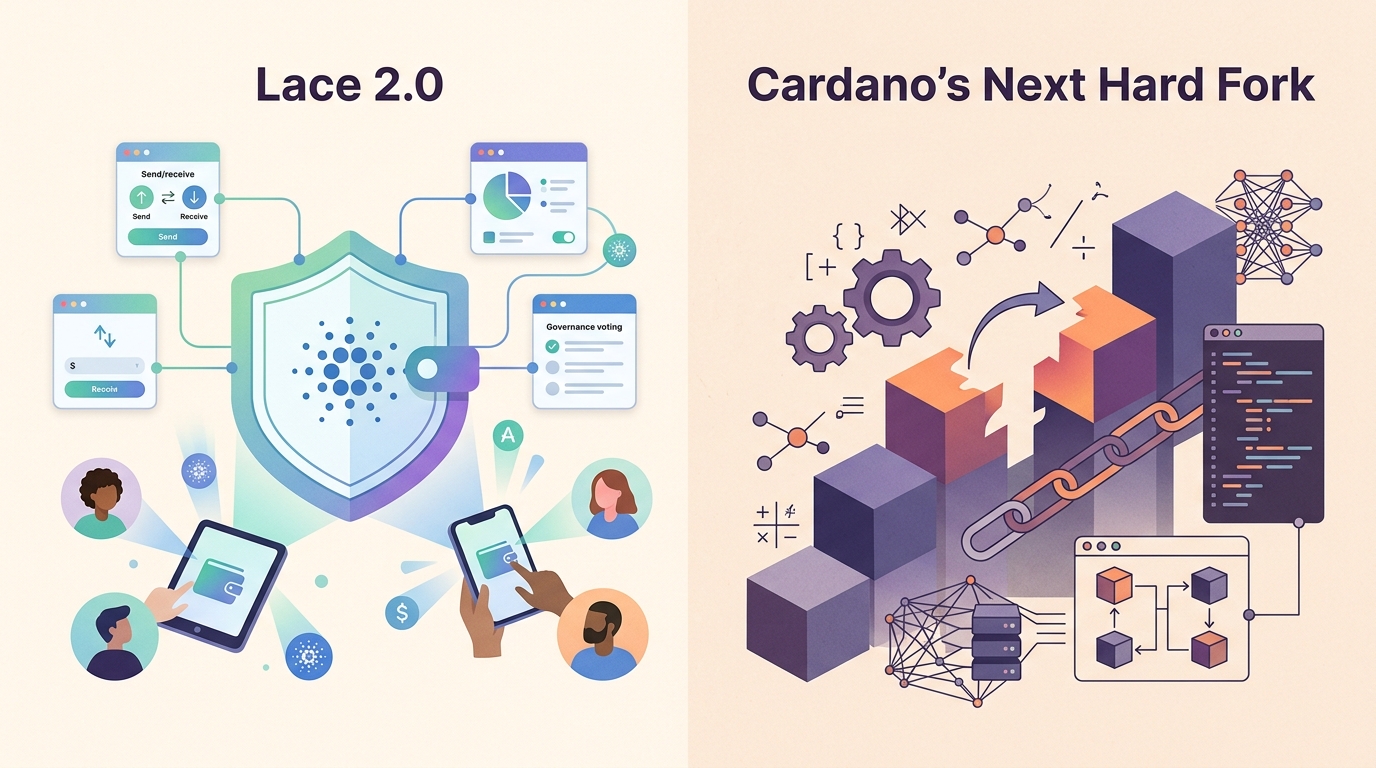
That is why the multi-chain angle is strategically stronger than the hard fork headline. By putting Cardano, Midnight, and Bitcoin in one interface, Lace reduces the number of places a user has to manage keys, balances, and connections. In crypto, every extra interface is a tax on usage. The chains that win are the ones that collapse those taxes first. Cardano is finally acting like it understands that.
Small UX fixes beat big protocol promises in the short run
The 2.0.4 update adds a default view mode, an auto-lock timer, and translation fixes for Spanish and Japanese tabs. None of that sounds glamorous, and that is exactly the point. Real adoption comes from eliminating the little annoyances that make users quit. An auto-lock timer reduces repeated password prompts. A default sidebar or tabs view makes the wallet feel predictable. Missing translations are not minor in a global product; they are a sign that non-English users were not being fully served.
This is the same lesson every consumer software company eventually learns: reliability is a feature. A wallet that loads fast, communicates state clearly, and respects user settings earns trust faster than a chain that only talks about throughput. The white-screen fix in 2.0.3 is a perfect example. One broken screen can destroy confidence in the entire ecosystem. One polished release can restore it. That is not hype. That is product reality.
The hard fork still matters, but not for the reason Cardano fans think
Cardano’s planned Protocol 11 upgrade, Van Rossem, is not irrelevant. Better Plutus performance, stronger ledger consistency, and improved node security are all meaningful engineering gains. The decision to avoid a generational transition also lowers integration burden, which is smart. But protocol health is an enabling condition, not a growth strategy. Users do not adopt Cardano because its ledger rules are elegant. They adopt it when the ecosystem around those rules is easy to use.
The release of Node 11.0.1 as a pre-release matters in the same way. It is necessary infrastructure work, but infrastructure alone does not create momentum. The Leios prototype and testnet progress show Cardano is still serious about scaling research, yet research milestones do not convert into daily activity without a front door people want to walk through. Lace is that front door. If Cardano gets the wallet right, the hard fork becomes a multiplier. If it does not, the hard fork becomes another technical footnote.
The counter-argument
Supporters of the protocol-first view are not wrong to say that chains live or die on base-layer performance. If Plutus gets faster, nodes get safer, and the ledger gets more consistent, then the entire ecosystem benefits. Developers care about those primitives because they determine what kinds of applications can exist at all. A polished wallet cannot rescue a chain with weak fundamentals.
There is also a fair argument that wallet updates are replaceable. Teams can switch wallets, DApp connectors can be rebuilt, and users can migrate again if needed. By contrast, a successful hard fork can reset expectations across the whole ecosystem. On this view, Lace is useful but secondary.
That view misses the adoption bottleneck. Strong fundamentals do not create usage on their own, and replaceable wallets do not stay replaceable once they become the default user path. The first point of failure is the first point of churn. Lace is not a side project; it is the UX layer that determines whether Cardano’s technical progress reaches actual users. The hard fork is necessary. The wallet is what turns necessity into growth.
What to do with this
If you are a founder, stop treating wallet UX as a support function and make it a distribution strategy. If you are a PM, measure migration success, DApp connection success, and first-session retention before you celebrate protocol milestones. If you are an engineer, ship the boring fixes first: loading states, defaults, localization, lock timing, and recovery paths. Those are the details that decide whether a chain feels modern or fragile. Cardano’s Lace 2.0 update is the right bet because it attacks the actual adoption layer, not just the headline layer.
// Related Articles
- [CHAIN]
Web3 Communication Is Becoming Trust Infrastructure
- [CHAIN]
Why Base’s x402 Protocol Matters More Than the $100M Milestone
- [CHAIN]
Gala Games Finds New Life in Web3 Gaming
- [CHAIN]
Why Ethereum Treasury Buying Is Becoming a Bad Long-Term Bet
- [CHAIN]
Yakovenko Warns AI Could Crack PQC Wallets
- [CHAIN]
MegaETH Token Debuts at $2B Valuation