Web3 Explained: What It Is and Why It Matters
Web3 shifts data, identity, and ownership toward users. Here’s how blockchain, smart contracts, and IPFS change the web.

Web3 is one of those ideas that gets used so loosely it can mean almost anything. AWS uses it as an umbrella term for technologies such as blockchain that move data ownership and control away from centralized platforms, and that definition is a useful starting point. The reason it matters is simple: the modern web still runs on a handful of companies that store your data, set the rules, and decide how much of the value you created stays with you.
That tension is what gives Web3 its appeal. It promises a web where users can own assets, control identity, and participate directly in the systems they use, rather than handing everything to a platform in exchange for access.
What AWS means by Web3
Get the latest AI news in your inbox
Weekly picks of model releases, tools, and deep dives — no spam, unsubscribe anytime.
No spam. Unsubscribe at any time.
AWS describes Web3 as a set of technologies that decentralize data ownership and control on the internet. In practice, that means the project’s rules are encoded in software and distributed across a network instead of living inside one company’s database and policy team.

That shift changes the economics of online products. In a Web2 app, the platform owns the data and usually monetizes the users who generate it. In a Web3 app, users can hold tokens, vote on changes, and in some cases keep more direct control over the assets they create.
It is worth separating the marketing from the mechanics. Web3 is not a single product, and it is not automatically better than the web we use today. It is a design pattern built on a few technical ideas that show up again and again across blockchain, smart contracts, and decentralized storage.
- Data and state are spread across multiple nodes instead of one central server.
- Users can interact through rules written in code, often through smart contracts.
- Ownership can be represented with tokens, including fungible tokens and NFTs.
- Identity can be tied to decentralized identifiers rather than a single login provider.
The four ideas that keep showing up
AWS breaks Web3 into four core ideas: decentralization, trustlessness, semantic web, and interoperability. Those are big words, but the practical meaning is easier to see in real products.
Decentralization means data is stored across a distributed network. Trustlessness means users do not have to depend on one central authority to process transactions honestly. The semantic web angle is about machines understanding context, not just keywords. Interoperability is about moving data and value between systems without getting trapped inside one vendor’s walls.
These ideas overlap, but they solve different problems. Decentralization reduces single points of control. Trustlessness reduces the need to place faith in one operator. Interoperability reduces lock-in. Semantic web tools help software understand what data means, which is why W3C RDF and related standards keep coming up in Web3 discussions.
- Decentralization: data lives across a network of participants.
- Trustlessness: rules are enforced by software and consensus.
- Semantic web: metadata and linked data add machine-readable meaning.
- Interoperability: users and assets can move across platforms more easily.
Why people care about Web3
The strongest argument for Web3 is ownership. On a typical social or marketplace platform, the company owns the infrastructure, the data model, and the power to change the rules. If the company changes fees, ranking systems, or moderation policy, users usually have little say.
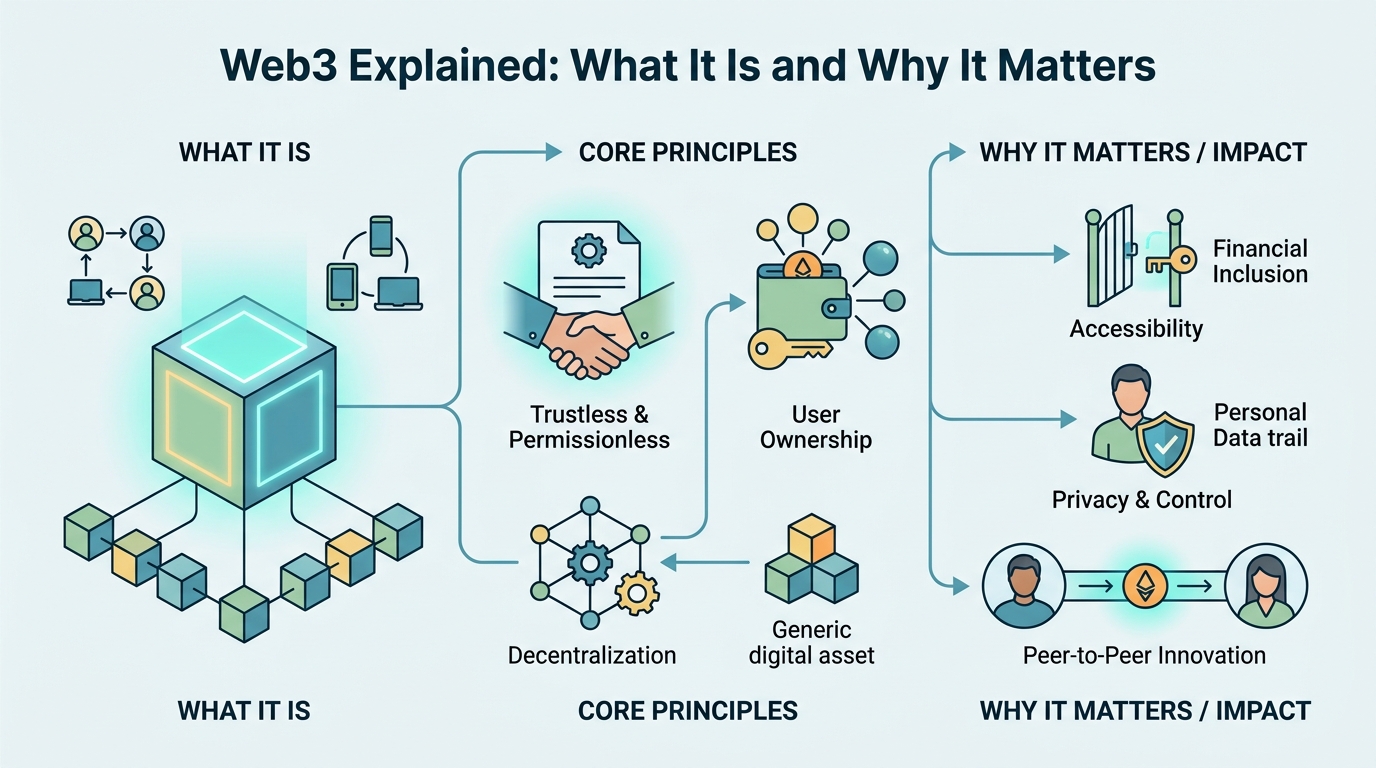
Web3 tries to change that by turning users into participants. AWS says users can control their data, determine pricing, and contribute directly to development. That is a big claim, but the underlying incentive model is real: if a network issues tokens or uses on-chain governance, users can have an economic stake in how the system evolves.
There is a reason this idea keeps showing up in Ethereum projects. Ethereum made smart contracts mainstream, and smart contracts are the machinery that lets a DAO or decentralized app operate without a traditional administrator.
"The Web as I envisaged it, we have not seen it yet. The future is still so much bigger than the past." — Tim Berners-Lee
That quote is old, but it still fits the argument around Web3. Berners-Lee was talking about the web’s unfinished nature, and Web3 is one attempt to push the web toward more user control, richer machine-readable data, and fewer gatekeepers.
The technologies behind the pitch
Web3 is not powered by one stack. It is a mix of infrastructure layers that each solve a different part of the problem. AWS highlights blockchain, tokenization, WebAssembly, semantic web standards, and decentralized storage as key pieces.
Blockchain is the foundation for many Web3 systems because it provides a shared ledger that is hard to alter without network agreement. Tokenization maps real-world or digital assets into tradeable units on-chain. WebAssembly gives developers a way to run code at near-native speed in the browser. IPFS spreads file storage across a peer-to-peer network instead of one server cluster.
The practical difference is visible when you compare how these systems store and move data. Traditional apps usually depend on one database, one identity provider, and one cloud backend. Web3 apps distribute those responsibilities across several layers, which can improve resilience but also adds complexity.
- Amazon Managed Blockchain helps teams build blockchain networks without running every node by hand.
- Smart contracts automate transfers, voting, and business logic.
- Decentralized identifiers give users more control over identity data.
- IPFS uses content hashes so files can be found even if one node disappears.
Where Web3 gets real, and where it still hurts
Web3 shows up most clearly in decentralized finance, digital collectibles, supply chain tracking, identity systems, and community-governed apps. The promise is attractive: lower dependence on intermediaries, more portable assets, and more transparent rules.
But the tradeoffs are real. Public blockchains can be slow compared with a normal database. Fees can spike when demand rises. Governance can become messy when token holders disagree. And while decentralized identity sounds elegant, it still has to work for ordinary users who do not want to manage private keys like a cryptography lab exercise.
Here is the comparison that matters if you are deciding whether Web3 fits a product:
- Web2 marketplace: one company owns the platform, sets fees, and stores user profiles centrally.
- Web3 marketplace: rules can live in smart contracts, assets can live in wallets, and governance can move to token holders.
- Web2 storage: files sit on company-managed servers and can be moved or removed by the operator.
- Web3 storage: content can be addressed by hash and retrieved from multiple peers through systems like IPFS.
That does not make Web3 automatically better. It makes it different. For products that need high throughput, low latency, and simple onboarding, a conventional architecture may still win. For products where ownership, censorship resistance, or community governance matter more, Web3 can be the better fit.
So what should builders do now?
If you are building in this space, the right question is not whether Web3 will replace the web. The better question is which parts of a product actually benefit from distributed ownership, shared state, or on-chain rules.
My take: most teams should start with a narrow use case, such as asset ownership, membership, or settlement, and keep the rest of the application conventional. That approach reduces complexity and makes it easier to judge whether the blockchain layer earns its keep.
Over the next few years, the most useful Web3 products will probably be the ones that hide their plumbing well. Users will care less about whether a system is decentralized and more about whether they can move their data, keep their identity, and own the thing they paid for. If a product cannot answer those questions clearly, the Web3 label will not save it.
For a deeper look at the infrastructure side, see our related guide on blockchain basics for builders. The next wave of practical Web3 work will likely come from teams that treat decentralization as a tool, not a slogan.
// Related Articles
- [CHAIN]
UAE Web3 setup turns crypto rules into a checklist
- [CHAIN]
Five AI Futurist features shaping Futurist 2026
- [CHAIN]
Regulation Now Moves Bitcoin and Ethereum More Than War
- [CHAIN]
The SEC Crypto Rule Proposal Will Clean Up Crypto, Not Kill It
- [CHAIN]
Web3 platforms need fee discipline, not token theatrics, to make money
- [CHAIN]
Riyadh’s blockchain show proves Web3 is now infrastructure