Jensen Huang: AI Will Add More Jobs Than It Cuts
NVIDIA CEO Jensen Huang says AI will create more work than it removes, pointing to NVIDIA’s headcount growth and past tech shifts.

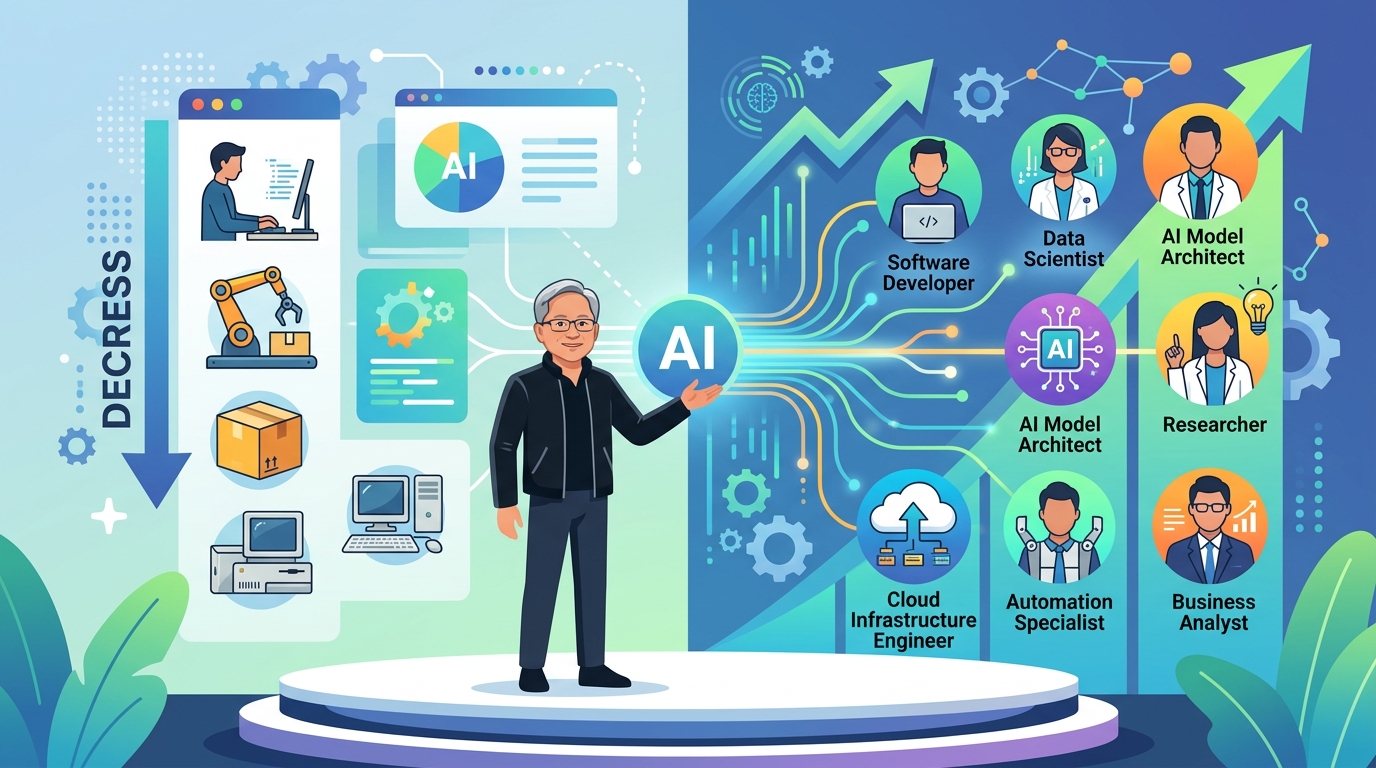
NVIDIA CEO Jensen Huang is making a blunt bet: AI will create more jobs than it destroys. That sounds optimistic until you look at his company’s numbers, which grew from 29,600 employees at fiscal 2024 year-end to 42,000 by March 2026.
Huang’s argument is simple. Every major computing shift has made people more productive, which usually means more work gets done, more products get built, and more roles appear around the new tools. He says AI fits that pattern, even if the transition feels uncomfortable right now.
Why Huang thinks the job fear is overblown
Get the latest AI news in your inbox
Weekly picks of model releases, tools, and deep dives — no spam, unsubscribe anytime.
No spam. Unsubscribe at any time.
On the Lex Fridman Podcast, Huang said the tools he has used for work have changed “continuously” over 34 years. His point was that the purpose of a job does not change just because the tools do. A designer still designs, a developer still builds, and a manager still coordinates work. The software just changes the speed and scale.

That argument matters because public anxiety is real. The article cites research showing 71% of Americans worry AI will cause permanent job loss. Huang is pushing back on that fear with a historical comparison: PCs, the internet, and mobile devices all made workers busier, not idle.
He framed AI the same way. If a model can finish a task in seconds instead of hours, companies do not necessarily stop at one task. They usually try to do more with the same staff, or they open up new lines of business that did not make sense before.
- NVIDIA headcount rose from 29,600 to 42,000 in about a year and a half.
- Huang says AI speeds up tasks enough to increase total work output.
- The article cites 71% of Americans worrying about lasting AI-driven job loss.
- Huang has led NVIDIA for 34 years, giving him a long view of tech cycles.
What NVIDIA’s growth says about AI demand
NVIDIA’s own staffing jump is the strongest evidence in Huang’s case. If AI were shrinking the need for technical labor across the board, you would expect the company selling the chips and software to flatten out. Instead, it added thousands of employees as AI adoption spread into cloud infrastructure, enterprise software, robotics, and consumer products.
That growth also lines up with Huang’s claim that AI increases the amount of work companies can take on. More customers mean more support, more product planning, more research, more sales, and more deployment work. Even if AI automates some internal tasks, the overall business can still expand faster than headcount falls.
At NVIDIA GTC 2026, Huang went further and predicted AI use would lead to $1 trillion in orders by 2027. That is an enormous number, and it helps explain why the company keeps hiring. A market that large does not just need chips; it needs people who can integrate, deploy, secure, and maintain them.
- NVIDIA said it had 42,000 employees by March 2026.
- The company had 29,600 employees at fiscal year-end 2024.
- Huang projected $1 trillion in AI-related orders by 2027.
- Those orders would likely touch hardware, software, cloud, and systems integration.
The quote that sums up Huang’s view
Huang’s podcast comments were the clearest version of his argument. He does not think AI shrinks work into nothing. He thinks it compresses task time, which pushes people to do more. That is the same logic he applies to every major computing wave that came before it.
“The tools that I've used to do my job have changed continuously in the last 34 years, and sometimes quite dramatically,” Huang said on the Lex Fridman podcast.
He also told worried workers to remember that “the purpose of your job, and the tasks and tools that you use to do your job, are related, not the same.” That is a neat way of saying automation changes workflows faster than it changes why most jobs exist in the first place.
There is a management angle here too. Huang said he avoids one-on-one meetings with his roughly 60 direct reports and instead runs group sessions where everyone attacks the same problem with the same information. It is a very NVIDIA-style answer to complexity: fewer silos, faster decisions, and less time wasted on private briefings.
How Huang compares AI with past tech shifts
Huang keeps returning to the same comparison set: PCs, the internet, and mobile devices. Each one made workers more productive, but each one also raised expectations. When email arrived, people answered faster. When smartphones arrived, people were reachable all the time. When cloud software arrived, teams moved faster and shipped more often.
AI is following that same pattern, but at a higher speed. Instead of helping people send messages or search documents faster, it can draft code, summarize research, generate visuals, and automate support workflows. That means fewer minutes spent on repetitive tasks and more pressure to produce at a higher volume.
Here is the comparison in plain numbers and outcomes:
- Microsoft Copilot targets knowledge work inside Office apps, where time savings can be measured in minutes per task.
- ChatGPT scaled from chat to coding, search, and enterprise workflows, showing how fast AI tools can spread across job functions.
- Claude and other assistant models are being used for writing, analysis, and customer support, which changes how teams allocate labor.
- NVIDIA’s own workforce grew by 12,400 people between fiscal 2024 year-end and March 2026.
That last number matters because it cuts against the simple “AI replaces people” story. If AI were only a cost-cutting tool, the biggest beneficiary in the market would not be adding staff this quickly while demand explodes.
What to watch next
Huang also made a bolder claim this year, saying NVIDIA has already “achieved AGI,” while clarifying that the term applies in specific scenarios rather than universally. He is clearly using a narrower definition than people usually mean when they say artificial general intelligence, but the larger message is the same: AI capability is moving fast enough to change what companies can ask humans and machines to do together.
The real test is not whether AI removes some roles. It already will. The question is whether the new demand it creates is larger, and whether workers can move into those new tasks fast enough. Based on NVIDIA’s hiring, the company is betting yes.
My take: the next 12 to 24 months will tell us more than the last decade did. If AI adoption keeps pushing companies to hire for deployment, integration, and oversight, Huang’s argument gets stronger. If firms freeze hiring while automation rises, the labor story changes fast. For now, the safer bet is that AI will reshape job descriptions before it shrinks the total amount of work people do.
If you want a useful question to ask inside your own company, it is this: which tasks are about to get faster, and what new work will appear once they do?
// Related Articles
- [IND]
WebX 2026 turns speaker hype into a conference brief
- [IND]
AI Weekly: 2026-07-06 ~ 2026-07-13
- [IND]
The AI Act should be treated as Europe’s operating system for AI
- [IND]
Booz Allen’s OpenAI Deal Is Real Advantage, Not Hype
- [IND]
OpenSearch’s vector search benchmark in 5 parts
- [IND]
Vector Databases That Work in Production