KuCoin’s AI stack turns blockchain into AI plumbing
I break down KuCoin’s decentralized AI outlook into a practical stack and give you a copy-ready template for agents, payments, and inference.

This breaks KuCoin’s decentralized AI outlook into a copy-ready stack.
I've been staring at decentralized AI writeups for a while now, and most of them read like someone emptied a buzzword jar onto the page. This KuCoin piece was different in a way that annoyed me at first. It kept circling the same hard problems I keep running into when I try to build anything AI-adjacent that touches money, identity, or private data: centralized GPU access gets expensive fast, outputs are hard to verify, and the minute you want an agent to do something real, the trust model falls apart.
That’s the part that gets me. A chatbot can be wrong and you shrug. An agent moving funds, calling APIs, or making decisions from private data cannot just “sound confident.” It needs identity, auditability, payment rails, and a way to prove it didn’t make stuff up. KuCoin’s article is messy, sure, but the core complaint is the right one. I’ve seen too many teams bolt AI onto Web2 infrastructure and then act surprised when the whole thing becomes brittle. If the stack can’t explain itself, can’t settle value, and can’t keep private data private, it’s not a system. It’s a demo.
The source that kicked this off is KuCoin’s "Decentralized AI 2026 Outlook: Why Blockchain is the Key to AI's Future", compiled from MarsBit and attributed to Pink Brains / Foresight News. I’m not treating it like gospel. I’m treating it like a field note from the crypto side of the AI world, with a lot of concrete project names and enough numbers to tell me where people are actually building versus just talking.
Centralized AI is expensive, opaque, and one bad policy away from breaking
Get the latest AI news in your inbox
Weekly picks of model releases, tools, and deep dives — no spam, unsubscribe anytime.
No spam. Unsubscribe at any time.
Computing resources are scarce and expensive. Excessive concentration of control. Model output is unverifiable. Obtaining training data is becoming increasingly difficult.
What this actually means is: the current AI model is a bottleneck machine. You need expensive GPUs, you need a few giant vendors, and you need to trust outputs you can’t really inspect. KuCoin’s article says the shortage is structural, not just temporary. It points to GPU infrastructure growing from $10 billion in 2025 to $77 billion in 2035, and a decentralized computing market rising from $9 billion in 2024 to $22 billion in 2035, citing Research and Markets.

I don’t care much about the exact forecast. I care that the shape of the problem is real. When a few companies own the models, own the compute, and own the policies, everyone else rents intelligence on terms they don’t control. That’s fine for a chatbot. It’s a bad fit for anything that needs reliability, audit trails, or data sovereignty.
I ran into this exact wall when prototyping an agent that had to summarize private records and then trigger a workflow. The model was fine. The infrastructure was not. Every extra compliance requirement turned into another API gateway, another logging layer, another place where data could leak or get blocked. The system got slower and less trustworthy with every patch.
How to apply it: stop asking whether AI is “good enough” and start asking whether the surrounding system is inspectable. If your use case involves finance, healthcare, or anything with consequences, the infrastructure matters as much as the model. If you can’t explain where the data went, who ran the model, and how the result was produced, you don’t have a product you can defend.
- Use centralized models for low-stakes drafting and search.
- Use verifiable or auditable infrastructure when the output changes money, access, or policy.
- Design for failure modes first, not happy-path demos.
Agentic finance is the first place this stack stops being theoretical
KuCoin’s strongest section is the one about agent finance and agentic payments. It lists projects like Giza, Infinit, Coinvest, Minara, Cod3x, and Zyfai as examples of AI agents turning prompts into on-chain actions. It also cites ARMA processing over $4.6 billion in agent-driven trading volume across selected lending markets on EigenLayer’s AVS framework.
What this actually means is that the first serious AI-native workload is not “write me a poem.” It’s “take an intent, inspect the environment, and execute a transaction.” Finance is where the chain of custody matters enough that people will pay for the plumbing. If an agent can rebalance yield, route a trade, or execute a payment, then we finally have a reason to care about identity, permissions, and settlement as first-class features.
I like this framing because it’s honest about where the money is. The article doesn’t pretend consumers will suddenly trust autonomous AI to do everything. It says the obvious thing: people are willing to let AI research, but they’re way less willing to let AI buy. That gap is the product opportunity. Close the trust gap and you get adoption. Ignore it and you get another toy.
How to apply it: if you’re building in this space, start with bounded execution. Let the agent propose, then constrain what it can actually do. Put caps on spend, whitelist protocols, require simulation before execution, and log every step. If you can’t audit the decision path later, you’re not building an agent. You’re building a liability with a UI.
- Keep human approval for high-risk transactions.
- Use policy engines to limit asset types, venues, and amounts.
- Store prompts, tool calls, and execution receipts together.
Machine-to-machine payments are the part that finally feels real
The article’s payment section is one of the few places where the hype calms down and the numbers start to matter. KuCoin says x402 had processed over 173 million transactions on Base and Solana as of May 2026, with members including Google, Visa, AWS, Circle, Anthropic, Stripe, and Cloudflare. It also says Stripe has used it since February 2026 and AWS launched native AgentCore Payments. Then it points to Stripe and Tempo’s Machine Payments Protocol, which it says has recorded over 411,900 transactions and 9,600 buyers.
What this actually means is that machine payments are moving from concept to infrastructure. Not “AI will someday pay for stuff,” but “software agents need a settlement layer now.” That’s a big difference. Once software can buy inference, buy API calls, or pay for data on demand, the whole architecture changes. You don’t need a human in the loop for every micro-transaction. You need a policy, a wallet, and a way to prove the payment was authorized.
I’ve seen teams overcomplicate this by trying to keep payments entirely off-chain or entirely inside traditional billing systems. That just recreates the same bottlenecks with extra steps. If the agent is acting in real time, the payment rail has to be just as programmable as the rest of the stack. Otherwise the agent is only half autonomous.
How to apply it: separate authorization from settlement. Let the policy engine decide whether a payment is allowed, then let the payment rail execute it with a clear receipt. Use stablecoins or chain-native settlement where the transaction volume is machine-driven and frequent. If you’re building developer tooling, make payment events as observable as API logs.
Identity and reputation are the missing middleware nobody wants to own
KuCoin calls out the middleware layer as the coordination problem: how agents discover each other, authenticate, and transact without human intervention. It mentions ERC-8004 for portable on-chain identity and reputation, and GoKite building a dedicated L1 with identity and payments as native primitives. It also highlights Virtuals as an operating system for the agent economy on Base, with over 2.38 million agent tasks and nearly $480 million in “agent GDP” by June 2026, according to the article.
What this actually means is that the agent economy dies without trust plumbing. API keys are not identity. Proxies are not entities. A model that can call tools but cannot prove who it is, what it can do, and how trustworthy it has been is just another script with better marketing.
I keep coming back to this because it’s the part most builders skip. They obsess over model quality and then hand-wave the coordination layer. But once agents need to find each other, negotiate terms, and complete tasks across systems, you need reputation that travels with them. You need portable identity. You need a way to say, “this agent did good work before, and here’s evidence.”
How to apply it: treat agent identity like service identity, but with a reputation trail. Give each agent a stable identifier, scoped permissions, and an auditable history. If you’re building a marketplace, include verification, not just discovery. If you’re building tools, make it easy to inspect what an agent is allowed to touch before you let it anywhere near production.
Bittensor is the clearest example of incentives doing the hard work
KuCoin spends a lot of time on Bittensor, and honestly, that makes sense. It frames Bittensor as a network of specialized subnets where miners run AI models and validators score outputs, with TAO emissions going to the work that produces value. The article says the network has surpassed 128 active subnets, and claims the top three compute subnets reached a combined $20 million ARR within three months of monetization. It also points to the 2025 December halving, dTAO, and the Taoflow upgrade as mechanisms that tighten the incentive loop.
What this actually means is that Bittensor is trying to make AI infrastructure behave like a market instead of a monopoly. The interesting part isn’t the token talk. It’s the idea that useful work gets rewarded, bad work gets priced out, and the network keeps rebalancing itself based on demand.
I’m skeptical of any system that claims to solve coordination with token emissions alone. But I’m less skeptical of systems where the economics are legible. If a subnet has to earn its place by being useful, that’s better than pretending compute allocation is neutral. It isn’t. Someone is always deciding who gets resources and why.
How to apply it: if you’re building decentralized infrastructure, make the reward function explicit and testable. Define what “useful” means. Define how bad output is penalized. Define how participants can exit or move between subnets. If your incentive design can’t survive adversarial behavior, it won’t survive real users either.
- Reward measurable output, not vague participation.
- Make slashing or penalties understandable before launch.
- Keep the economics simple enough that builders can reason about them.
Compute, inference, training, and storage are the actual stack
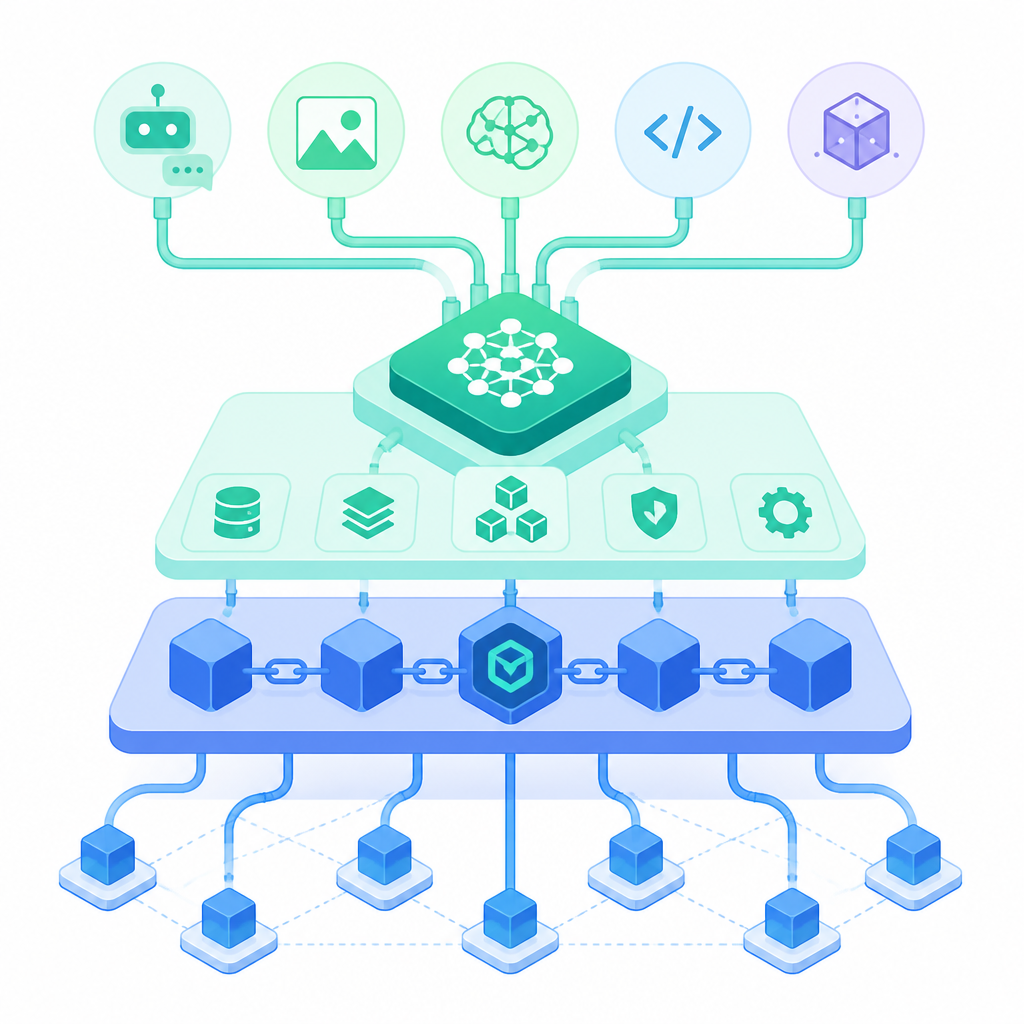
KuCoin’s infrastructure section is the least glamorous and the most useful. It names Akash, Render, io.net, and Aethir for decentralized compute. It also mentions Venice, OpenGradient, Chutes, and Dolphin for private or verifiable inference, plus Prime Intellect, tplr, Nous Research, and Macrocosmos for distributed training and data.
What this actually means is that decentralized AI is not one thing. It’s a pile of separate problems: where compute comes from, how inference stays private, how training is distributed, and where the data lives. If you try to collapse all of that into one slogan, you end up with nonsense. If you separate the layers, the architecture starts to make sense.
I’ve found this layer-cake view useful because it stops teams from overcommitting too early. Maybe you don’t need decentralized training. Maybe you only need private inference. Maybe your biggest issue is storage or data availability, not model execution. The article’s value is that it gives you a menu instead of a manifesto.
How to apply it: pick the layer you actually need. If cost is the main problem, start with decentralized compute. If privacy is the issue, start with verifiable inference. If model development is blocked by data silos, focus on data coordination and storage. Don’t buy the whole stack unless your product really needs the whole stack.
The template you can copy
# Decentralized AI stack template for a real product

## 1) Problem statement
We need AI to do work that touches money, private data, or shared infrastructure.
Centralized AI is fine for drafting and search, but it is not enough for:
- auditable decisions
- private inference
- machine payments
- autonomous execution

## 2) Pick the layer you actually need
Choose one primary layer first:
- Compute: decentralized GPU access
- Inference: private or verifiable model execution
- Training: distributed model training
- Middleware: agent identity, reputation, discovery
- Payments: machine-to-machine settlement
- Storage/Data: data availability and coordination

## 3) Minimal architecture

### Identity
- Every agent gets a stable on-chain or cryptographic identity
- Permissions are scoped by task, asset, and venue
- Reputation is stored with the agent, not in a hidden dashboard

### Policy
- Human or programmatic approval gates for high-risk actions
- Spend caps per agent, per day, and per protocol
- Whitelisted tools only
- Simulation required before execution

### Execution
- Model makes a proposal
- Policy engine validates the proposal
- Wallet or settlement layer executes the action
- Receipt is written to an audit log

### Payments
- Use stablecoin or chain-native settlement for machine-driven transactions
- Separate authorization from settlement
- Store payment receipts with tool-call logs

### Data
- Keep private data out of raw prompts when possible
- Use retrieval with access controls
- Log what was accessed, not just what was answered

## 4) Build order
1. Start with one narrow use case
2. Add identity and logging before autonomy
3. Add payments only after you can audit execution
4. Add reputation after you have enough real usage data
5. Move to distributed compute or training only when centralized infrastructure becomes the bottleneck

## 5) Red flags
- The agent can act but cannot explain its actions
- The system can spend money but cannot prove authorization
- The model is private but the surrounding logs leak data
- Reputation is stored off-chain with no portability
- Incentives reward activity instead of useful output

## 6) Implementation checklist
- [ ] Agent identity is stable and portable
- [ ] Permissions are explicit and machine-readable
- [ ] Every tool call is logged
- [ ] Every payment has a receipt
- [ ] Every execution path can be replayed
- [ ] Failure modes are tested before launch
- [ ] A human can review or revoke high-risk actions

## 7) Copy-ready prompt for an autonomous agent
You are an AI agent operating inside a constrained financial or operational workflow.
Your job is to propose actions, not assume unlimited authority.
Before acting, you must:
- identify the task
- list required inputs
- check policy constraints
- simulate the outcome when possible
- request approval for anything above the allowed threshold
- record the reasoning, tool calls, and final receipt

If the task involves money, private data, or external side effects:
- do not proceed unless the policy engine approves
- do not invent missing information
- do not make unsupported assumptions
- prefer the smallest safe action

Your output must include:
- proposed action
- risk level
- required approvals
- execution plan
- audit log summary
This template is original to me, but the shape comes from KuCoin’s breakdown of the decentralized AI stack and the project examples it cites. If you want the source material, start with KuCoin’s article here: KuCoin: Decentralized AI 2026 Outlook. For the underlying pieces, I linked the main projects and standards above so you can check what’s real, what’s aspirational, and what’s just marketing with a wallet attached.
// Related Articles
- [IND]
Anthropic’s safe Claude Mythos 5 turns access into tiers
- [IND]
G7 should treat AI CEOs as power brokers, not guests
- [IND]
Ping Identity is right: AI agents need runtime identity, not just log…
- [IND]
Cloudflare’s design partner program is a smart security wedge
- [IND]
Claude 5双模型上线,代码与科学任务全面领跑
- [IND]
Mistral’s €20B valuation hinges on compute