Mistral’s €20B valuation hinges on compute
Mistral is talking about a €3B raise at a €20B valuation while building its own compute stack and EU-focused AI infrastructure.

Mistral is seeking €3 billion at a €20 billion valuation to fund its own AI compute infrastructure.
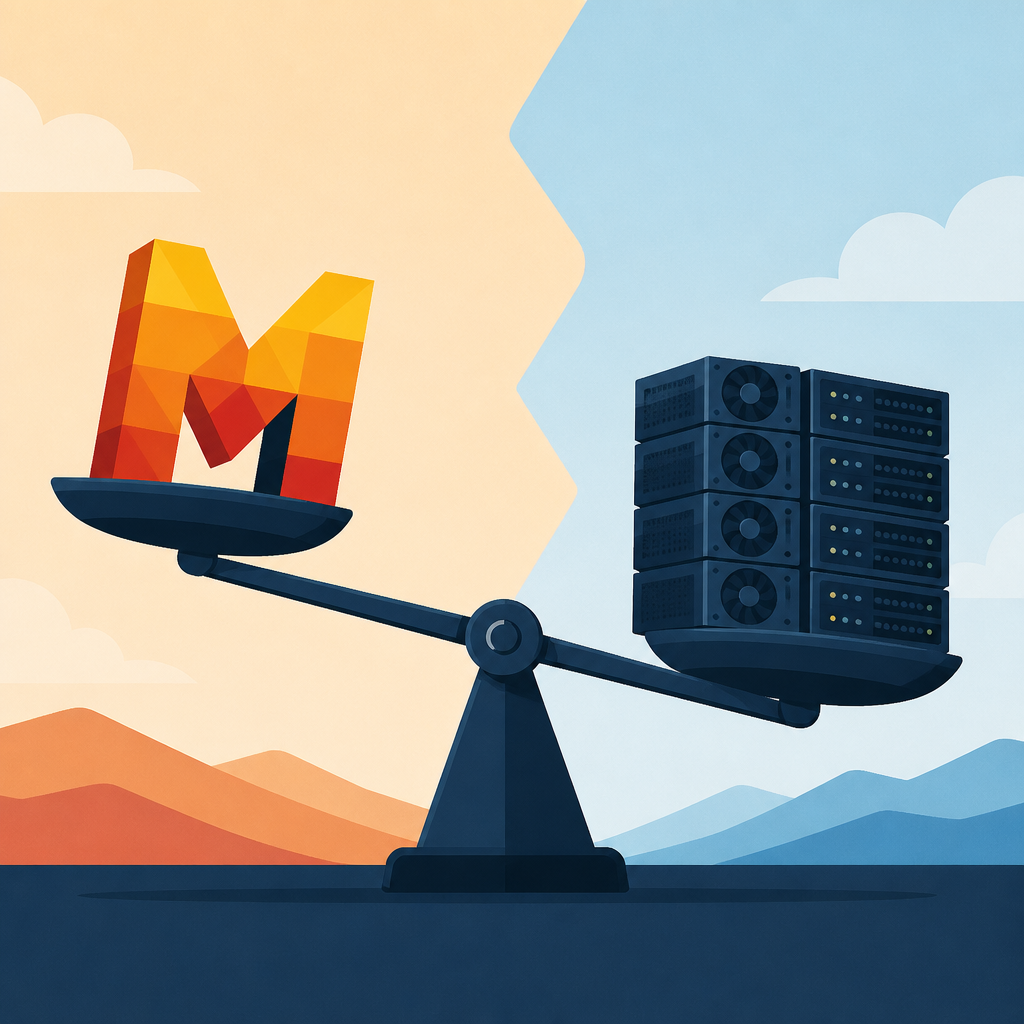
Mistral AI is now in talks to raise €3 billion at a €20 billion valuation, and the pitch is bigger than model quality. The Paris startup wants to build its own data centres, hit 200 megawatts by 2027, and reach 1 gigawatt of capacity by 2030.
| Metric | Value | What it means |
|---|---|---|
| Target raise | €3 billion | New equity funding under discussion |
| Target valuation | €20 billion | Nearly 2x the September 2025 mark |
| March 2026 debt | $830 million | Already earmarked for data centre expansion |
| 2027 compute target | 200 megawatts | Midpoint milestone for Mistral Compute |
| 2030 compute target | 1 gigawatt | Long-term infrastructure goal |
Mistral is pricing itself like an infrastructure company
Get the latest AI news in your inbox
Weekly picks of model releases, tools, and deep dives — no spam, unsubscribe anytime.
No spam. Unsubscribe at any time.
The headline valuation matters, but the strategy matters more. If this round closes at €20 billion, Mistral would nearly double the €11.7 billion valuation it reached in September 2025, when it raised €1.7 billion in a Series C round. That is a huge jump in less than a year for a company that is still only three years old.
The company was founded in April 2023 by Arthur Mensch, Guillaume Lample, and Timothée Lacroix after they left Google DeepMind and Meta. In a short stretch, the company went from a Paris AI lab to one of Europe’s most expensive private tech names.
That valuation climb is tied to a very specific bet: Mistral wants control over the compute layer, not just the model layer. The company says its Mistral Compute programme will serve its own models and also European governments and enterprises that want AI capacity outside US-controlled infrastructure.
- €5.8 billion valuation at Series B in June 2024
- €11.7 billion valuation at Series C in September 2025
- €20 billion target valuation in current talks
- €6.5 billion total equity and debt financing if the round closes
ASML is the most interesting name on the cap table
The biggest signal in this story is not the round size. It is ASML, the Dutch chip equipment maker that led Mistral’s Series C and bought an 11% stake for €1.3 billion. ASML is known for extreme ultraviolet lithography machines, the tools advanced chipmakers need to produce cutting-edge silicon. It is not known for backing software startups.
That makes the relationship unusually revealing. ASML and Mistral signed a long-term collaboration agreement to explore AI across ASML’s product portfolio, from lithography system design to manufacturing operations. In plain English, ASML is using Mistral’s models to improve its own machines, while also helping finance the startup’s rise.
“AI is going to be the next major technology revolution,” said Christophe Fouquet, ASML’s president and chief executive officer, in ASML’s 2024 annual report.
If the current valuation lands near €20 billion, ASML’s paper stake would be worth about €2.2 billion. That is a tidy gain, but the bigger point is strategic: a European industrial giant is helping fund a European AI company that wants to own more of its own stack.
Mistral’s other backers include Nvidia, Andreessen Horowitz, General Catalyst, DST Global, Index Ventures, Lightspeed, and Bpifrance.
Open weights give Mistral a different sales pitch
Mistral built its reputation on open-weight models, which let customers inspect, customise, and run the systems on their own infrastructure. That matters a lot in Europe, where banks, public agencies, and industrial firms often want tighter control over data and deployment.

There is a practical reason this resonates. A German bank can run Mistral’s models inside its own network and keep customer data in-house. With closed systems from OpenAI or Anthropic, that control is much harder to get.
The company’s current model lineup includes Mistral Small 4, Ministral 14B, Mistral Large 3, and Voxtral, its first audio model. Mistral says the Ministral 14B reasoning variant scores 85% on AIME 2025, while a comparable Qwen 14B model scores 73.7% in the company’s own comparison. Mistral Small 4 is priced at $0.15 per million input tokens, which the company says is five times cheaper than GPT-5.4 Mini at $0.75.
- About 350 employees today
- Founded in April 2023
- Open-weight models built for self-hosting
- Strategic partnership with Ericsson for telecom AI
The infrastructure bet is where the risk lives
Mistral is competing in a part of AI that gets expensive fast. OpenAI and Anthropic have deep-pocketed backers in Microsoft and Google Cloud, which means they can spend heavily on compute without worrying about every dollar. Cohere, another enterprise AI company, has raised more than $1 billion.
Mistral, by contrast, is trying to do two hard things at once: stay credible as a model company and build physical infrastructure like a cloud provider. That is why the March 2026 debt package matters. The company already secured $830 million in debt financing for data centre expansion, and the new equity round would take total financing to roughly €6.5 billion.
The financing history shows how quickly investors have been forced to reprice the company. Mistral raised a €105 million seed round in June 2023, a €385 million Series A in December 2023, a €600 million Series B in June 2024, and then a €1.7 billion Series C in September 2025. A €3 billion raise would put it in a different weight class again.
That said, the company is still early in the process. The talks are preliminary, the terms can change, and the real test is whether Mistral can turn capital into durable infrastructure advantage rather than just a higher headline price.
Europe wants its own AI stack, but compute is the bottleneck
Mistral’s pitch lands in the middle of a bigger European debate: can the region build serious AI systems without depending entirely on US cloud and model providers? The company is betting that governments and enterprises will pay for local control, open deployment, and compute capacity they can trust.
That is a sensible commercial story, but the execution bar is high. Grand View Research says the global AI infrastructure market will reach $570 billion by 2030, which explains why everyone from chipmakers to cloud giants is racing to own more of the stack. Mistral wants a slice of that market while still acting like a model lab.
The question now is simple: can a startup founded in 2023 build enough compute by 2030 to matter against Amazon, Microsoft, Google, and the rest of the hyperscalers? If Mistral gets to 200 megawatts by 2027, it will have a real answer. If it misses that milestone, the €20 billion valuation will look a lot more fragile.
For now, the company has made its bet clear. It is no longer asking investors to value it only on model performance. It is asking them to price in data centres, power contracts, and a European AI stack that can stand on its own.
// Related Articles
- [IND]
Claude 5双模型上线,代码与科学任务全面领跑
- [IND]
$2 billion Nvidia-Coherent AI plant backs Huang's warning
- [IND]
Huang’s Marvell call turns AI hype into a thesis
- [IND]
China’s AI bet: open-source, efficiency, global sales
- [IND]
ERGO Hestia cut pricing time-to-market with Databricks
- [IND]
OpenAI and Oracle Universal Credits Enter Enterprise Buying