What Stage Is the Metaverse In, Really?
The metaverse is still early: Meta, Roblox, and Apple show it looks more like the web’s pre-portal era than a finished platform.

The metaverse is still in its awkward teenage years, and the numbers make that pretty clear. Meta spent billions on Reality Labs, Roblox keeps posting huge daily user counts, and Apple Vision Pro arrived with a $3,499 price tag that instantly narrowed the audience. If you want the short answer, the metaverse today looks less like a finished internet era and more like the period before the web became ordinary.
That may sound vague, but it is actually a useful way to think about where things stand. The internet did not begin with Facebook or Google; it went through messy, experimental phases before most people cared about it. The metaverse is doing the same thing now, with hardware, software, and business models all moving at different speeds.
What the metaverse looks like today
Get the latest AI news in your inbox
Weekly picks of model releases, tools, and deep dives — no spam, unsubscribe anytime.
No spam. Unsubscribe at any time.
Right now, the metaverse is a bundle of separate ideas rather than one clear product. Some people mean VR headsets, others mean social worlds, and others mean digital ownership or persistent 3D spaces. That confusion is a signal in itself. Mature platforms usually have a shared definition; early-stage ones do not.

The strongest evidence comes from where the money and users are. Meta Reality Labs has burned tens of billions of dollars over several years, while Roblox reported 79.5 million daily active users in Q4 2024. Those are not signs of a finished market. They are signs of a market still trying to decide what people actually want.
- Meta reported Reality Labs operating losses of $16.1 billion in 2023.
- Roblox reached 79.5 million daily active users in Q4 2024.
- Apple Vision Pro launched at $3,499, which keeps it in early-adopter territory.
- OpenAI’s Sora pushed 3D and spatial content back into the conversation, but it is not a metaverse product.
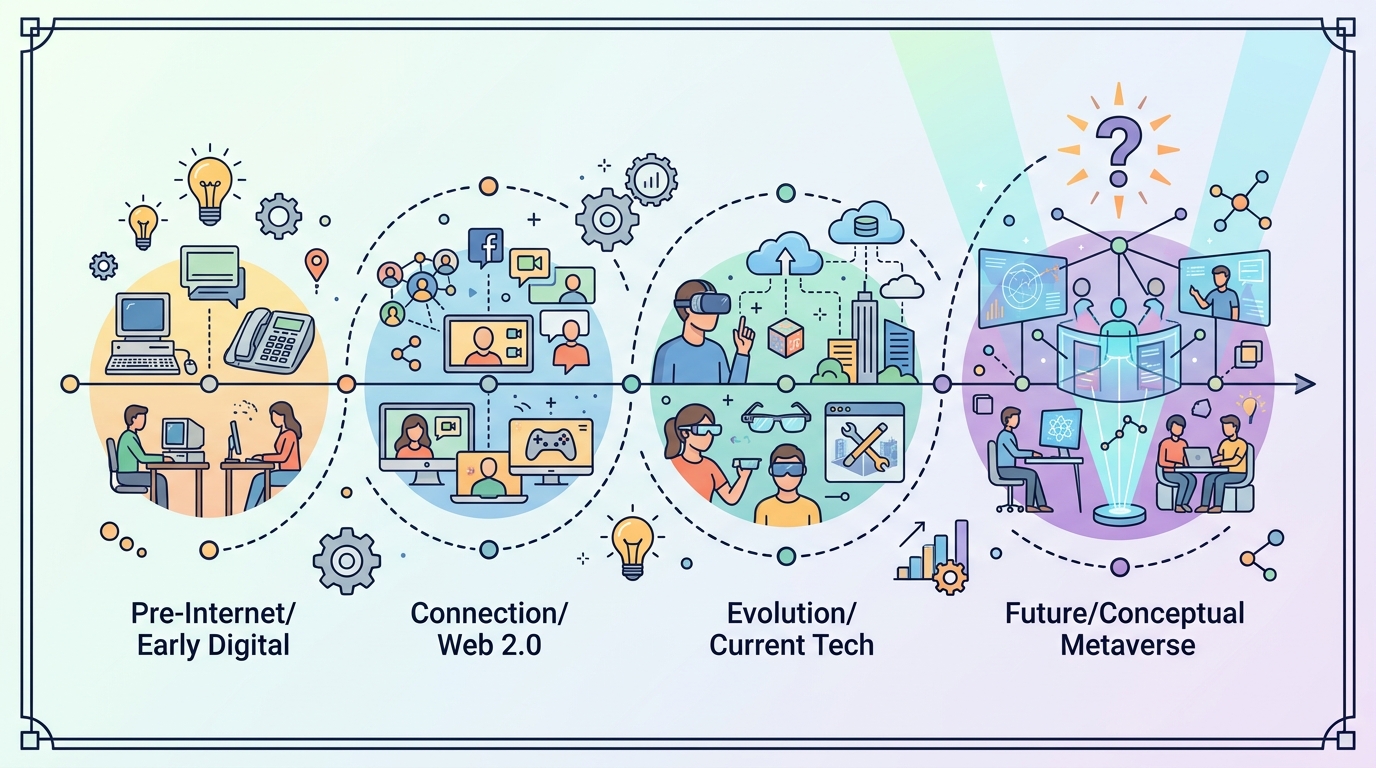
If you map that to internet history, the closest comparison is the pre-Web 1.0 and early Web 1.0 period: lots of technical promise, lots of demos, weak standards, and very uneven user adoption. The metaverse has the same feel. It is real, but it is not settled.
Why the internet comparison matters
The internet did not become useful because someone declared a new era. It became useful when browsers got easier, connections got faster, and the average person could do something practical online without reading a manual. The metaverse needs the same kind of boring progress. Headsets must get lighter, battery life must improve, and interfaces must stop feeling like a science fair project.
That is why comparing the metaverse to a specific stage of internet history helps more than the usual hype cycle language. If we treat it like the early web, we stop expecting mass adoption tomorrow and start asking better questions: Who is it for? What problem does it solve? Why would someone use it for 30 minutes a day instead of five?
“The metaverse is the next evolution of social connection.” — Mark Zuckerberg, Meta Connect 2021 keynote
Zuckerberg said that when Meta was still pitching the metaverse as the company’s central future. The quote matters because it captures the ambition, but the market response has been far more cautious. Investors have kept watching Reality Labs losses, while consumers have mostly treated immersive worlds as a niche hobby or a demo.
That gap between vision and behavior is exactly what early internet history looked like. The web had a vision long before it had mass utility. The metaverse is following that pattern, which is why the current stage feels closer to infrastructure building than to a consumer breakthrough.
The hardware and software gap is still huge
The metaverse depends on a stack of technologies that are advancing at different speeds. Meta Quest headsets are cheaper and more accessible than before, but they still ask users to wear a computer on their face. Vision Pro delivers impressive visuals, yet its price and weight make it feel like a premium prototype rather than a mass-market device.
Software has similar problems. Many virtual worlds still feel empty, repetitive, or awkward after the first novelty wears off. That is why the most successful metaverse-adjacent products so far are not giant open universes. They are focused experiences: games, social spaces, training tools, and enterprise demos.
- Meta Quest 3 starts at $499.99, far below Vision Pro but still expensive for casual buyers.
- Vision Pro starts at $3,499, which is roughly seven times the Quest 3 entry price.
- Roblox has a massive user base because it already solves a simple need: play and creation.
- Enterprise XR tools often win because companies can justify the cost with training or simulation ROI.
That price gap matters more than most product announcements. Consumer tech usually scales when the experience gets better and the price drops enough to feel normal. The metaverse has not reached that point yet, and the market knows it.
So what stage are we actually in?
If we borrow internet history as a guide, the metaverse is closest to the era when the web had become visible but had not yet become necessary. Think early browsers, dial-up frustration, and a lot of speculation about what online life might become. The infrastructure exists, the vocabulary exists, and the use cases are real, but the default behavior of most people is still to stay outside it.
That is why the most honest answer is this: the metaverse is in its pre-mainstream platform stage. It is past pure concept, but it is nowhere near the point where it feels as normal as email, search, or messaging. In internet terms, we are before the big consumer standardization wave, not after it.
That also explains why so many answers online sound contradictory. Some people see the metaverse as Web3, some as XR, some as a future operating system for digital life. They are all pointing at different parts of the same unfinished stack. The disagreement is not a bug; it is proof that the category has not stabilized yet.
For a useful comparison, here is the simplest version:
- Web 1.0 had static pages and basic publishing.
- Web 2.0 added social participation, creator tools, and platform economies.
- The metaverse is trying to add spatial interaction, persistent identity, and embodied presence.
- That puts it earlier than most people think, because the interaction model is still being invented.
That last point is the key one. The metaverse will not be judged by how many keynote demos it produces. It will be judged by whether a normal person can use it for work, play, or social life without feeling like they are beta testing the future.
What to watch next
The next meaningful milestone is not a bigger hype cycle. It is a boring one: lower headset prices, better comfort, stronger app ecosystems, and clearer reasons to spend time in immersive spaces. If those four things move together, the metaverse can move from novelty to habit.
For now, the best answer is that the metaverse is where the web was before most people had a browser on their desk. It has the ingredients, but not the habit. If you are tracking this space, watch adoption numbers more than keynote language, because user retention will tell us far more than any company slogan.
The real test is simple: when can the metaverse become something people use without being told it matters? Until that happens, it remains an early internet story, not the next finished chapter.
// Related Articles
- [IND]
WebX 2026 turns speaker hype into a conference brief
- [IND]
AI Weekly: 2026-07-06 ~ 2026-07-13
- [IND]
The AI Act should be treated as Europe’s operating system for AI
- [IND]
Booz Allen’s OpenAI Deal Is Real Advantage, Not Hype
- [IND]
OpenSearch’s vector search benchmark in 5 parts
- [IND]
Vector Databases That Work in Production