OpenAI and Anthropic Eye Historic IPOs
OpenAI may approach a $1 trillion valuation, while Anthropic targets $400B-$500B. Their IPOs could reshape AI funding and cloud spending.

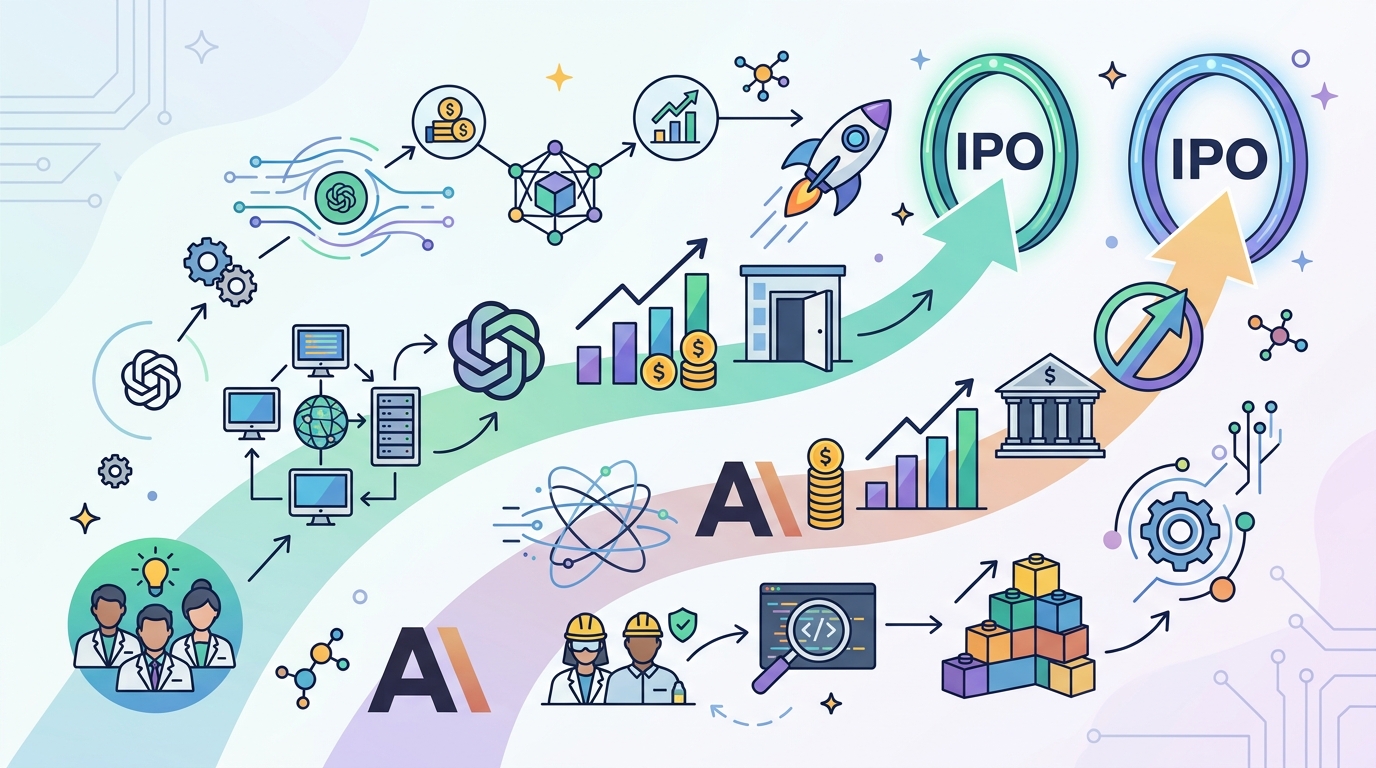
OpenAI may be heading toward a valuation near $1 trillion, while Anthropic is reportedly aiming for $400 billion to $500 billion. If both companies list in late 2026, the combined capital raise could top $150 billion, which would make this one of the largest market events ever tied to a single technology wave.
That number matters because these are not ordinary software IPOs. OpenAI and Anthropic sit at the center of the generative AI boom, and their public listings would turn private model-building economics into something Wall Street can price every quarter.
Why these IPOs matter now
Get the latest AI news in your inbox
Weekly picks of model releases, tools, and deep dives — no spam, unsubscribe anytime.
No spam. Unsubscribe at any time.
The timing is what makes this story so interesting. Both companies have spent the last two years turning model quality into revenue, while also absorbing the kind of compute bills that only a handful of firms can stomach. That combination has pushed them toward the public markets, where they can raise capital, satisfy infrastructure needs, and give investors a direct way to buy into frontier AI.

OpenAI’s path has been especially visible. The company reworked its structure in 2025 and later converted its for-profit arm into OpenAI Group PBC, a public benefit corporation. That matters because the company now has to balance mission language with shareholder expectations, which is always a tricky act for a lab that still spends heavily on research.
Anthropic has taken a different route. Its pitch is more enterprise-heavy, more developer-centric, and more focused on software teams that want AI inside the workflow instead of hanging around the edges of it. The company’s product mix has made it a favorite in corporate settings where reliability and coding assistance matter more than consumer hype.
- OpenAI is reportedly targeting a valuation close to $1 trillion.
- Anthropic is reportedly targeting $400 billion to $500 billion.
- The two IPOs could raise more than $150 billion combined.
- Both listings are being discussed for Nasdaq.
- Training frontier models now requires data-center budgets measured in tens of billions of dollars.
The revenue numbers behind the pitch
What separates this wave of AI listings from the dot-com era is that both companies already generate serious revenue. According to the article’s reported figures, OpenAI hit a $25 billion annualized revenue run rate in February 2026. Anthropic, meanwhile, reportedly climbed from $9 billion at the end of 2025 to more than $19 billion by March 2026.
Those numbers do not mean either company is profitable in the traditional sense. They do show that demand is real, especially for products that have moved beyond chat into coding, workflow automation, and enterprise deployment. In other words, investors are not being asked to fund a concept. They are being asked to fund a very expensive scaling problem.
One of the clearest examples is Claude Code, Anthropic’s agentic coding tool. The article says it has become a standard inside Fortune 500 software teams, and that helps explain why Anthropic can argue for a premium valuation. If a tool becomes part of daily engineering work, switching costs start to matter fast.
“We are entering a period where AI systems will be used by everyone, everywhere, all the time.” — Sam Altman, OpenAI DevDay 2023
Altman’s line is memorable because it captures the commercial logic behind these IPO rumors. If AI usage becomes routine, the companies that control the strongest models can charge for access, integrations, and infrastructure at a scale that smaller startups cannot match.
Who wins if the listings happen
The biggest near-term winners may not be the IPO candidates themselves. They may be the companies that have already sold them the picks and shovels. Microsoft, Amazon, and Alphabet all gain if their AI bets get publicly marked at much higher valuations.
Microsoft’s stake in OpenAI has drawn the most attention. The article says it holds roughly 27% diluted ownership, which could translate into a huge mark-to-market gain. Amazon and Alphabet would also benefit from Anthropic’s rise, since their cloud businesses are deeply tied to the company’s training and inference needs.
Nvidia may be the cleanest winner of all. It sells the GPUs that train these models, and it also holds equity exposure to both companies. When AI companies raise money, they usually turn around and spend a large chunk of it on compute. That creates a feedback loop that keeps Nvidia’s hardware in constant demand.
- Microsoft could see a major balance-sheet gain if OpenAI revalues near $1 trillion.
- Amazon and Alphabet benefit if Anthropic keeps scaling on AWS and Google Cloud.
- Nvidia sells the chips needed for frontier model training, including Blackwell Ultra and Vera Rubin architectures mentioned in the article.
- CoreWeave and Oracle gain from the infrastructure buildout around AI training.
The pressure on SaaS and enterprise software
The downside of this story is easy to miss if you only watch the IPO headlines. If OpenAI and Anthropic keep pushing deeper into agentic AI, a lot of traditional software vendors will feel pressure on pricing and seat counts. The article singles out Salesforce, Adobe, and Snowflake as companies that may need to rethink how they sell software in an AI-first market.
The reason is simple. If software can act on behalf of a user, the old model of charging per seat starts to look expensive and clumsy. That does not mean these companies disappear. It does mean they need to prove that their platforms add enough value to stay central once AI agents start doing more of the work.
The competitive tension is especially sharp for data platforms. Snowflake and the soon-to-list Databricks are both trying to sit in the middle of enterprise AI spending, but they also depend on the very model makers that could reduce their pricing power. That is a tough place to be when budgets tighten.
There is also a broader market implication here. If AI model providers become public giants with massive cash needs, they may pull more capital away from smaller software startups. That could make the next few years less friendly to venture-backed “AI wrapper” companies that depend on cheap access to foundation models.
What investors should watch next
The next few months will tell us whether these IPO plans are real or just strategic signaling. The most important milestone is the S-1 filing, because that document will show revenue mix, compute commitments, customer concentration, and the size of the cloud contracts behind the curtain.
Investors should also watch model efficiency. If inference costs fall faster than expected, margins could improve before either company hits the market. If costs stay high, then even giant revenue numbers may look less impressive once the bills for training and serving models show up.
There is a useful comparison here. Facebook’s 2012 IPO raised about $16 billion, and Alibaba’s 2014 IPO raised about $25 billion. If OpenAI and Anthropic hit the numbers being discussed now, they would leave those records far behind.
- Watch for Q3 2026 S-1 filings from both companies.
- Track compute-lease obligations and cloud ownership stakes.
- Watch revenue-per-compute-unit, not just top-line growth.
- Monitor rate cuts or market volatility, since huge IPOs need stable risk appetite.
- Pay attention to any safety incident or regulatory action before listing.
My read: if these IPOs happen on the timeline being discussed, the real story will not be the headline valuations. It will be whether public-market discipline forces OpenAI and Anthropic to turn AI from a cash-burning race into a repeatable business. That is the number investors should watch first.
// Related Articles
- [IND]
WebX 2026 turns speaker hype into a conference brief
- [IND]
AI Weekly: 2026-07-06 ~ 2026-07-13
- [IND]
The AI Act should be treated as Europe’s operating system for AI
- [IND]
Booz Allen’s OpenAI Deal Is Real Advantage, Not Hype
- [IND]
OpenSearch’s vector search benchmark in 5 parts
- [IND]
Vector Databases That Work in Production