OpenAI pauses UK data centre plan over costs
OpenAI is pausing its Stargate UK project, citing energy prices and regulation as it keeps investing in UK talent and AI work.

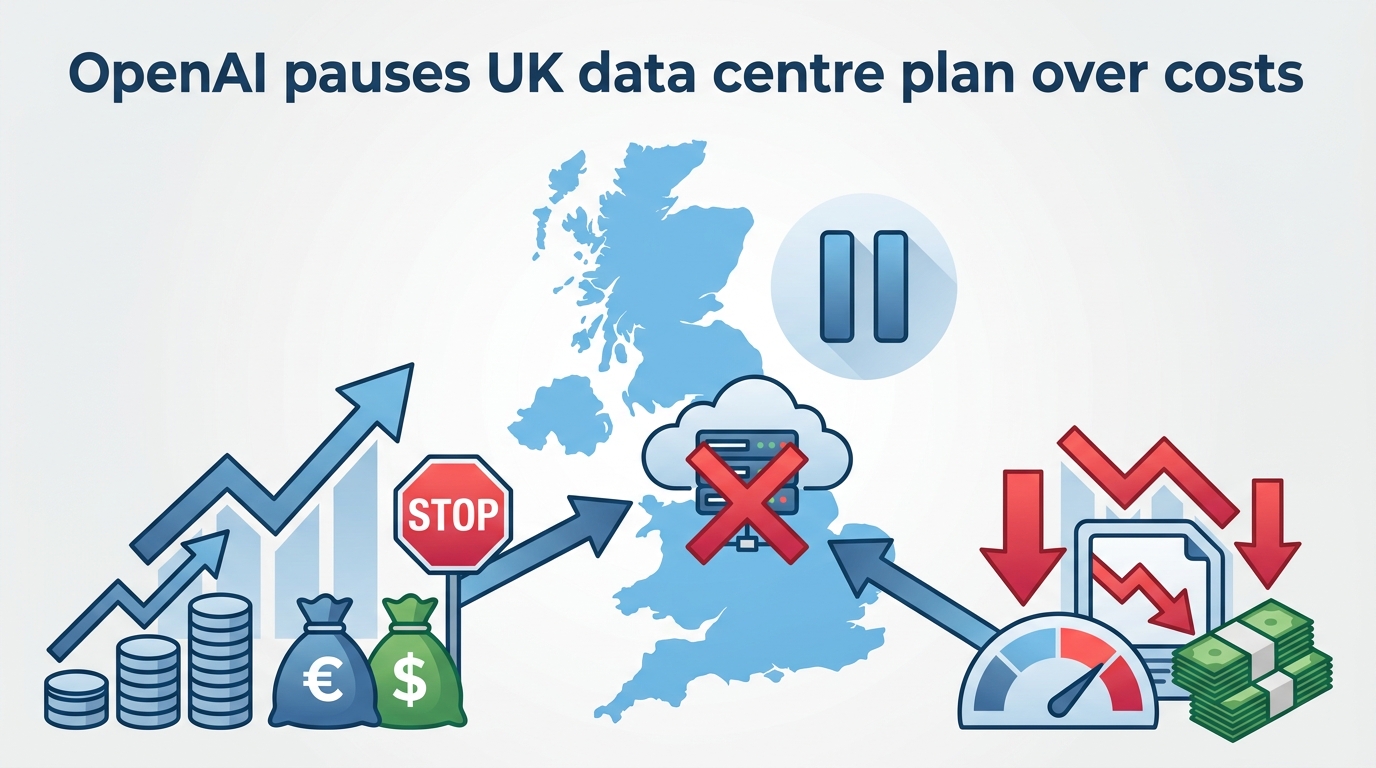
OpenAI has hit pause on its UK data centre plan, a project tied to a wider £31bn wave of tech investment and a promise to expand Britain’s AI capacity. The company says it will wait for the “right conditions” before moving ahead with Stargate UK, which was meant to anchor a major build-out in North East England.
The timing matters. OpenAI’s US Stargate effort has been framed around a $500bn, four-year push for AI infrastructure, while the UK version was pitched as a smaller but still serious bet on sovereign compute. Now the company is signaling that Britain’s energy bills and policy uncertainty may be enough to slow the whole thing down.
What OpenAI actually paused
Get the latest AI news in your inbox
Weekly picks of model releases, tools, and deep dives — no spam, unsubscribe anytime.
No spam. Unsubscribe at any time.
The project in question was Stargate UK, a planned data centre in North Tyneside at Cobalt Park. OpenAI said it would help strengthen the UK’s “sovereign compute capabilities,” a phrase that matters because AI companies need huge amounts of local compute if they want faster training, lower latency, and more control over where data and workloads sit.

OpenAI also said the UK project would support native AI development and help deliver the government’s national AI plan. That’s a big claim, but the company is still keeping its foot in the door: it says it will continue hiring in the UK, keep growing its presence there, and work on commitments tied to public-sector AI deployment.
- Stargate UK was planned for North Tyneside, not Northumberland, after a BBC correction.
- The broader UK tech package linked to the announcement was worth £31bn.
- OpenAI’s US Stargate effort was described as a $500bn, four-year infrastructure plan.
- The company says London is home to its largest international research hub.
That split tells you a lot about how OpenAI is thinking. It is not leaving the UK. It is just saying the country has to look better on power prices, regulation, and long-term policy before it commits to a major physical build.
Energy costs are the easy excuse and the real problem
OpenAI said high energy costs are one reason for the pause, and that part is easy to understand. Data centres are electricity-hungry by design, and AI workloads can be especially expensive because they rely on dense clusters of powerful chips running for long periods. If a country has pricey power, every future operating bill gets heavier.
Britain’s electricity prices have been higher than those in the US for years, so this is not a fresh problem. What changed is that AI infrastructure is now competing with everything else for cheap, reliable power. That means the economics of a new data centre are shaped less by hype and more by whether the monthly bill makes sense over a decade.
“AI compute is foundational to that goal - we continue to explore Stargate UK and will move forward when the right conditions such as regulation and the cost of energy enable long-term infrastructure investment,” an OpenAI spokesperson said.
The quote is doing a lot of work. OpenAI is not saying the UK is closed for business. It is saying the business case has to survive contact with utility rates and policy risk. That is a very different message from the one delivered when the project was first announced in September.
Regulation and copyright are part of the equation
Energy is only half the story. OpenAI’s concerns also include regulation, and the BBC reports that uncertainty around copyright law is part of that. The issue is whether AI companies will be allowed to train systems on copyrighted works without asking permission first, or whether creators will be able to opt out.
That debate matters because training data is the fuel for large models. If the law becomes stricter, model builders may need to pay more, negotiate more licenses, or work with smaller data pools. If the law stays looser, publishers and artists worry that their work gets used without fair compensation.
- OpenAI’s UK statement links investment to “regulation and the cost of energy.”
- The BBC says copyright uncertainty is part of the regulatory concern.
- The UK had previously considered an opt-out style approach for creators.
- Artists including Sir Elton John criticized that direction.
OpenAI’s pause also lands in a wider political argument. The UK government has been trying to sell the country as a place where AI companies can scale quickly, while still keeping some guardrails in place. That balance is hard, because the more predictable the rules are for companies, the more exposed creators may feel.
The numbers behind the UK AI bet
The UK has been leaning hard into AI as an economic strategy. Technology secretary Liz Kendall said in January that the UK’s AI sector had grown 23 times faster than the economy as a whole. The government also says the sector has attracted more than £100bn in private investment since it came into office.
Those numbers are meant to show momentum, and they do. But they also raise the stakes for every delayed project. If the UK wants to keep pulling in capital for AI data centres, chip supply, and model development, it has to look like a place where long-term infrastructure bets can survive.
- UK AI sector growth: 23 times faster than the economy, according to Liz Kendall.
- Private investment in the sector: more than £100bn, according to the government.
- OpenAI says its London research hub is its largest international one.
- Stargate UK was meant to support public-service AI deployment commitments.
There is also a basic physical reality here. AI policy is not only about model safety or copyright. It is also about power grids, land, cooling, and chip supply. If any one of those pieces looks shaky, the whole pitch gets harder to sell to a company trying to spend billions over years.
What this means for the UK, and for OpenAI
For the UK government, this is an awkward pause rather than a full rejection. OpenAI says it still wants to invest in talent and keep expanding in the country, and it still supports the government’s ambition to make Britain an AI leader. That means the relationship is alive, just conditional.
For OpenAI, the move is classic large-scale corporate behavior: keep the strategic option open, avoid locking in capital too early, and wait for better economics. The company is already making policy noise too, including a recent proposal that floated a four-day week on full pay as a possible response to a more automated economy. That tells you it is thinking about AI as both infrastructure and labor shock.
If the UK wants Stargate UK back on the table, it probably needs two things: cheaper, more predictable power pricing and a copyright framework that reduces uncertainty without triggering a political backlash. If it gets those right, the next question is whether OpenAI’s pause lasts months or becomes the start of a much longer wait.
My bet: this project comes back only if the UK can make AI infrastructure look boring to finance teams. If the country cannot do that, the money will keep drifting toward places where electricity is cheaper and the rules are clearer.
// Related Articles
- [IND]
WebX 2026 turns speaker hype into a conference brief
- [IND]
AI Weekly: 2026-07-06 ~ 2026-07-13
- [IND]
The AI Act should be treated as Europe’s operating system for AI
- [IND]
Booz Allen’s OpenAI Deal Is Real Advantage, Not Hype
- [IND]
OpenSearch’s vector search benchmark in 5 parts
- [IND]
Vector Databases That Work in Production