Why the U.S. should keep frontier AI out of China
The U.S. should block China’s access to frontier AI models because the strategic risk is greater than the commercial upside.

The U.S. should block China’s access to frontier AI models because the strategic risk is greater than the commercial upside.
America should keep Anthropic’s newest models out of China, and it should do the same for every frontier system that materially advances reasoning, coding, and agentic capability. The New York Times report makes the stakes plain: the newest releases from Anthropic and OpenAI are widening the U.S. lead, and Beijing is actively trying to narrow it. In that setting, access is not a neutral commercial decision. It is a transfer of strategic capability to a rival state that has already shown it will absorb, adapt, and scale whatever it can get.
Frontier models are now strategic infrastructure
Get the latest AI news in your inbox
Weekly picks of model releases, tools, and deep dives — no spam, unsubscribe anytime.
No spam. Unsubscribe at any time.
We should stop pretending the latest model is just another software product. A frontier system is a general-purpose force multiplier: it improves code generation, research synthesis, workflow automation, and increasingly the ability to build other models and tools. When a company like Anthropic ships a major upgrade, it is not only selling a chatbot. It is distributing a high-leverage layer of cognitive infrastructure that can accelerate the entire downstream stack.

The clearest proof is how fast these systems become embedded in real work. OpenAI and Anthropic models are already used to draft code, analyze documents, and support technical decision-making across industries. If those capabilities are available to firms and institutions inside China, the benefit does not stay inside one company. It spreads through procurement, state-linked enterprises, universities, and military-adjacent research ecosystems. That is exactly why access control matters: frontier AI is no longer a consumer convenience, it is a strategic input.
Denial works better than trying to outcompete on every front
The United States does not need to win by making every model better forever. It needs to preserve an edge where the edge matters most. Export restrictions, access denials, and careful model gating are blunt tools, but they are effective when the goal is to slow diffusion of the highest-value capabilities. If China cannot easily buy or test the newest frontier systems, it must spend more time and money rebuilding them from scratch.
We have seen this logic in compute controls and semiconductor policy. Advanced chips are treated as strategic assets because they compress years of development into a purchasable package. Frontier models now deserve the same treatment. A state that can buy its way into the latest reasoning systems gains a shortcut around domestic bottlenecks in talent, tooling, and iteration speed. Refusing access does not end the competition, but it raises the cost of closing the gap, and that is the point.
The commercial upside is smaller than the security cost
There is a tempting argument for selling access anyway: keep the market open, collect revenue, and let norms of global software commerce do their work. That argument fails because the upside is narrow and the downside is asymmetric. A sale to a Chinese customer might generate near-term revenue for Anthropic or OpenAI, but the strategic loss from helping a rival improve its AI stack is much larger and much harder to reverse.
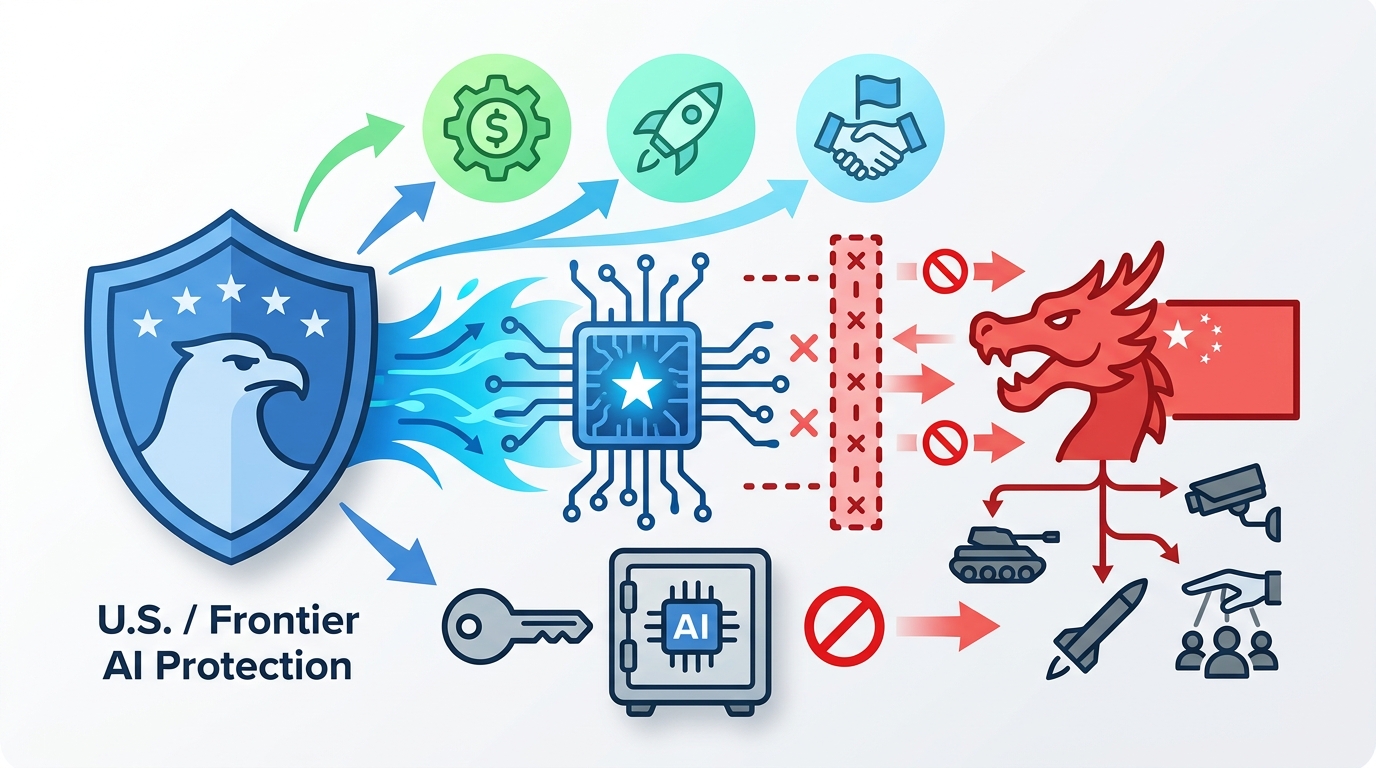
There is also a practical point. Frontier model providers are not ordinary SaaS vendors. They already operate under policy constraints, safety reviews, and national-security scrutiny. Once a company accepts that some uses and some users are too risky, the question becomes where to draw the line. China is not a marginal case. It is the central case. If a model can materially improve coding, research, or automated planning, then handing it to a geopolitical competitor is a policy mistake dressed up as market expansion.
The counter-argument
Steelman the other side: broad access can spread standards, encourage transparency, and keep U.S. firms ahead by forcing them to compete globally. Some argue that if American companies lock down their best models, China will simply build alternatives, while U.S. firms lose revenue and influence. Others say that engagement creates interdependence, and interdependence lowers the odds of dangerous escalation.
That view is not frivolous. Closed systems can fragment markets, and overbroad restrictions can punish allies, researchers, and legitimate cross-border business. The limit is real: not every Chinese user is a state actor, and not every use is military or industrial espionage. But the rebuttal is stronger. Frontier AI is not a normal market good, and China is not a normal commercial rival. When the product in question can materially accelerate national capability, the burden of proof sits with the seller, not the buyer. In this case, the risk of enabling a strategic competitor outweighs the value of openness.
What to do with this
Engineers, PMs, and founders should treat frontier-model access as a security and policy decision, not a sales checkbox. Build region-aware controls, customer screening, audit trails, and escalation paths for high-risk accounts. If you work on model distribution, assume the default should be denial for sensitive jurisdictions unless there is a clear, reviewable exception. If you are setting strategy, align your roadmap with the reality that the best models are now part of national competition, and design your product, compliance, and go-to-market plans accordingly.
// Related Articles
- [IND]
Why AI infrastructure is now the real moat
- [IND]
Circle’s Agent Stack targets machine-speed payments
- [IND]
IREN signs Nvidia AI infrastructure pact
- [IND]
Circle launches Agent Stack for AI payments
- [IND]
Why Nebius’s AI Pivot Is More Real Than Hype
- [IND]
Nvidia backs Corning factories with billions