Vibe coding turns app ideas into crowded markets
I break down why vibe coding makes apps easy to ship but brutally hard to sell, with a copy-ready launch template.
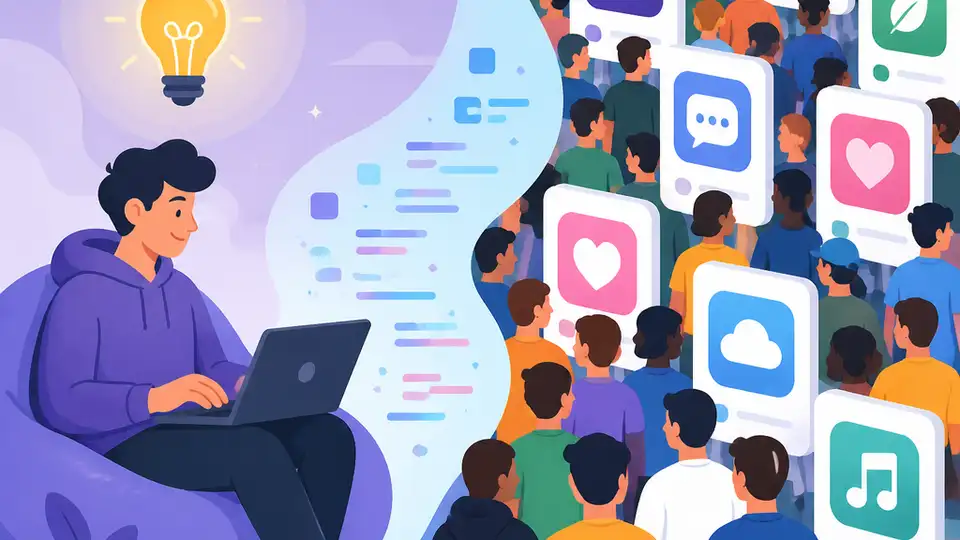
Vibe coding makes apps easy to ship but brutally hard to sell.
I've been watching this vibe-coding wave for a while, and honestly, it’s been bugging me. The pitch keeps getting simpler: buy a laptop, subscribe to a model, type the thing you want, and out pops an app. Great. Except that’s not the part that used to be hard. The hard part was never just “can I get code on the screen?” It was everything after that: making the product not fall apart, making it understandable, making it worth paying for, and making anyone notice it in the first place.
That’s why the current enthusiasm feels a little lopsided. A lot of founders are treating shipping as the finish line when it’s really the first ugly mile. I’ve seen this movie before with no-code tools, template stores, and “build in a weekend” promises. The tooling gets better, the barrier gets lower, and suddenly everybody thinks the market has gotten bigger too. It hasn’t. In a lot of cases, the opposite happens. The market gets noisier, the clones get faster, and the people who can actually explain why their app matters become the ones who survive.
The weird part is that I’m not even anti-vibe-coding. I’m anti-fantasy. If you’re a founder, this shift is useful. If you’re pretending it replaces product thinking, distribution, and maintenance, you’re setting yourself up for a very expensive lesson.
Business Insider’s Emily Stewart wrote the piece that pushed me to spell this out, “Vibe Coding Made It Easy to Build Apps — Now the Market Is Flooded”. She uses founder stories, Appfigures data, and quotes from people like Rebecca Kaden, Charity Majors, Kate Minogue, Amjad Masad, and Kylan Gibbs to make one point clear: the bottleneck has moved. Building is cheaper. Standing out is not.
The old bottleneck was code. That part is mostly gone.
Get the latest AI news in your inbox
Weekly picks of model releases, tools, and deep dives — no spam, unsubscribe anytime.
No spam. Unsubscribe at any time.
“For the first time in 20 years, the wall between having an idea and actually building it has come down.”
That’s Eli Cohen, the founder building MediTailor, and I get why he says it. A few years ago, an app idea could die in the gap between “I can picture this” and “I can afford to build this.” Now that gap is smaller. With tools like Claude, OpenAI, and Replit, people can get from idea to prototype with a speed that would have felt ridiculous in 2015.
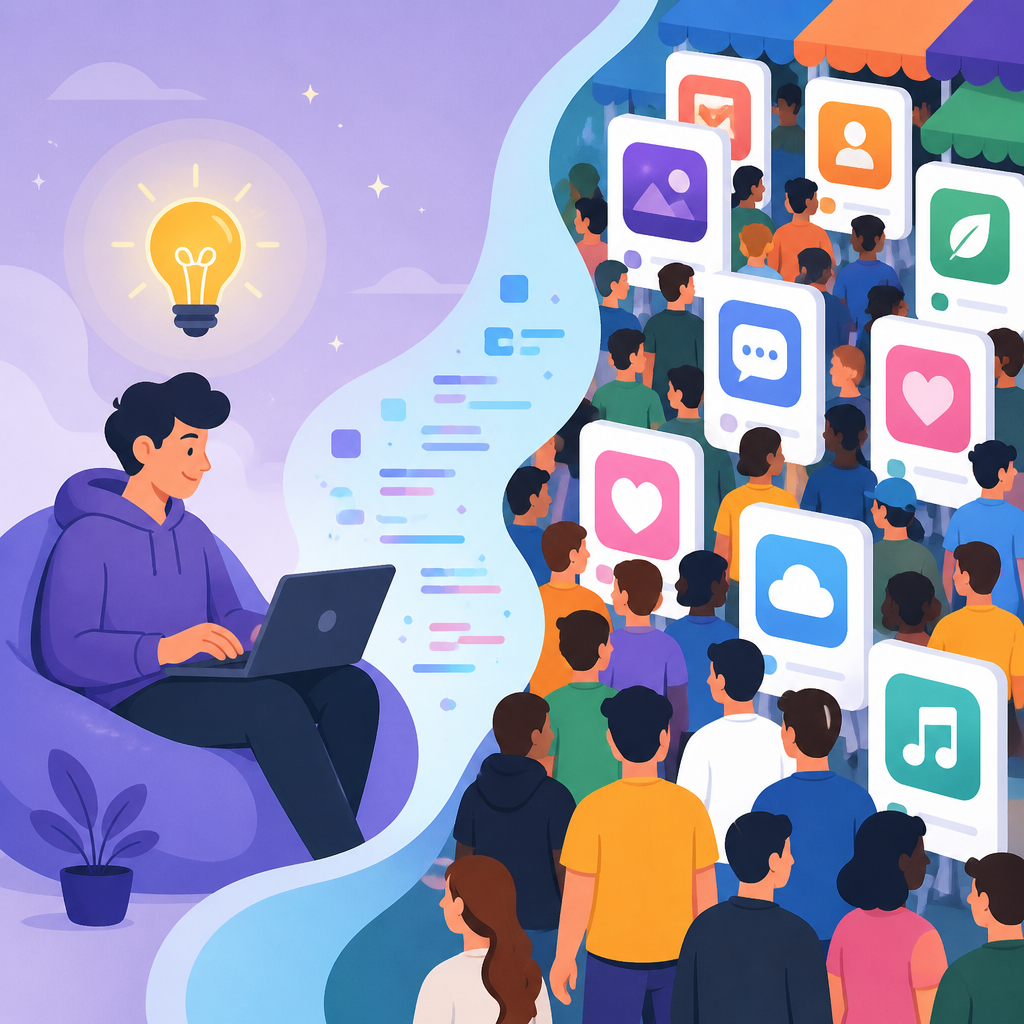
What this actually means is simple: coding stopped being the main gatekeeper for a lot of small software products. I ran into this myself when I watched non-technical founders go from “I need a developer” to “I already have a working app skeleton” in a weekend. That’s real progress. I’m not going to pretend otherwise.
But the trap is obvious once you’ve built a few things. When code gets cheaper, the market doesn’t reward code more. It rewards judgment. The people who win are the ones who know what to build, what to ignore, and what to cut before it becomes a mess. Vibe coding helps with the first draft. It doesn’t magically create taste, strategy, or product sense.
How to apply it: use AI to get to a testable prototype fast, but define the decision you’re trying to make before you write a single prompt. Are you testing demand, workflow fit, pricing, or retention? If you can’t answer that, you’re not building a product. You’re just generating software-shaped noise.
- Build the smallest thing that proves one user behavior.
- Write down the one metric that matters before launch.
- Assume the first version is disposable.
App stores are now full of proof, not just products.
Business Insider cites Appfigures data showing 414,000 new iOS and Android apps released in the first quarter of 2026, up 115% from the same period in 2025. That’s not a gentle uptick. That’s a flood. The article also says only 118 of those apps hit “high-traction” status, meaning more than 50,000 downloads in the US. That’s a 0.02% hit rate.
What this actually means is that the app store is becoming less like a marketplace and more like a giant public lab. People are shipping experiments faster than ever, but most of those experiments are not businesses. They’re tests. They’re drafts. They’re proof that someone could make something, not proof that someone should buy it.
I’ve seen founders confuse “we launched” with “we found a market” more times than I can count. That mistake gets more expensive when everyone else can launch too. If your app solves a real problem, good. But now you’re competing against a hundred other people who can also make an app that looks good enough on day one. The bar for shipping has dropped. The bar for relevance has gone up.
How to apply it: stop benchmarking yourself against app count and start benchmarking against user pull. If you can’t get repeat usage, referrals, or paid conversion from a tiny audience, the fact that you launched fast doesn’t matter. You need signal, not just artifacts.
- Track retention at 7 and 30 days, not just installs.
- Interview the first 10 users before adding features.
- Kill ideas that don’t get repeat use quickly.
The real work moved to distribution, and that’s where people get humbled.
Kate Minogue says distribution is still the hardest problem, and she’s right. Getting into the App Store or Google Play is not the same as getting attention. It never was, but now the mismatch is harsher because there are so many more apps fighting for the same eyeballs.
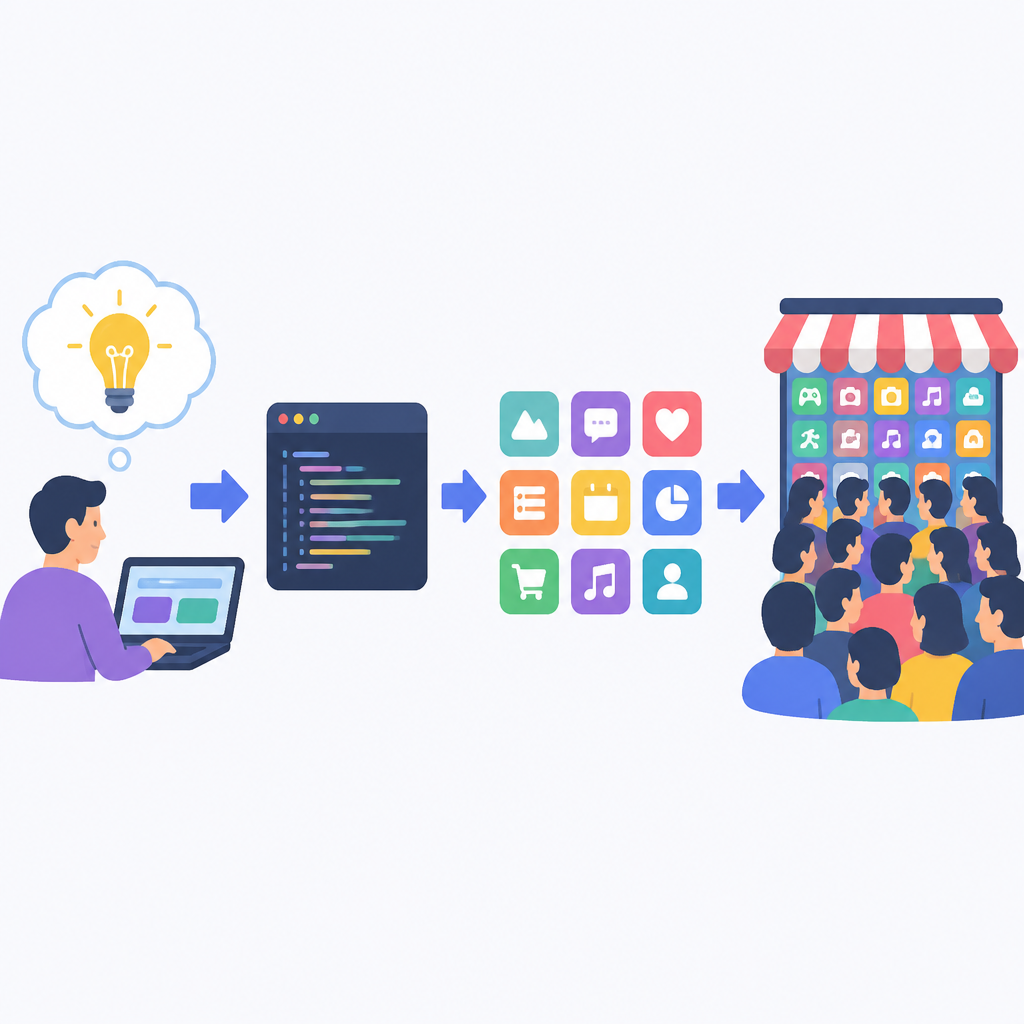
Here’s the quote that should make every founder sit up: “When I talk to companies that are building an app, I try to prepare them for having to spend hundreds of thousands of dollars to get scaled distribution of their apps,” Minogue says. That’s the line people skip when they’re fantasizing about their app idea. They imagine the product. They forget the bill.
What this actually means is that marketing is no longer an afterthought you slap on after launch. It’s part of the product plan. If nobody hears about your app, it doesn’t matter how elegant the onboarding flow is. If nobody understands why it exists, it doesn’t matter how fast your AI-generated code shipped.
I’ve watched founders burn months polishing features that no one asked for while their acquisition channels stayed a blurry mess. That’s backwards. If you don’t know how you’ll reach users, you don’t have a business plan. You have a hobby with a deployment pipeline.
How to apply it: design distribution before you design features. Pick one channel you can actually own or learn: search, creator partnerships, paid ads, community, outbound, app-store optimization, or B2B sales. Then build the product around that channel’s constraints.
Useful places to study the mechanics: Google Play listing guidance, Apple App Store resources, and Shopify if you’re thinking about commerce instead of consumer apps. None of those solve distribution for you, but they do remind you that discoverability is a system, not a wish.
“Underpants gnome logic” is exactly the right insult here.
The vibe coding environment is leading to a bit of “underpants gnome logic.”
That’s Charity Majors, CTO and cofounder of Honeycomb, and I think she nailed it. The joke is old, but the shape of the problem is current: phase one is “collect underpants,” phase three is “profit,” and phase two is a giant question mark. In app terms, phase one is “build the thing,” phase three is “make money,” and phase two is where reality shows up with a wrench.
What this actually means is that code generation is a tiny slice of product creation. Even if AI helps you build the first version, you still have to think about architecture, maintenance, bugs, security, analytics, onboarding, and all the boring stuff that makes software usable after the demo ends.
I’ve had to explain this to people who think software is basically a screenshot with buttons. It isn’t. The moment users depend on your app, you inherit a support burden. The moment you have payments, you inherit trust and compliance. The moment you have scale, you inherit failures that no prompt can wave away.
That’s why I’m skeptical when people talk as if vibe coding removes engineering. It doesn’t. It often just delays the engineering until after the launch, when it’s more expensive and more embarrassing.
How to apply it: budget for maintenance before you budget for growth. Add logging, error handling, backups, and a way to inspect what your app is doing. If you can’t debug it, you don’t own it.
- Set up basic observability from day one.
- Document the “what breaks first” list.
- Keep a human in the loop for security-sensitive flows.
The moat got thinner, so product taste matters more.
One of the sharper points in Stewart’s piece is that a saturated market makes it harder to stand out. That sounds obvious until you remember how many founders still think “there are tons of competitors” is proof of demand. Sometimes it is. Sometimes it just means the market is crowded and users are confused.
Charity Majors says Slack’s hard part wasn’t writing the code. It was the design that made it intuitive and scalable. That’s the real lesson. The code is the easy copy. The product judgment is the part that’s hard to clone.
What this actually means is that taste becomes a business asset. Not “taste” in the vague designer sense. I mean the ability to know what friction is useful, what confusion is fatal, and what small detail makes a user trust you enough to come back. AI can help you generate options. It can’t tell you which option feels inevitable.
I’ve seen the same thing in internal tools. Two teams can build the same workflow faster than ever, but the one that wins is the one that feels less annoying to use. That’s not magic. It’s a pile of small decisions made by someone who understands the user better than the competition does.
How to apply it: don’t copy features, copy user outcomes. Ask what the user is actually trying to get done, then remove steps until the app feels almost suspiciously simple. If your product needs a tutorial to explain the basic value, you probably haven’t found the right shape yet.
Good reference points here include Nielsen Norman Group for usability thinking and Intercom for how product teams talk about onboarding and support. Neither will save a bad idea, but both will keep you honest.
The people who win will treat AI as a factory, not a fantasy.
Amjad Masad, the CEO of Replit, makes the most grounded point in the piece: not every app has to be venture-scale. Some tools just need to make money for the founder or support day-to-day expenses. That’s a healthier frame than the usual startup theater where every app is secretly supposed to become the next giant platform.
What this actually means is that AI lowers the cost of trying, not the cost of succeeding. That distinction matters. If your goal is to build a useful tool for a narrow audience, vibe coding can be fantastic. If your goal is to build a durable company, you still need a reason people keep paying you after the novelty wears off.
I actually like this shift because it strips away some of the ego. Not every founder needs to be chasing a billion-dollar outcome. Some people need a reliable side business. Some need a niche product. Some need a way to test whether an idea deserves more time. AI makes those paths more accessible.
But accessibility also means more competition from people who are willing to try. That’s the trade. More builders, more noise, more mediocre products, more chances for the good ones to emerge. If you’re serious, you don’t complain about the noise. You build a better signal.
How to apply it: decide whether you’re building a venture bet, a cash-flow product, or an internal tool. Those are different businesses with different standards. If you blur them together, you’ll waste time chasing metrics that don’t fit the goal.
The template you can copy
# Vibe-Coded App Launch Template

## 1. What I’m building
- Product name:
- User problem:
- One-sentence promise:
- Target user:

## 2. What I’m testing first
- Hypothesis:
- Success metric:
- Time window:
- Kill criteria:

## 3. MVP scope
- Must-have features:
- Nice-to-have features:
- Explicitly not building:

## 4. Build plan
- AI tool(s):
- Human review steps:
- Data model:
- Auth / payments / analytics:
- Error handling / logging:

## 5. Distribution plan
- Primary channel:
- Secondary channel:
- First 20 users:
- Acquisition budget:
- Launch date:

## 6. Retention plan
- Activation event:
- Week-1 habit:
- Reason to return:
- Support loop:

## 7. Maintenance plan
- Who fixes bugs:
- How issues are reported:
- Backup / recovery:
- Security review:
- Monthly review date:

## 8. Pricing plan
- Free tier:
- Paid tier:
- Price point:
- Upgrade trigger:

## 9. Decision log
- What worked:
- What failed:
- What to cut:
- What to double down on:

## 10. Launch checklist
- App store listing done
- Landing page live
- Analytics installed
- Support email working
- Privacy policy published
- 5 beta users onboarded
- First feedback review scheduled
That’s the version I’d hand to a founder before they disappear into a weekend of prompts and optimism. It forces the conversation away from “can we build this?” and toward “can this become something people actually use and pay for?”
And that’s the whole point. Vibe coding did not remove the hard parts of software. It just exposed them faster. If you use it well, you’ll ship sooner and learn sooner. If you use it badly, you’ll just create more apps that look finished and behave like guesses.
Source attribution: I broke this down from Emily Stewart’s Business Insider article, https://www.businessinsider.com/vibe-coding-build-apps-ai-market-flooded-killer-app-guy-2026-5. The framing, template, and practical guidance here are mine; the reported quotes and market data come from the original piece.
// Related Articles
- [IND]
WebX 2026 turns speaker hype into a conference brief
- [IND]
AI Weekly: 2026-07-06 ~ 2026-07-13
- [IND]
The AI Act should be treated as Europe’s operating system for AI
- [IND]
Booz Allen’s OpenAI Deal Is Real Advantage, Not Hype
- [IND]
OpenSearch’s vector search benchmark in 5 parts
- [IND]
Vector Databases That Work in Production