Why DAIR Is More Important Than Another AI Lab
DAIR matters because it is an independent AI institute built to challenge Big Tech’s influence.

DAIR is an independent AI institute built to challenge Big Tech’s influence.
DAIR matters because it is not trying to be another prestige lab inside the machine it is meant to scrutinize. Founded by Timnit Gebru in December 2021, the institute announced itself as a community-rooted counterweight to Big Tech’s influence on AI research, development, and deployment. That is the point. In a field where the biggest companies fund the biggest models, control the biggest datasets, and publish the loudest papers, independence is not a branding flourish. It is the condition for telling the truth.
First, independence changes what gets studied
Get the latest AI news in your inbox
Weekly picks of model releases, tools, and deep dives — no spam, unsubscribe anytime.
No spam. Unsubscribe at any time.
When a research institute depends on the same companies it might need to criticize, the agenda narrows. Questions that threaten product timelines, ad revenue, surveillance systems, or model rollouts become harder to pursue with full force. DAIR was created to escape that trap. Its founding premise is not just that AI needs more research, but that AI needs research outside the gravitational pull of corporate priorities.

The clearest evidence is the institute’s own origin story. Gebru launched DAIR after being pushed out of Google, and two more members of Google’s Ethical AI group later joined her there. That matters because it shows the institute is not an abstract think tank. It is a response to a specific failure inside the industry: the inability of internal ethics work to survive when it collides with corporate power. DAIR exists because the industry’s self-checks were not enough.
Second, community-rooted research is a real corrective
AI systems are deployed on people, not on spreadsheets, and the harms are rarely distributed evenly. A lab rooted in affected communities is more likely to ask who gets excluded, who gets surveilled, and who pays the costs when a model fails. DAIR’s public framing makes that priority explicit. It is not claiming neutrality. It is claiming accountability to people who are usually treated as downstream edge cases.
That approach is not sentimental, it is methodologically stronger. The mainstream AI pipeline often rewards benchmark gains while ignoring social damage until after deployment. Community-rooted research pushes the opposite order: start with lived impact, then decide what should be built. In practice, that means the institute is better positioned to study power, labor, bias, and governance as central technical issues rather than side topics for policy teams.
Third, DAIR shows why talent leaves Big Tech
People do not leave well-paid research jobs for a smaller institute unless they think the larger system is broken. The move by Alex Hanna and Dylan Baker from Google’s Ethical AI group to DAIR is a telling example. It signals that even inside elite corporate teams, some researchers concluded that influence without independence was not enough. They chose a place where the mandate is clearer and the compromises are fewer.
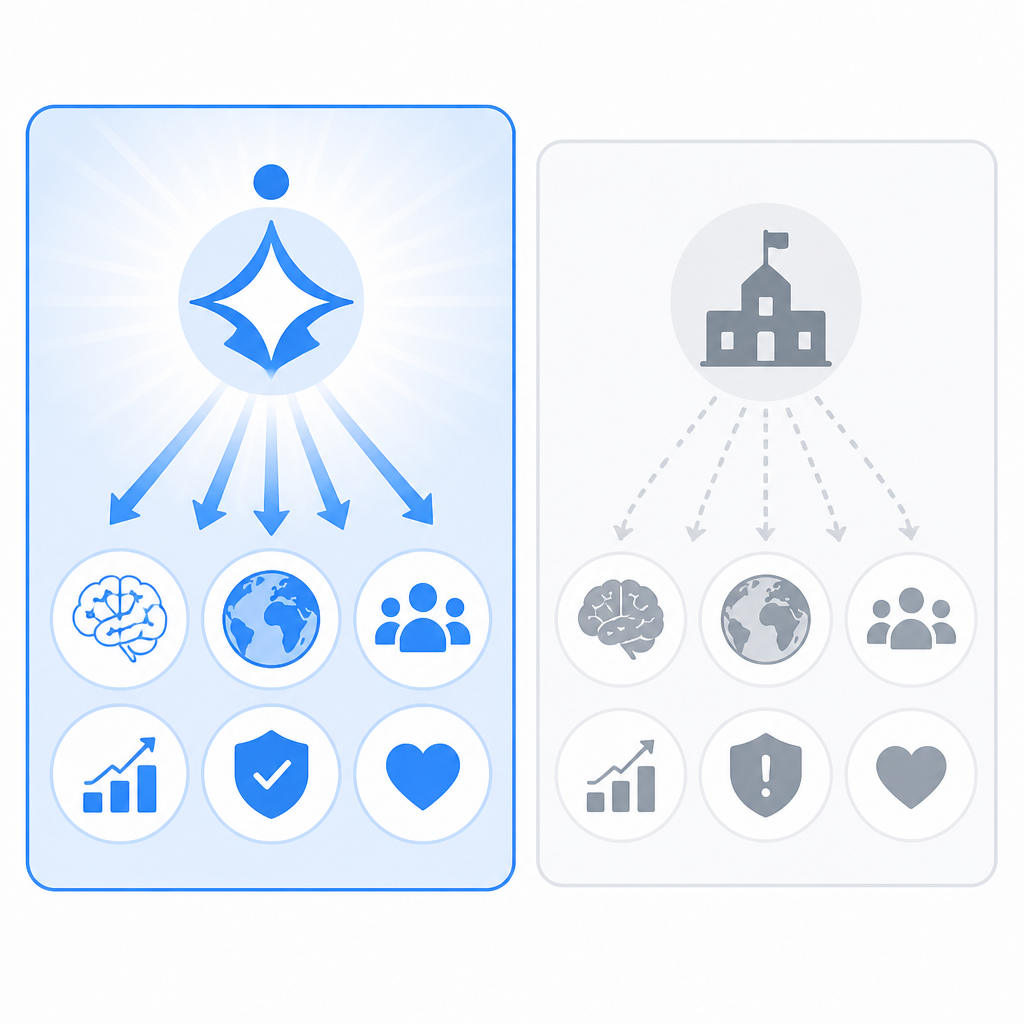
That talent shift is important because it exposes a myth that still dominates AI discourse: that the best work only happens at the biggest companies. DAIR is evidence against that. The institute’s appeal comes from mission clarity, not scale. If the most serious people in the room keep walking out of the room, the room is the problem. DAIR is one answer to that problem, and it is the right one.
The counter-argument
The strongest objection is simple: Big Tech still owns the compute, the data, and much of the talent, so a small independent institute cannot move the field at the same speed or scale. Corporate labs ship models, publish papers, and shape standards. They can fund large teams, run expensive experiments, and influence policy through sheer reach. From that angle, DAIR risks becoming morally admirable but operationally marginal.
There is truth in that criticism. DAIR does not have the resources of Google, Meta, or OpenAI, and it should not pretend otherwise. But this is not a reason to dismiss the institute. It is a reason to value it differently. Independence is not a substitute for scale; it is a safeguard against capture. The field does not need one more lab optimized for output. It needs institutions that can say no when the output is harmful.
What to do with this
If you are an engineer, PM, or founder, treat DAIR as a model for institutional design, not just a news item. Build review processes that are structurally independent from launch pressure, fund external critique, and make room for research that can block a product, not merely polish it. If your AI strategy cannot survive scrutiny from outside your org, it is not robust. DAIR’s lesson is blunt: the future of AI will be shaped not only by what gets built, but by who gets to question the builders.
// Related Articles
- [IND]
OpenAI updates its Europe privacy policy
- [IND]
OpenAI is right to keep ads out of sensitive chats
- [IND]
AI bootlegs are already draining streaming royalties
- [IND]
AMD and Microsoft push Windows ML on GPU and NPU
- [IND]
OpenAI’s IPO filing turns hype into scrutiny
- [IND]
Skatteetaten proves public sector AI should be judged by outcomes