Why engineering will win in the AI era
Engineering will thrive in the AI era because it turns AI into real-world systems, jobs, and growth.

Engineering will thrive in the AI era because it turns AI into real-world systems, jobs, and growth.
Engineering is the career path that will gain the most from AI, and Jensen Huang is right to say so.
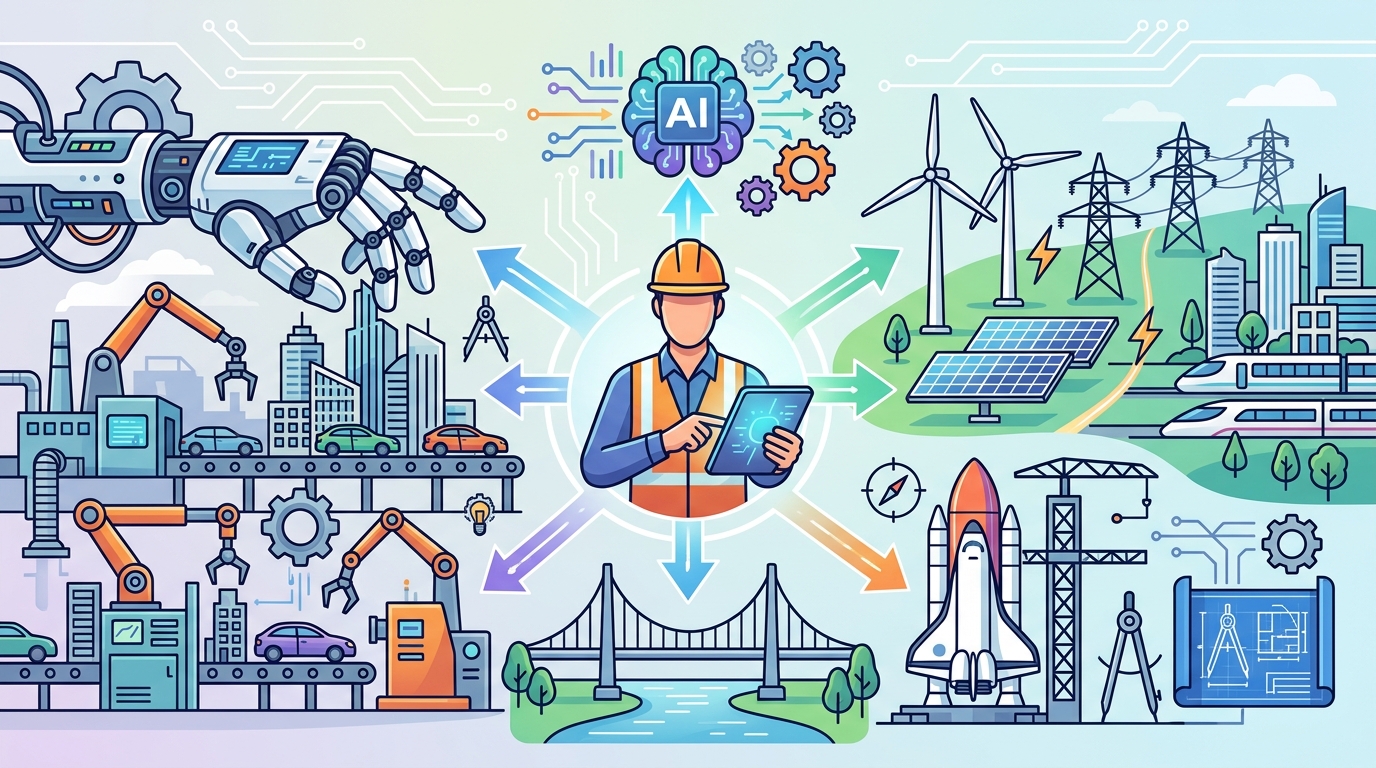
That is not a sentimental defense of a classic profession. It is a reading of what AI actually does when it leaves the demo stage and enters factories, data centers, medical devices, power grids, robots, and defense systems. Nvidia’s rise is the clearest proof: the company moved from gaming graphics into the hardware layer of AI, then into the infrastructure that makes modern AI usable at scale. Huang did not become the leader of the world’s most valuable company by treating engineering as a narrow technical trade. He built a business on the idea that engineering is the bridge between invention and civilization.
Engineering is where AI becomes useful
Get the latest AI news in your inbox
Weekly picks of model releases, tools, and deep dives — no spam, unsubscribe anytime.
No spam. Unsubscribe at any time.
AI is not a finished product. It is a capability that still needs packaging, testing, integration, and control. That work is engineering. Huang’s own definition gets to the point: engineers take an invention and advance it so it is safe, beneficial, and transformative. That is exactly why AI will not replace engineering in the aggregate. It will increase the amount of engineering work that needs doing, because every AI system that matters has to be embedded in a larger system with power, latency, security, reliability, and cost constraints.

Look at the scale of the problem. Nvidia says it plans to double its workforce to 75,000 over the next decade, and the U.S. Bureau of Labor Statistics expects engineering disciplines such as electrical, electronics, and computer hardware to grow faster than the national average. Those are not abstract signals. They reflect a world where AI demand is colliding with energy demand, chip demand, and infrastructure demand all at once. The more AI spreads, the more engineers are needed to make it run in the physical world.
AI raises the value of first-principles thinking
Huang’s strongest point is not that engineers know more tools. It is that engineers know how to think. He says engineering teaches first principles, physics, mathematics, and the habit of breaking impossible problems into solvable parts. That mindset is exactly what AI rewards. In a world where models can draft, summarize, and code at speed, the scarce skill is not output generation. It is judgment about what should be built, what can fail, what should be trusted, and what can scale.
That is why AI fluency will matter most for people who already work like engineers. A marketer can use an AI assistant, but an engineer can decide whether the system belongs in a low-latency edge device, a cloud cluster, or a safety-critical control loop. A founder can prompt a prototype, but an engineer can tell whether the prototype will survive real users, real loads, and real failure modes. Huang is right that “every young person should become an AI expert,” but the deeper point is that AI expertise becomes most powerful when paired with engineering discipline.
The labor market will reward builders, not spectators
Huang also makes a practical labor-market argument, and it is hard to dismiss. He says AI expands the scope of human work rather than shrinking it, because productivity creates capacity, and capacity creates new ambitions. That logic fits the current market better than the panic narrative. Entry-level routine work is under pressure, but the demand for people who can design systems, manage complexity, and turn AI into revenue-producing infrastructure is rising fast.
The wage and status premium will follow that shift. Engineers sit close to the value creation point in AI companies, which means they are better positioned than many knowledge workers whose tasks are more easily automated or commoditized. The same pattern showed up in earlier industrial revolutions: the highest leverage went to the people who built the machines, the networks, and the factories, not the people who only used them. Huang is not predicting a return to a romantic past. He is identifying where power concentrates when a new general-purpose technology arrives.
The counter-argument
The strongest objection is that engineering is not immune to AI, and pretending otherwise is naive. Coding copilots already compress the time needed for many software tasks. Design tools are getting better. Simulation, testing, and even parts of systems engineering are being automated. If AI can do more of the work, critics say, then the career moat around engineering narrows, especially for junior workers whose value used to come from repetitive execution.
There is also a distribution problem. Not every engineer will benefit equally. Some roles will be squeezed by automation, offshoring, or capital concentration in a handful of giant firms. The field will not become uniformly prosperous just because AI is everywhere. Some engineers will be pushed toward maintenance and compliance work while the highest rewards flow to a smaller group building frontier systems.
That counter-argument is real, but it does not overturn Huang’s case. It only clarifies it. AI will automate pieces of engineering work, not the need for engineering judgment. The more software writes itself, the more important it becomes to define requirements, verify systems, manage risk, and integrate across hardware, energy, and operations. The profession will change, and some tasks will vanish. The career path still wins because the center of gravity moves toward people who can orchestrate complexity, not away from them.
What to do with this
If you are an engineer, lean into the parts of the job AI cannot fake: systems thinking, domain depth, debugging, safety, and cross-functional design. If you are a PM or founder, build teams that treat AI as infrastructure, not decoration, and hire engineers early enough to shape the product architecture before the shortcuts harden into technical debt. If you are choosing a field, Huang’s advice is blunt for a reason: learn AI, but anchor that learning in engineering if you want durable leverage in the next decade.
// Related Articles
- [IND]
WebX 2026 turns speaker hype into a conference brief
- [IND]
AI Weekly: 2026-07-06 ~ 2026-07-13
- [IND]
The AI Act should be treated as Europe’s operating system for AI
- [IND]
Booz Allen’s OpenAI Deal Is Real Advantage, Not Hype
- [IND]
OpenSearch’s vector search benchmark in 5 parts
- [IND]
Vector Databases That Work in Production