Why Jensen Huang is wrong about AI creating jobs
AI will create some jobs, but it will destroy more roles than it replaces.
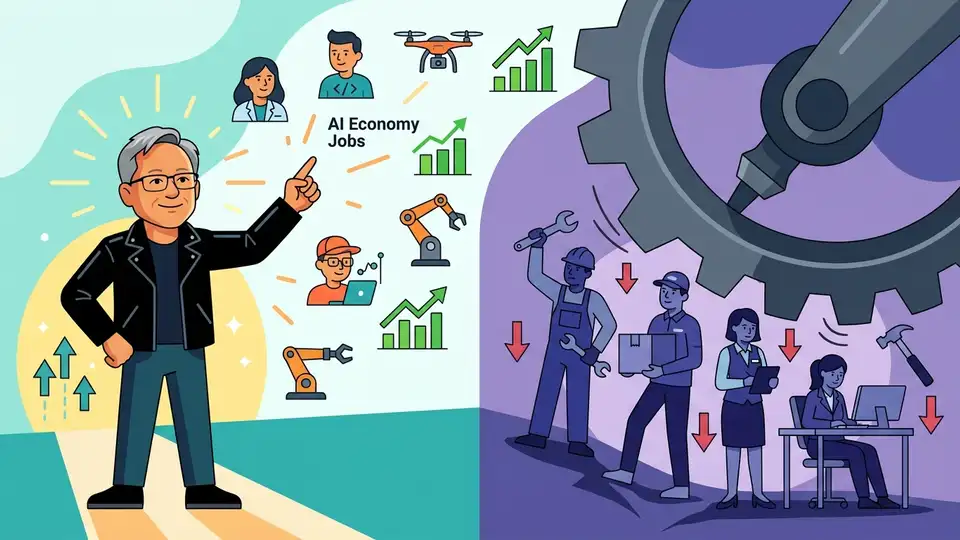
AI will create some jobs, but it will destroy more roles than it replaces.
Jensen Huang is wrong to tell workers that AI is “creating an enormous number of jobs.” The truth is harsher: AI is already cutting the number of people needed to produce the same output, and the new jobs it creates are narrower, fewer, and harder to reach than the old ones it erases.
We can see the imbalance in the way AI is being deployed today. Companies are not adopting generative tools to expand headcount; they are using them to compress work. A support team that once needed 50 agents can now run with 30 plus a chatbot. A marketing department that once needed a junior writer, editor, and analyst can often get by with one operator and a stack of models. That is not job creation in the ordinary sense. It is labor substitution dressed up as productivity.
AI is not a broad employment engine
Get the latest AI news in your inbox
Weekly picks of model releases, tools, and deep dives — no spam, unsubscribe anytime.
No spam. Unsubscribe at any time.
The first problem with Huang’s argument is that it confuses task growth with job growth. Yes, AI creates demand for chip designers, data-center technicians, model trainers, and prompt-savvy operators. But those are specialized roles clustered around a small number of firms and regions. The rest of the labor market does not get a matching wave of openings. The U.S. does not need millions of people to stand up and maintain GPU clusters. It needs far fewer than that.
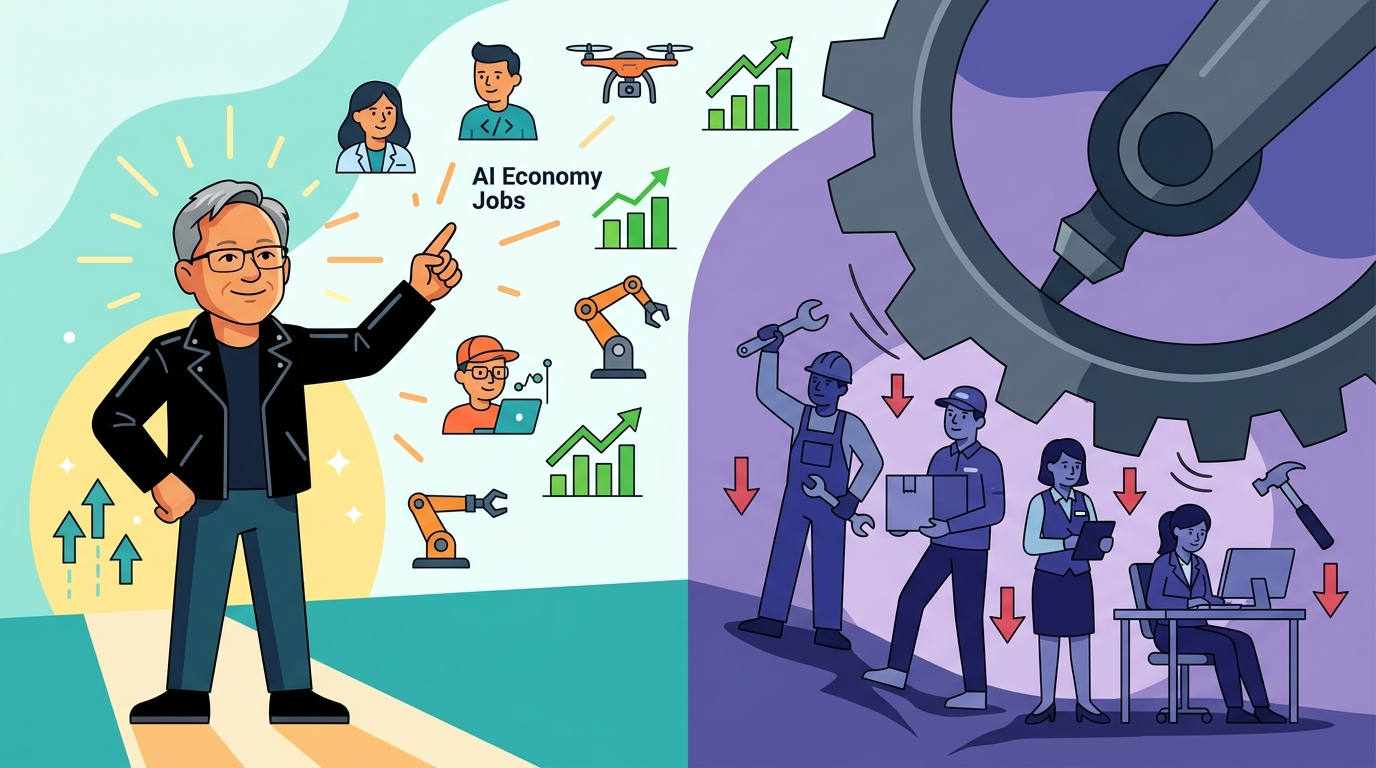
The scale mismatch matters. Nvidia can ship more chips, cloud providers can build more racks, and startups can layer AI into products, but each of those steps increases output without increasing labor at the same rate. That is the core pattern of automation. One factory becomes more productive, not more crowded. One worker supervises more systems, not fewer. The economy grows, but employment growth lags behind it.
Reindustrialization is not the same as reemployment
Huang’s claim that AI is the United States’ best chance to re-industrialize sounds persuasive because it borrows the language of manufacturing revival. But industrial policy and labor policy are not the same thing. Building more fabs, server farms, and cooling systems does mean more capital spending, and it does create some construction and operations jobs. It also concentrates value in a thin layer of suppliers and owners. A reindustrialized AI economy can still be a low-employment economy.
We have seen this before in other technology cycles. Automation in factories did not eliminate manufacturing output; it eliminated manufacturing jobs. American industry produced more cars, more appliances, and more steel while employing fewer workers per unit of output. AI is following the same logic, only faster. The fact that an industry is physically large does not mean it is labor-intensive. In Nvidia’s case, the boom is real, but the labor footprint is tiny compared with the revenue footprint.
The job losses are already visible
There is a reason workers are anxious. Reputable financial and academic groups have warned that AI could eliminate as much as 15% of U.S. jobs over the next several years. That is not a fringe prediction from a doomer account on social media. It is a serious estimate of displacement risk, and it aligns with what companies are doing on the ground. They are not waiting for AI to mature before trimming teams. They are reorganizing now.

The most dangerous part is that the losses will not arrive evenly. White-collar jobs with repeatable digital workflows are exposed first: customer support, basic legal review, entry-level coding, routine analysis, and content production. These are the ladder jobs that help people enter the middle class. When AI strips away the bottom rung, it does not just reduce employment. It weakens career mobility. That is the deeper threat Huang glosses over.
The counter-argument
To steelman Huang’s case, he is right about one thing: technology does not simply subtract jobs, it reshapes them. The spreadsheet did not erase accounting. The internet did not erase sales. Cloud software did not erase IT. In each case, new tools changed what workers did and created adjacent roles that nobody had planned for in advance. AI will do the same, and the people who adapt fastest will gain leverage.
He is also right that panic is counterproductive. If workers and policymakers treat AI as a science-fiction apocalypse, they will miss the practical work of adoption, training, and regulation. A technology that is feared too early can be underused, and underuse has costs too.
But this counter-argument only goes so far. Past technologies augmented labor in industries that still needed large human workforces. AI is different because it targets cognition itself, which is exactly what modern office work sells. The replacement pressure is therefore broader and faster. Yes, new roles will emerge. No, they will not absorb the same number of displaced workers at the same speed. That gap is the story, and Huang does not answer it.
What to do with this
If you are an engineer, PM, or founder, stop treating AI adoption as a headcount-neutral efficiency play. Build with the assumption that it will remove work before it creates durable new roles. That means you should measure displacement, not just throughput. Track which tasks vanish, which users are left behind, and which jobs become harder to enter. If you lead a team, use AI to raise output, but pair every deployment with retraining, internal mobility, and a plan for the work that remains human. The companies that survive this transition will not be the ones that repeat “AI creates jobs.” They will be the ones that admit AI destroys some jobs first and design for that reality.
// Related Articles
- [IND]
WebX 2026 turns speaker hype into a conference brief
- [IND]
AI Weekly: 2026-07-06 ~ 2026-07-13
- [IND]
The AI Act should be treated as Europe’s operating system for AI
- [IND]
Booz Allen’s OpenAI Deal Is Real Advantage, Not Hype
- [IND]
OpenSearch’s vector search benchmark in 5 parts
- [IND]
Vector Databases That Work in Production