Why MiniMax M2.7’s Self-Evolution Claim Matters More Than Its Benchma…
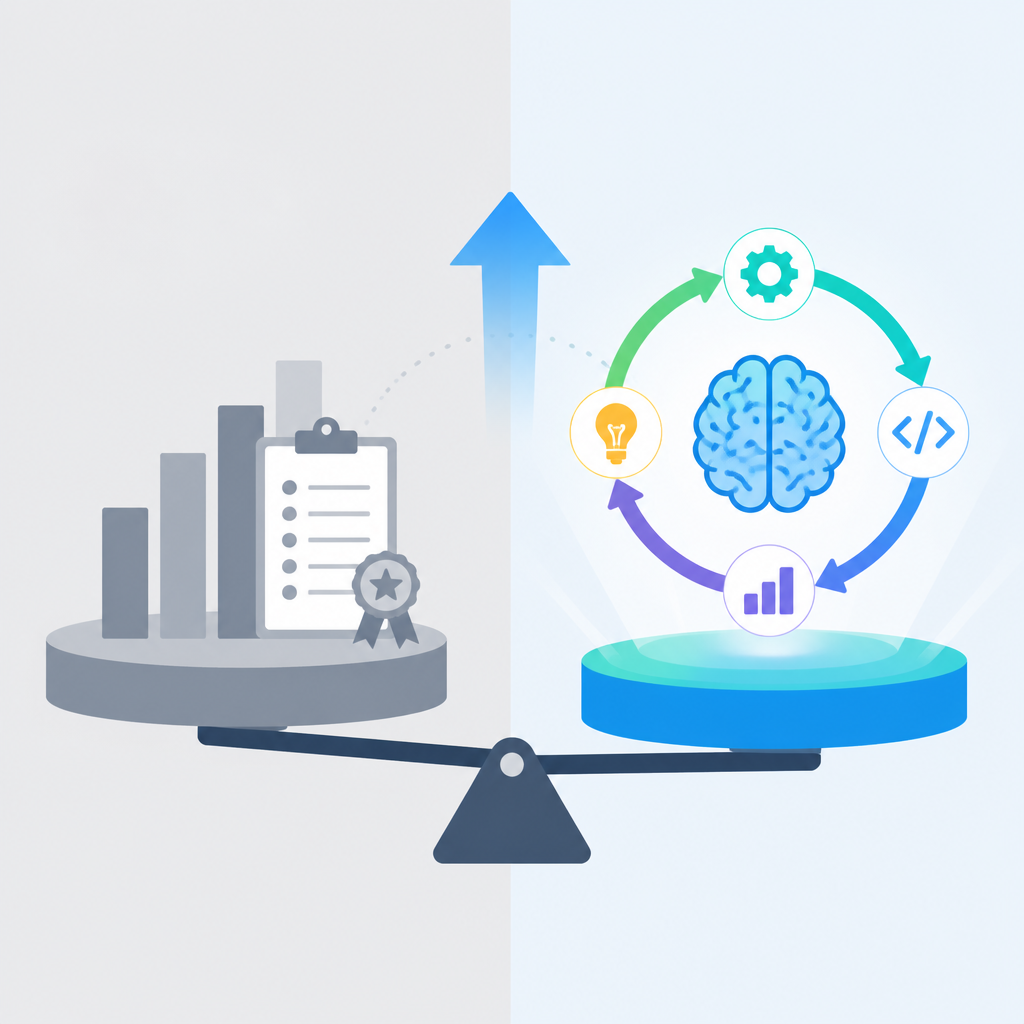
MiniMax M2.7 matters because it turns model improvement into an agentic workflow, not just a benchmark race.

MiniMax M2.7 matters because it turns model improvement into an agentic workflow, not just a benchmark race.
MiniMax is not just shipping another stronger model; it is arguing that the next leap in AI comes from models that help improve themselves. That is the real story behind M2.7. The company says the model now participates in its own evolution, builds complex agent harnesses, updates memory, and iterates on workflows that improve training and task delivery. It also claims strong results on software engineering, office work, and multi-agent collaboration, but the benchmark numbers are not the point. The point is that MiniMax is trying to make the model part of the development loop, and that changes what “better AI” means.
First, self-evolution is the right strategic target
Get the latest AI news in your inbox
Weekly picks of model releases, tools, and deep dives — no spam, unsubscribe anytime.
No spam. Unsubscribe at any time.
MiniMax’s most important claim is not that M2.7 is slightly better at code or documents. It is that the model can help build the system that improves the next model. The company describes an internal workflow where M2.7 updates memory, builds skills, and improves its own harness through repeated experiment cycles. In one example, it ran more than 100 autonomous rounds of analysis, scaffold changes, evaluation, and rollback decisions, producing a 30% gain on internal evaluation sets. That is a meaningful shift: model progress is moving from one-off training runs toward an iterative engineering loop.

This matters because AI progress has been bottlenecked by human coordination. Researchers, infra teams, eval teams, and product teams all touch the same system, and each handoff slows iteration. MiniMax says M2.7 can now handle 30% to 50% of that workflow in some internal research settings. If that claim holds, the advantage is not just speed. It is compounding. A model that can help design experiments, inspect failures, and propose fixes creates a tighter feedback cycle than a model that only answers prompts. That is the kind of leverage that changes company throughput, not just leaderboard placement.
Second, the software engineering results are the real proof point
The strongest evidence for M2.7 is its performance in software engineering, because that is where agentic systems either work or fail in practice. MiniMax says M2.7 scored 56.22% on SWE-Pro, reached 55.6% on VIBE-Pro, and hit 57.0% on Terminal Bench 2. Those are not toy tasks. They map to end-to-end delivery, repo-level reasoning, debugging, and system comprehension. MiniMax also claims it reduced live incident recovery time to under three minutes in some cases by using the model for observability analysis, database checks, and root-cause reasoning. That is the kind of result that matters to engineering teams because it shows the model can operate in a real production context, not just generate plausible code.
Just as important, MiniMax is framing M2.7 as a systems model rather than a code generator. The article emphasizes agent teams, role boundaries, adversarial reasoning, protocol adherence, and dynamic tool search. That is a smarter positioning than the usual “better coding model” pitch. Most coding benchmarks reward isolated correctness. Production work rewards coordination, recovery, and judgment under messy constraints. If M2.7 can actually debug, revise, test, and route work through a harness with minimal supervision, then its value is broader than code completion. It becomes an operating layer for engineering work.
The office-work angle is not fluff
MiniMax also makes a serious claim about office software tasks, and this should not be dismissed as marketing noise. The company says M2.7 achieved an ELO of 1495 on GDPval-AA, the highest among open-source models, and that it improved complex editing in Excel, PowerPoint, and Word. That matters because enterprise AI adoption is not won only by developers. It is won by models that can revise documents, preserve formatting, manage multi-round edits, and respect user intent across messy business workflows. In many organizations, document work is still where AI systems break down first.
The broader point is that “task delivery” is becoming as important as raw reasoning. MiniMax highlights a 97% skill adherence rate across more than 40 complex skills, each over 2,000 tokens. That suggests the company is focusing on stability, not just intelligence. For office use, that is exactly the right priority. A model that is brilliant once and inconsistent the next time is not useful in a real workflow. A model that can keep its role, follow instructions, and survive long context windows is the one that gets embedded into actual work processes.
The counter-argument
The skeptical view is straightforward: this is still a vendor-written announcement, and the claims are wide-ranging enough to invite caution. Self-evolution sounds impressive, but it is hard to verify. Benchmark scores can be tuned to specific task formats, internal gains can be selective, and autonomous loops can look better in a controlled demo than in a chaotic production environment. The article also leans heavily on comparisons with top proprietary models, which makes the story feel like a race for prestige as much as a technical milestone.
That skepticism is justified, but it does not erase the signal. The right question is not whether every claim is independently proven today. The right question is whether MiniMax is pointing at the correct direction of travel. On that count, the answer is yes. The industry is moving from chatbots to agents, and from static models to systems that can inspect, modify, evaluate, and improve workflows. Even if some of MiniMax’s numbers are best read as aspirational, the architecture of the argument is sound. The company is betting on agentic iteration as the next source of advantage, and that is where serious AI progress is headed.
What to do with this
If you are an engineer, do not judge M2.7 only by its raw benchmark scores. Test whether it can sit inside your workflow: triage incidents, draft fixes, run checks, preserve context, and hand off cleanly. If you are a PM or founder, focus on task completion and iteration speed, not demo polish. Build evaluations around real work: multi-step debugging, document revision, repo-level changes, and cross-tool coordination. The companies that win with models like M2.7 will be the ones that treat the model as part of the system of work, not as a nicer chatbot.
// Related Articles
- [MODEL]
GPT-5.6 turns OpenAI into a model menu
- [MODEL]
Seedream 5.0 Pro Is the Right Choice for Editable AI Images
- [MODEL]
Midjourney v8.2 release is close
- [MODEL]
Rust KRAID enters Mesa for Arm Mali GPUs
- [MODEL]
OpenAI Opens GPT-5.6 and Launches Live Voice AI
- [MODEL]
Mistral is right to push Leanstral into proof engineering